The genetic code at Higher Level: The same statement as SL. At HL the same features return in mutations, where degeneracy explains why some base changes are silent.
Practise this as you read
- Outline the characteristics of the genetic code.
- Describe the relationship between codons and polypeptide structure.
Free preview
This is the free notes preview
You're reading the free notes. Aimnova Pro unlocks the full study experience — and you can try it with your first topic free to keep:
- FlashcardsLock in vocabulary and key terms with spaced repetition.
- Practice questionsAnswer exam-style questions and get instant AI marking.
- Mock exams & past-paper vaultSit full mocks and see exactly how examiners award marks.
- Personalised study planA daily plan built around your exam date and weak areas.
The big idea: The ribosome reads mRNA three bases at a time. Each group of three bases is a codon, and each codon specifies one amino acid.
From mRNA to the genetic code
- After transcription, the cell has an mRNA molecule — a long sequence of the four bases A, U, G and C.
- To turn that sequence into a protein, the ribosome reads it three bases at a time.
- Each group of three bases is a codon; each codon specifies one amino acid.
- The full set of rules linking every codon to its amino acid is the genetic code.
- A codon table lists those rules.
The mRNA made by transcription is read at the ribosome in non-overlapping groups of three bases — each three-base codon specifies one amino acid in the growing polypeptide.
Interactive diagram
Explore the labelled diagram, charts and maps for this topic in full study mode.
- Codon
- A group of three consecutive bases on an mRNA molecule that codes for one amino acid (or for a start or stop signal).
- Genetic code
- The set of rules that links each mRNA codon to the amino acid it specifies. It is the same in nearly all living things.
- Codon table
- A lookup table that shows which amino acid each mRNA codon codes for.
- Triplet code
- The genetic code is a triplet code — the bases are read in non-overlapping groups of three.
- Start codon
- The codon AUG, which signals where to begin reading and also codes for the amino acid methionine.
- Stop codon
- A codon (such as UAA) that signals the end of the amino acid sequence; it codes for no amino acid.
Why three bases?: There are only four bases, but cells need to code for 20 different amino acids.
| Bases read at a time | Combinations | Enough for 20 amino acids? |
|---|---|---|
| one | 4 | No |
| two | 16 | No — still too few |
| three | 4 × 4 × 4 = 64 | Yes — more than enough for all 20 amino acids plus start and stop signals |
Practice with exam-style questions
Answer exam-style questions and get AI feedback that shows you exactly what examiners want to see in a full-marks response.
Two features of the genetic code come up again and again in exams, and they are easy to confuse.
Universal
- Nearly every organism uses the same codons for the same amino acids.
Degenerate (redundant)
- Most amino acids are coded by more than one codon.
Universal — the same code everywhere: The genetic code is almost exactly the same in all living things — bacteria, plants, fungi and animals all read the codon AUG as methionine, and so on.
Why universality matters
- Because the code is shared, a gene taken from one species can be read correctly by another.
- This is what makes genetic engineering possible — for example, putting a human gene into bacteria to make insulin.
- Universality is also strong evidence that all life evolved from a common ancestor.
Degenerate — more than one codon per amino acid: Degenerate (redundant) means a single amino acid can be specified by several different codons. Most amino acids have 2, 4 or even 6 codons.
Examples and the pattern
- UUU and UUC both code for phenylalanine.
- UCU and UCC both code for serine.
- Notice the pattern: codons for the same amino acid often differ only in their third base.
- So a base change in that third position frequently makes no difference to the amino acid.
A short codon table (mRNA codon → amino acid)
| mRNA codon | Amino acid |
|---|---|
| UUU | Phenylalanine (Phe) |
| UUC | Phenylalanine (Phe) |
| UCU | Serine (Ser) |
| UCC | Serine (Ser) |
| UAU | Tyrosine (Tyr) |
| CAU | Histidine (His) |
| AUG | Methionine (Met) — start |
| UAA | STOP (no amino acid) |
The consequence: silent mutations: Because the code is degenerate, a base substitution does not always change the protein.
How a silent mutation happens
Substitution
A base changes, but the new codon still codes for the same amino acid (for example UUU → UUC, still phenylalanine).
Same protein
The amino acid sequence is unchanged and the protein works normally.
Silent
A mutation with no effect on the protein is a silent (neutral) mutation — the degeneracy of the code is exactly why these are possible.
Universal
- The same codons mean the same amino acids in (almost) all organisms
- Compares the code between different species
- Lets a human gene be read correctly inside a bacterium
- Evidence that all life shares a common ancestor
Degenerate (redundant)
- Several different codons code for the same amino acid
- Compares codons within the one code
- Most amino acids have 2, 4 or even 6 codons
- Allows silent mutations — a base change that does not change the amino acid
Don't mix up the two words: Universal compares the code between species — the same codons mean the same amino acids everywhere.
Degenerate compares codons within the one code — several codons map to the same amino acid.
One is 'same code in everyone'; the other is 'many codons, one amino acid'.
The big idea: Four bases read in threes give 64 codons. That is more than the 20 amino acids need, so the code is degenerate, and the same code is used by nearly all life.
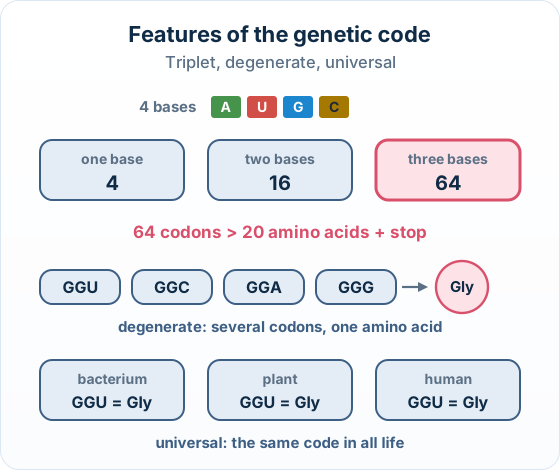
The points to remember
- Triplet: four bases in threes give 4 x 4 x 4 = 64 codons; pairs would give only 16.
- 64 codons cover 20 amino acids plus stop codons.
- Degenerate: most amino acids have more than one codon.
- Universal: the same codon means the same amino acid in nearly all organisms.
Remember it as: Three bases, 64 codons: spare codons make it degenerate, sharing makes it universal.
Real example: nearly universal. In the nucleus, UGA is a stop codon. In human mitochondria the same codon codes for the amino acid tryptophan, one of a few small exceptions to a universal code.
Feeling unprepared for exams?
Get a clear study plan, practice with real questions, and know exactly where you stand before exam day. No more guessing.
How this is tested: These questions are a Paper 1A speciality — they give you a codon table and ask you to use the data.
Common formats
- Given a short list of amino acids, select the mRNA sequence that codes for them — read the table codon by codon.
- Identify which set of codons shows degeneracy (two different codons for the same amino acid).
- Identify a consequence of degeneracy — the answer is usually that a substitution can be a silent mutation.
Exam-style question — read the codon table
Using the codon table above, deduce the order of amino acids coded by the mRNA sequence UCU–UAU–CAU. [3]
How to read it codon by codon
- Split into codons. The sequence is already grouped into threes: UCU, then UAU, then CAU. Read it 5′ to 3′, one codon at a time.
- Look up each codon. From the table: UCU → serine (Ser); UAU → tyrosine (Tyr); CAU → histidine (His).
- Write the amino acids in order. The polypeptide segment is Ser – Tyr – His.
Final answer
Serine – Tyrosine – Histidine (Ser–Tyr–His), read one codon at a time from the table in order.
Why this scores full marks: Each three-base codon is looked up separately and the amino acids are given in the right order.
The common slip is to read the bases overlapping or out of order — always take the codons in non-overlapping blocks of three, left to right.
| Property of the genetic code | What it means | Why it matters |
|---|---|---|
| Triplet (read in threes) | The mRNA is read in non-overlapping groups of THREE bases (codons), one codon per amino acid | Four bases in groups of three give 64 possible codons — more than enough for 20 amino acids plus start/stop |
| Universal | Almost every organism uses the SAME codons for the same amino acids | A gene from one species can be read correctly by another — the basis of genetic engineering |
| Degenerate (redundant) | Most amino acids are coded by MORE THAN ONE codon | A base change in the third position is often SILENT — it still codes the same amino acid |