Codon and anticodon at Higher Level: The same statement as SL. At HL the same pairing happens at the A site of the ribosome during elongation.
Practise this as you read
- Deduce an anticodon from a codon.
- Explain how codon-anticodon pairing sets the amino acid order.
Free preview
This is the free notes preview
You're reading the free notes. Aimnova Pro unlocks the full study experience — and you can try it with your first topic free to keep:
- FlashcardsLock in vocabulary and key terms with spaced repetition.
- Practice questionsAnswer exam-style questions and get instant AI marking.
- Mock exams & past-paper vaultSit full mocks and see exactly how examiners award marks.
- Personalised study planA daily plan built around your exam date and weak areas.
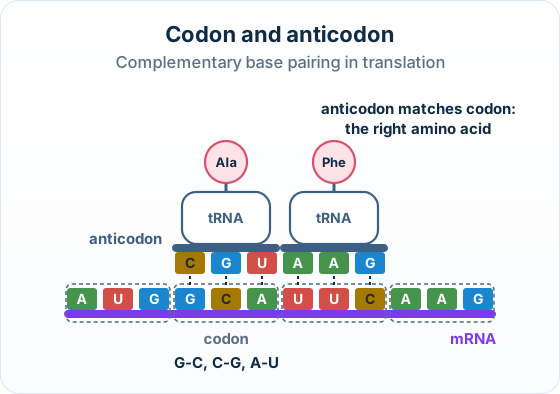
The big idea: A codon is three bases on mRNA. An anticodon is three bases on tRNA. They pair by complementary base pairing, so each tRNA lands on the right codon.
The points to remember
- A codon is a triplet of bases on mRNA.
- An anticodon is a triplet of bases on tRNA.
- They pair by complementary base pairing: A with U, G with C.
- The pairs are held by hydrogen bonds.
- Each tRNA carries the amino acid that matches its anticodon, so the codon order sets the amino acid order.
Remember it as: Codon on mRNA, anticodon on tRNA: pair them like a zip, A with U and G with C.
Real example: mitochondria. Human mitochondria have their own DNA, which codes for 13 proteins. It also codes for 22 kinds of tRNA, whose anticodons pair with the codons of those mitochondrial mRNAs.
Feeling unprepared for exams?
Get a clear study plan, practice with real questions, and know exactly where you stand before exam day. No more guessing.
Working out an anticodon: Pair each base of the codon in turn. Both are RNA, so the anticodon has U, never T.
| Base in the codon (mRNA) | Base in the anticodon (tRNA) |
|---|---|
| A | U |
| U | A |
| G | C |
| C | G |
Worked example. The codon G C A pairs with the anticodon C G U. That tRNA carries alanine.
Two traps: An anticodon is complementary to the codon, not the same as it. And it never contains T: tRNA is RNA.
How it is asked: Picking the anticodon that pairs with a codon from a short table, or explaining the pairing in two marks.
Explain how complementary base pairing between tRNA and mRNA makes sure that amino acids are joined in the correct order.
Model answer plan
See the answer broken into clear points, with guidance on how each point earns marks.