Roles in translation at Higher Level: The same statement as SL. At HL the same parts return in initiation and in the A, P and E sites of the large subunit.
Practise this as you read
- Explain the role of tRNA in translation.
- Outline the role of mRNA in translation.
Free preview
This is the free notes preview
You're reading the free notes. Aimnova Pro unlocks the full study experience — and you can try it with your first topic free to keep:
- FlashcardsLock in vocabulary and key terms with spaced repetition.
- Practice questionsAnswer exam-style questions and get instant AI marking.
- Mock exams & past-paper vaultSit full mocks and see exactly how examiners award marks.
- Personalised study planA daily plan built around your exam date and weak areas.
Start Studying Free Full access to Aimnova Pro · cancel anytime
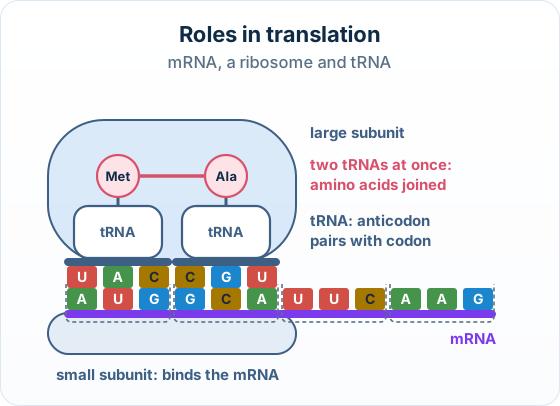
The big idea: Translation needs three things: mRNA carries the code, the ribosome reads it and joins the amino acids, and tRNA brings each amino acid.
The points to remember
- mRNA carries the code from the nucleus to the cytoplasm, as codons of three bases.
- A ribosome has two parts: a small subunit and a large subunit.
- The mRNA binds to the small subunit.
- Each tRNA carries one amino acid and has an anticodon that pairs with a codon.
- Two tRNAs can bind to the large subunit at the same time, so their amino acids can be joined.
Remember it as: mRNA brings the message, tRNA brings the amino acids, the ribosome does the joining.
Real example: erythromycin. The antibiotic erythromycin binds to the large subunit of bacterial ribosomes, in the tunnel the new polypeptide leaves by. The chain cannot grow, so the bacteria stop making proteins.
Study smarter, not longer
Most students waste 40% of study time on topics they already know. Our AI tracks your progress and optimizes every minute.
Try Smart Study FreeYour first topic is free to keep • No credit card required
Who does what: Learn one job for each molecule, and which ribosome subunit each one binds.
| Molecule | What it does | Where it binds |
|---|---|---|
| mRNA | Carries the code as codons; sets the order of amino acids | Small subunit of the ribosome |
| tRNA | Brings one specific amino acid; its anticodon pairs with a codon | Large subunit (two tRNAs at a time) |
| Ribosome | Holds mRNA and tRNA together and joins amino acids by peptide bonds | Made of a small and a large subunit |
Small or large?: The mRNA binds the small subunit. The tRNAs bind the large subunit, and there is room for two at once.
How it is asked: Naming the ribosome and mRNA on a diagram, a multiple-choice question on what binds where, or the role of mRNA or tRNA in a few marks.
IB-style questionExplain[2 marks]
Explain the role of tRNA in translation.
Model answer plan
See the answer broken into clear points, with guidance on how each point earns marks.