Base pairing at Higher Level: The same statement as SL. At HL the same pairing rule runs through the direction of transcription and the start at the promoter.
Practise this as you read
- Explain the role of hydrogen bonding in transcription.
- Deduce an mRNA sequence from a DNA template strand.
Free preview
This is the free notes preview
You're reading the free notes. Aimnova Pro unlocks the full study experience — and you can try it with your first topic free to keep:
- FlashcardsLock in vocabulary and key terms with spaced repetition.
- Practice questionsAnswer exam-style questions and get instant AI marking.
- Mock exams & past-paper vaultSit full mocks and see exactly how examiners award marks.
- Personalised study planA daily plan built around your exam date and weak areas.
Start Studying Free Full access to Aimnova Pro · cancel anytime
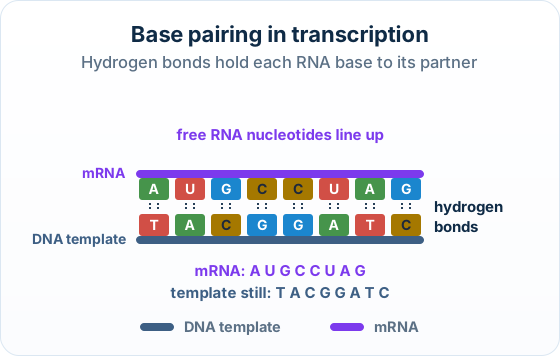
The big idea: In transcription each free RNA nucleotide is held to the template by hydrogen bonds, and only the complementary base fits.
The points to remember
- RNA polymerase exposes the bases of the template strand.
- A free RNA nucleotide forms hydrogen bonds with the template base it matches.
- A on the template pairs with U on the RNA; T with A; C with G; G with C.
- Because each base has only one partner, the mRNA sequence is set by the template.
- Hydrogen bonds are weak, so the mRNA can be released and the DNA closes again.
Remember it as: Template A calls for U; hydrogen bonds hold, then let go.
Real example: speed and accuracy. Human RNA polymerase adds about 20 to 50 nucleotides a second, yet nearly every base it adds is correct, because each template base can hydrogen bond properly with only one RNA base.
Stop wasting time on topics you know
Our AI identifies your weak areas and focuses your study time where it matters. No more overstudying easy topics.
Try Smart Study FreeYour first topic is free to keep • No credit card required
From template to mRNA: Write the mRNA one base at a time from the template strand, using the pairing rule.
| Base on the DNA template | Base added to mRNA |
|---|---|
| A (adenine) | U (uracil) |
| T (thymine) | A (adenine) |
| C (cytosine) | G (guanine) |
| G (guanine) | C (cytosine) |
Worked example. Template T A C G G A T C gives mRNA A U G C C U A G.
Template or coding strand?: The mRNA is complementary to the template strand. It has the same sequence as the other (coding) strand, but with U in place of T.
How it is asked: Writing the mRNA from a template strand, or the role of base pairing inside a transcription answer.
IB-style questionExplain[2 marks]
Explain the role of hydrogen bonding in transcription.
Model answer plan
See the answer broken into clear points, with guidance on how each point earns marks.