Transcription at Higher Level: The same statement as SL. HL questions add where transcription starts (the promoter) and its direction (5' to 3'), taught on their own pages.
Practise this as you read
- Outline the production of mRNA by transcription.
- Determine whether a diagram shows transcription or replication.
Free preview
This is the free notes preview
You're reading the free notes. Aimnova Pro unlocks the full study experience — and you can try it with your first topic free to keep:
- FlashcardsLock in vocabulary and key terms with spaced repetition.
- Practice questionsAnswer exam-style questions and get instant AI marking.
- Mock exams & past-paper vaultSit full mocks and see exactly how examiners award marks.
- Personalised study planA daily plan built around your exam date and weak areas.
The big idea: A gene is a stretch of DNA that holds the instructions for building a protein.
Why the cell makes a copy
The problem
DNA stays locked inside the nucleus, while proteins are built outside it, at a ribosome.
The working copy
So the cell first makes a working copy of the gene that can leave the nucleus. That copy is a molecule of messenger RNA (mRNA), and making it is called transcription.
Who does it
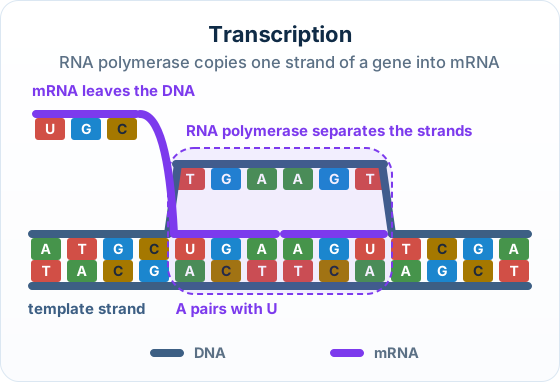
In transcription, the enzyme RNA polymerase copies one strand of the DNA gene into a complementary strand of mRNA.
Transcription (in the nucleus): RNA polymerase copies one DNA strand into a complementary mRNA molecule, which then leaves the nucleus to be translated into a polypeptide.
Interactive diagram
Explore the labelled diagram, charts and maps for this topic in full study mode.
- Transcription
- The process in which the base sequence of a gene (DNA) is copied to make a complementary molecule of messenger RNA (mRNA). It happens in the nucleus.
- Messenger RNA (mRNA)
- A single-stranded copy of a gene that carries its base sequence out of the nucleus to a ribosome, where it is read to build a protein.
- RNA polymerase
- The enzyme that carries out transcription: it separates the DNA strands and joins free RNA nucleotides into an mRNA molecule.
- Template strand
- The one strand of the DNA gene that RNA polymerase reads and copies; the order of its bases decides the order of bases in the mRNA.
- Complementary base pairing
- The rule that decides which base pairs with which: A pairs with U (in RNA), T pairs with A, and C pairs with G.
One key difference from DNA: RNA uses the base uracil (U) wherever DNA would use thymine (T).
So when RNA polymerase copies an A on the DNA template, it adds a U to the mRNA — never a T. This is the single most-tested detail about transcription.
Memorize terms 3x faster
Smart flashcards show you cards right before you forget them. Perfect for definitions and key concepts.
Transcription is a step-by-step process. Know the steps in order: a Paper 2 'Describe how mRNA is produced' question wants each separate stage as a scoring point.
Follow the chain: Follow the cause-and-effect chain: unwind the DNA, read one strand, pair up matching RNA bases, join them into mRNA, then release the copy.
The steps of transcription, in order
- Step 1 — Bind. RNA polymerase binds to the start of the gene on the DNA.
- Step 2 — Unwind. It unwinds and separates the two DNA strands, breaking the hydrogen bonds between the bases.
- Step 3 — Read the template. One strand acts as the template, and RNA polymerase reads its base sequence.
- Step 4 — Pair the bases. Free RNA nucleotides pair with the template bases by complementary base pairing (A→U, T→A, C→G, G→C).
- Step 5 — Join. RNA polymerase joins the RNA nucleotides together into a single strand of mRNA.
- Step 6 — Release. The finished mRNA leaves the nucleus (through a nuclear pore) and travels to a ribosome; the DNA zips back up.
Why it is a complementary 'copy': RNA polymerase does not invent the mRNA sequence — it is dictated by the DNA template.
Each template base can only pair with one RNA base, so the order of bases in the gene fixes the order of bases in the mRNA.
Example: A template reading T–A–C–G is copied into mRNA as A–U–G–C (A pairs with T, U pairs with A, G pairs with C, C pairs with G).
A→U, never A→T in mRNA: The most common transcription error is writing T in the mRNA.
RNA has no thymine. Wherever the template strand has an A, the mRNA gets a U (uracil). Check every base you copy.
| Base on the DNA template strand | Complementary RNA base added to mRNA |
|---|---|
| A (adenine) | U (uracil) — NOT thymine |
| T (thymine) | A (adenine) |
| C (cytosine) | G (guanine) |
| G (guanine) | C (cytosine) |
Why mRNA matters at all: The whole point of transcription is to make a portable copy of the gene. DNA is too large and too precious to leave the nucleus, so the cell sends out mRNA instead.
Where the mRNA goes: The mRNA carries the gene's base sequence to a ribosome, where that sequence is read to build a polypeptide.
Without mRNA, the instructions in DNA could never reach the protein-building machinery.
RNA polymerase
- Carries out transcription
- Makes a single strand of mRNA
- Pairs A with U (uses uracil)
- Acts when a gene is expressed
DNA polymerase
- Carries out DNA replication
- Makes two new DNA molecules
- Pairs A with T (uses thymine)
- Acts before a cell divides
An easy way to remember: Transc-RIP-tion is RNA polymerase making RNA. Same first letter, easy to pair.
And Uracil belongs to U's only-in-RNA team — DNA keeps its thymine.
The big idea: RNA polymerase opens the DNA, reads one strand (the template) and builds a matching strand of mRNA.
The points to remember
- RNA polymerase binds to the gene and separates the two DNA strands.
- Only one strand, the template, is copied.
- Free RNA nucleotides pair with the template by complementary base pairing: A with U.
- RNA polymerase joins them into a single strand of mRNA, which then leaves the DNA.
Remember it as: Unzip, pair, join, release.
Real example: the death cap. The death cap mushroom contains alpha-amanitin, which stops the RNA polymerase that makes mRNA in human cells. Liver cells stop making proteins, which is why the poisoning is so dangerous.
Check for T: If your mRNA has a T in it, it is wrong: RNA has uracil (U) instead of thymine.
Know your predicted grade
Take timed mock exams and get detailed feedback on every answer. See exactly where you're losing marks.
How this is tested: The headline question is a Paper 2 4-mark Describe: describe how mRNA is produced in the nucleus (transcription).
Where the 4 marks come from
- Naming RNA polymerase
- The DNA unwinds/separates
- One strand is the template
- Free RNA nucleotides join by complementary base pairing (A→U)
| Other questions | What to give |
|---|---|
| 3-mark Describe: the importance of mRNA | It carries the gene's code out of the nucleus to the ribosome to be translated |
| Paper 1 | Match RNA polymerase to transcription (and DNA polymerase to replication), or determine which step a drug blocks if it stops RNA polymerase |
Exam-style question — describe how mRNA is produced
Describe how a molecule of mRNA is produced from a gene in the nucleus. [4]
How to score all four marks
- Name the enzyme and the unwinding. RNA polymerase binds to the gene and unwinds/separates the two DNA strands, breaking the hydrogen bonds between them.
- Identify the template. One of the two DNA strands acts as the template that is read and copied.
- Describe the base pairing. Free RNA nucleotides pair with the template bases by complementary base pairing — adenine pairs with uracil (not thymine), and cytosine with guanine.
- Join and release. RNA polymerase joins the RNA nucleotides into a single strand of mRNA, which then leaves the nucleus.
Final answer
RNA polymerase unwinds and separates the DNA strands; one strand acts as a template; free RNA nucleotides pair with it by complementary base pairing (A→U); they are joined into a single mRNA strand, which leaves the nucleus.
Focus on the top arrow — transcription. RNA polymerase reads the DNA template strand and builds a complementary mRNA copy; this is the only step that happens in 4.2.1.
Interactive diagram
Explore the labelled diagram, charts and maps for this topic in full study mode.
Why this scores full marks: Each step is a separate, distinct point — enzyme + unwinding, template strand, complementary base pairing, joining into mRNA.
A 4-mark 'Describe' needs four scoring ideas, and naming A→U (uracil) is the detail that separates a top answer from a vague one.
| Feature | RNA polymerase | DNA polymerase |
|---|---|---|
| Process it carries out | Transcription (makes mRNA) | DNA replication (copies DNA) |
| Product made | A single mRNA molecule | Two new DNA molecules |
| Base used opposite A | Uracil (U) | Thymine (T) |
| When it acts | When a gene is expressed | Before a cell divides |