Stable templates at Higher Level: The same statement as SL. At HL it links to how cells keep DNA intact for decades, with examples from the brain.
Practise this as you read
- Explain why DNA templates in non-dividing cells must be conserved.
- Outline why transcription does not change the template.
Free preview
This is the free notes preview
You're reading the free notes. Aimnova Pro unlocks the full study experience — and you can try it with your first topic free to keep:
- FlashcardsLock in vocabulary and key terms with spaced repetition.
- Practice questionsAnswer exam-style questions and get instant AI marking.
- Mock exams & past-paper vaultSit full mocks and see exactly how examiners award marks.
- Personalised study planA daily plan built around your exam date and weak areas.
Start Studying Free Full access to Aimnova Pro · cancel anytime
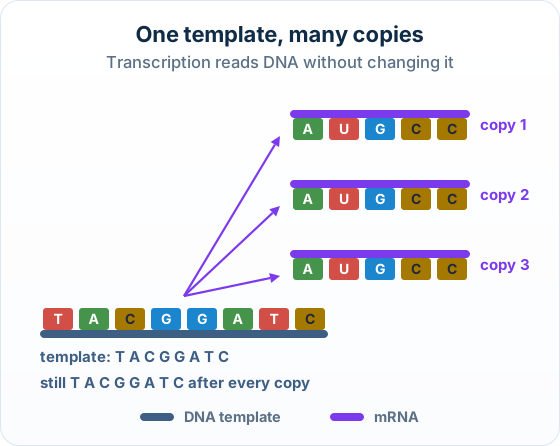
The big idea: Transcription reads a DNA strand but does not change it. The same template can be copied into mRNA again and again.
The points to remember
- Only one strand of a gene is used as the template.
- RNA nucleotides pair with it by hydrogen bonds; no DNA bases are added or removed.
- After transcription the mRNA leaves and the DNA strands pair up again.
- So the template's base sequence is unchanged, ready to be transcribed again.
Not the same as replication: Transcription makes RNA and leaves the DNA as it was. It is not a way of copying DNA.
Know your predicted grade
Take timed mock exams and get detailed feedback on every answer. See exactly where you're losing marks.
Try Mock Exams FreeYour first topic is free to keep • No credit card required
Templates that must last a lifetime: In body cells that never divide, the same DNA must keep working for the whole life of the cell.
Why it matters
- A cell that does not divide cannot replace its DNA with a new copy.
- Every protein it makes comes from transcribing the same genes.
- So these DNA sequences must be conserved (kept unchanged) throughout the cell's life.
- A change to a template would appear in every mRNA and protein made from it.
Remember it as: Read it, don't rewrite it.
Real example: neurons. Most neurons in the human brain never divide after birth, so a neuron may use the same DNA templates for eighty years or more.
How it is asked: An Explain on why DNA must stay unchanged in cells that do not divide, or a 1A item on what transcription does to the template.
IB-style questionExplain[2 marks]
Explain why the DNA templates in a non-dividing cell must be conserved throughout the life of the cell.
Model answer plan
See the answer broken into clear points, with guidance on how each point earns marks.