aımnova
DashboardMy LearningCrash CoursesStudy Plan

Aimnova site navigation

Stay in the loop

Get the latest study resources and updates

New features, study tips and exam insights — straight to your inbox.

IB Diploma

  • IB Past Papers
  • IB Study Notes
  • IB Question Bank
  • IB Mock Exams
  • IB Revision

IB Subjects

  • IB Math AA
  • IB Math AI
  • IB Economics
  • IB Business Management
  • IB Physics
  • IB Biology
  • View all IB subjects→

IB Past Papers

  • IB Math AA HL Past Papers
  • IB Math AA SL Past Papers
  • IB Math AI HL Past Papers
  • IB Math AI SL Past Papers
  • IB Economics HL Past Papers
  • IB Economics SL Past Papers
  • IB ESS Past Papers
  • View all past papers→

Study Resources

  • Study Notes
  • Question Bank
  • Mock Exams
  • Crash Courses
  • Flashcards
  • Revision Guide
  • Exam Skills
  • Command Terms
  • Grade Calculator
  • Exam Timetable 2027

Aimnova

  • Features
  • Pricing
  • For Teachers
  • For Schools
  • For Parents
  • About Us
  • Blog
  • Contact
aımnova

IB study, practice and feedback built around the real exam.

TermsPrivacyCookies·© 2026 Aimnova. All rights reserved.d9e1c61

Aimnova is not affiliated with or endorsed by the International Baccalaureate Organization (IB).

NotesBiology HLTopic 4.12Increases to the number of insect life cycles within a year due to climate change
Back to Biology HL Topics
4.12.113 min read

Increases to the number of insect life cycles within a year due to climate change (Biology HL)

IB Biology · Unit 4

AI-powered feedback

Stop guessing — know where you lost marks

Get instant, examiner-style feedback on every answer. See exactly how to improve and what the markscheme expects.

Try It Free

Contents

  1. 1Insect life cycles
  2. 2Spruce bark beetle
  3. 3Why warmth adds generations
  4. 4Exam-style question (step by step)
Insect life cycles: An AHL statement. Link it to phenology and to forest tipping points.

Practise this as you read

  • Explain why bark beetles have more generations in warm years.
  • Deduce a trend from data on generations.

Free preview

This is the free notes preview

You're reading the free notes. Aimnova Pro unlocks the full study experience — and you can try it with your first topic free to keep:

  • FlashcardsLock in vocabulary and key terms with spaced repetition.
  • Practice questionsAnswer exam-style questions and get instant AI marking.
  • Mock exams & past-paper vaultSit full mocks and see exactly how examiners award marks.
  • Personalised study planA daily plan built around your exam date and weak areas.
Start Studying Free Full access to Aimnova Pro · cancel anytime
The big idea: Insects develop faster when it is warm. With climate change, summers are warmer and longer, so insects such as the spruce bark beetle complete more life cycles within a year, and their populations grow faster.

See it drawn, step by step

In My Learning, handwritten diagrams build one step at a time. Play, pause and replay each explanation until it clicks. Create your free account to try it.

Claim your free topic
Life cycle (generation)
The stages from egg, through larva and pupa, to an adult that reproduces.
Spruce bark beetle
A beetle (Ips typographus) whose larvae feed under the bark of spruce trees and can kill them.

The points to remember

  • Insects cannot keep their bodies warm, so temperature sets their rate of development.
  • More generations a year means many more beetles by the end of the summer.
Remember it as: Warmer year, more generations.

Get feedback like a real examiner

Submit your answers and get instant feedback — what you did well, what's missing, and exactly what to write to score full marks.

Try AI Tutor FreeYour first topic is free to keep • No credit card required
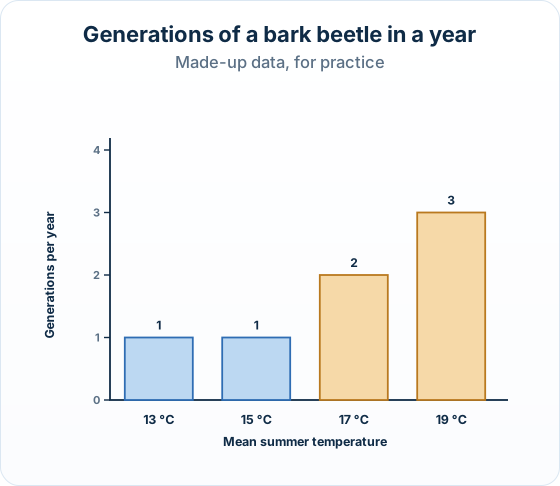
Bar chart of generations per year: 1 at 13 and 15 degrees, 2 at 17 degrees, 3 at 19 degreesBar chart of generations per year: 1 at 13 and 15 degrees, 2 at 17 degrees, 3 at 19 degrees
Generations of a bark beetle in a year at four mean summer temperatures (made-up data).
Real data: In lowland continental Europe and southern Scandinavia, warm years now allow two or three generations of the spruce bark beetle a year, while one is still normal in most of Scandinavia (Lindman and others, 2023).

The points to remember

  • Trees weakened by drought defend themselves poorly, so outbreaks are larger in hot dry years.
  • Dead spruce forest stores less carbon: a link to the boreal forest tipping point (4.12.3).
Remember it as: Warmth speeds the insect clock.
How it is asked: Paper 2 may ask you to explain how climate change increases insect populations, with the bark beetle, or to read data on generations and temperature.
IB-style questionExplain[3 marks]

Explain why outbreaks of the spruce bark beetle have become more common in a warming climate.

Model answer plan

See the answer broken into clear points, with guidance on how each point earns marks.

Claim your free topic

Try an IB Exam Question — Free AI Feedback

Test yourself on Increases to the number of insect life cycles within a year due to climate change. Write your answer and get instant AI feedback — just like a real IB examiner.

why insects complete more life cycles within a year as the climate warms. [2 marks]

Related Biology HL Topics

Continue learning with these related topics from the same unit:

4.1.1DNA replication as production of exact copies of DNA with identical base sequences4.1.2Semi-conservative nature of DNA replication and role of complementary base pairing4.1.3Role of helicase and DNA polymerase in DNA replication4.1.4Polymerase chain reaction and gel electrophoresis as tools for amplifying and separating DNA
View all Biology HL topics
Improve your exam techniqueCommand terms, paper structure, and mark-scheme tips for Biology HL
Previous4.12.10Disruption to the synchrony of phenological events by climate changeNextEvolution as a consequence of climate change4.12.12

5 exam-style questions ready for you

Students who practice on Aimnova improve their scores by 15% on average. Get instant feedback that shows exactly how to improve your answers.

Practice Now — FreeView All Biology HL Topics