Loss of synchrony: An AHL statement that builds on phenology (4.12.9).
Practise this as you read
- Explain the mismatch between great tits and caterpillars.
- Explain the mismatch between reindeer and chickweed.
Free preview
This is the free notes preview
You're reading the free notes. Aimnova Pro unlocks the full study experience — and you can try it with your first topic free to keep:
- FlashcardsLock in vocabulary and key terms with spaced repetition.
- Practice questionsAnswer exam-style questions and get instant AI marking.
- Mock exams & past-paper vaultSit full mocks and see exactly how examiners award marks.
- Personalised study planA daily plan built around your exam date and weak areas.
Start Studying Free Full access to Aimnova Pro · cancel anytime
The big idea: In an ecosystem, temperature may be the cue for one population and photoperiod for another. Warming moves the temperature-cued event earlier but not the other one, so events that used to happen together are no longer in synchrony.
See it drawn, step by step
In My Learning, handwritten diagrams build one step at a time. Play, pause and replay each explanation until it clicks. Create your free account to try it.
- Synchrony
- Two events happening at the same time, such as the peak of food and the need for food.
- Mismatch
- Loss of synchrony: the consumer's need for food no longer matches the peak of its food.
| Example | Cued by temperature | Cued by photoperiod |
|---|---|---|
| Greenland | Spring growth of Arctic mouse-ear chickweed | Arrival of migrating reindeer |
| North European forest | Peak biomass of caterpillars | Breeding of the great tit |
The points to remember
- The species do not change; their cues respond differently to warming.
- In an exam you may give the common or the scientific name.
Remember it as: Different cues, different dates.
Feeling unprepared for exams?
Get a clear study plan, practice with real questions, and know exactly where you stand before exam day. No more guessing.
Get Exam Ready FreeYour first topic is free to keep • No credit card required
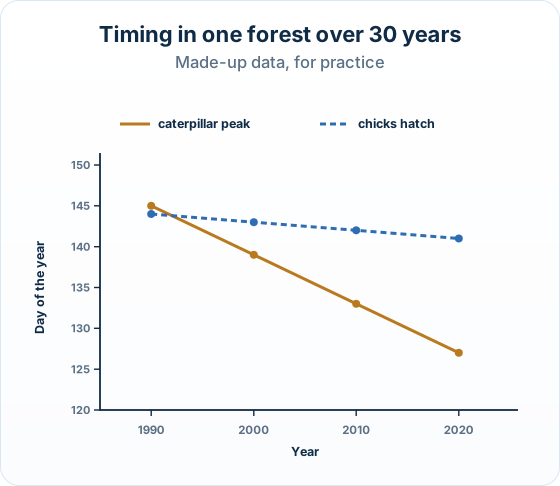
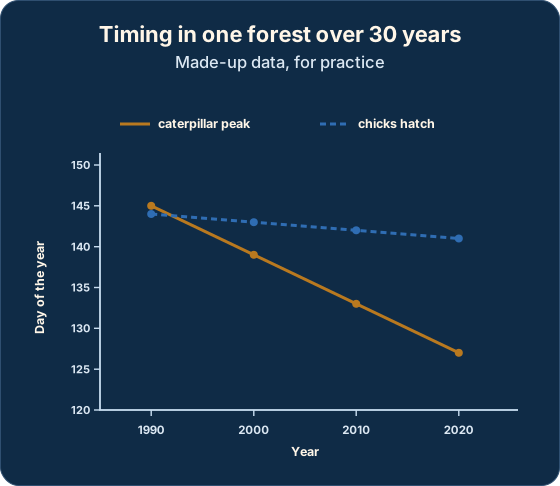
Real cases: Great tits: at Hoge Veluwe in the Netherlands, the caterpillar peak moved earlier but the birds did not lay earlier (Visser and others, 1998).
Reindeer: in West Greenland, plant growth started earlier as it warmed, calving did not keep pace and fewer calves were produced (Post and Forchhammer, 2008).
The points to remember
- Reindeer arrive by day length, but the chickweed now grows earlier: the best food is past.
- Great tit chicks hatch after the caterpillar peak, so they are poorly fed.
Remember it as: Food early, young late.
How it is asked: Paper 2 asks you to explain a loss of synchrony with one of the two guide examples, or to read a graph of dates.
IB-style questionExplain[3 marks]
Explain how climate change can disrupt the synchrony between great tits and the caterpillars that they feed to their young.
Model answer plan
See the answer broken into clear points, with guidance on how each point earns marks.