Evolution as a consequence of climate change: An AHL statement. It uses the natural selection of topic 4.10.
Practise this as you read
- Explain the change in tawny owl colour forms.
- Describe a trend in the frequency of a variant.
Free preview
This is the free notes preview
You're reading the free notes. Aimnova Pro unlocks the full study experience — and you can try it with your first topic free to keep:
- FlashcardsLock in vocabulary and key terms with spaced repetition.
- Practice questionsAnswer exam-style questions and get instant AI marking.
- Mock exams & past-paper vaultSit full mocks and see exactly how examiners award marks.
- Personalised study planA daily plan built around your exam date and weak areas.
Start Studying Free Full access to Aimnova Pro · cancel anytime
The big idea: Climate change can change which variants have the highest fitness, so populations evolve. In the tawny owl, brown birds survived less well than grey birds in snowy winters. With less snow cover, brown owls survive better and the brown form has become more common.
See it drawn, step by step
In My Learning, handwritten diagrams build one step at a time. Play, pause and replay each explanation until it clicks. Create your free account to try it.
- Fitness
- The ability of an individual to survive and reproduce in its environment.
- Colour variant (morph)
- One of two or more inherited forms of a species, here grey or brown plumage.
- Selection pressure
- A factor in the environment, such as snow cover, that makes some variants survive better than others.
The points to remember
- Colour is inherited, so a change in survival changes allele frequencies: that is evolution.
- The owls did not choose to change colour; the brown ones simply survived and bred more often.
Remember it as: Less snow, more brown owls.
Get feedback like a real examiner
Submit your answers and get instant feedback — what you did well, what's missing, and exactly what to write to score full marks.
Try AI Tutor FreeYour first topic is free to keep • No credit card required
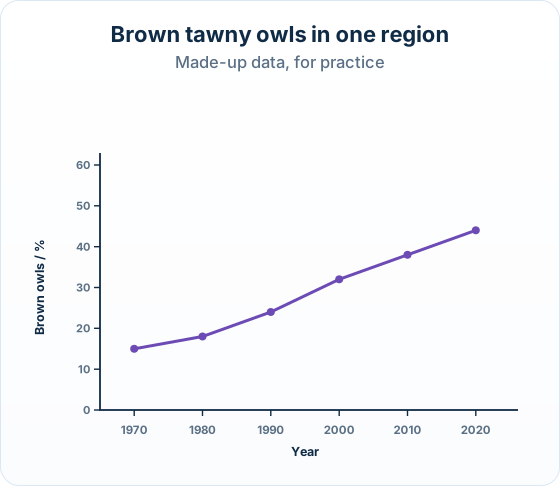
The real study: In Finland, records over several decades showed strong selection against brown owls in snowy winters. As winters became milder, this selection weakened and brown owls became more common (Karell and others, 2011).
The points to remember
- Climate change acts as a selection pressure, like any other change in the environment.
- Evolution here is a change in the frequency of a heritable variant, not a new species.
Remember it as: Climate selects, the population evolves.
How it is asked: Paper 2 may ask you to explain evolution caused by climate change, using the tawny owl, or to read data on the frequency of a variant.
IB-style questionExplain[3 marks]
Explain how a decrease in snow cover has led to evolution in the tawny owl.
Model answer plan
See the answer broken into clear points, with guidance on how each point earns marks.