Starting a pathway at Higher Level: An AHL statement: how binding at a receptor starts the chain of events inside the cell.
Practise this as you read
- Explain how binding starts a signal transduction pathway.
- Outline amplification by a cascade.
Free preview
This is the free notes preview
You're reading the free notes. Aimnova Pro unlocks the full study experience — and you can try it with your first topic free to keep:
- FlashcardsLock in vocabulary and key terms with spaced repetition.
- Practice questionsAnswer exam-style questions and get instant AI marking.
- Mock exams & past-paper vaultSit full mocks and see exactly how examiners award marks.
- Personalised study planA daily plan built around your exam date and weak areas.
The big idea: Many chemical signals — peptide hormones, adrenaline — are hydrophilic (water-loving). They cannot cross the cell membrane, so the message must be relayed in.
How the message gets inside
Blocked
The middle of the phospholipid bilayer is hydrophobic and repels the signal.
A transmembrane receptor
The cell uses a protein that spans the membrane, with a binding site outside and an end inside.
Bind outside
The ligand binds the outside of the receptor.
Relay inside
The receptor relays the signal across the membrane and makes a second messenger inside.
The message gets in without the ligand ever entering the cell. This relaying of a signal across the membrane is called signal transduction.
A hydrophilic ligand binds a transmembrane receptor on the cell surface; the activated receptor makes a second messenger (cyclic AMP), which sets off a cascade and a cellular response — the ligand itself never enters the cell.
Interactive diagram
Explore the labelled diagram, charts and maps for this topic in full study mode.
- Ligand
- The signalling molecule (e.g. a hormone) that binds to a receptor and carries the message.
- Hydrophilic ligand
- A water-loving signal that cannot cross the hydrophobic membrane, so it must bind a receptor on the cell surface.
- Transmembrane receptor
- A protein that spans the membrane, with a binding site outside the cell and an end inside; it relays the signal across the membrane.
- Signal transduction
- Converting (relaying) a signal received at the cell surface into a response inside the cell.
- Second messenger
- A small molecule made inside the cell (e.g. cyclic AMP / cAMP) that carries the signal onward and amplifies it.
Why the receptor must be on the OUTSIDE: A hydrophilic ligand is repelled by the hydrophobic core of the bilayer, so it physically cannot pass through. Its receptor therefore has to sit on the cell surface with a binding site facing outwards.
Compare a lipophilic signal: A lipophilic (fat-soluble) signal such as a steroid can dissolve straight through the membrane and meet a receptor inside — so it needs no transduction. The two routes differ because of where the receptor must sit.
Feeling unprepared for exams?
Get a clear study plan, practice with real questions, and know exactly where you stand before exam day. No more guessing.
Read the pathway as a chain of cause and effect. A common version uses a G-protein-coupled receptor (GPCR), but the shape is the same for many signals: bind → relay → make a second messenger → cascade → response.
The signal-transduction pathway, step by step
- Reception. The hydrophilic ligand binds the outside site of the transmembrane receptor (e.g. a GPCR).
- Activation. Binding makes the receptor change shape, activating an intracellular relay protein on its inside end.
- Second messenger. The relay switches on an enzyme that makes lots of cyclic AMP (cAMP) — the second messenger — inside the cell.
- Cascade. cAMP activates enzymes, and each activated enzyme activates many of the next — a cascade that amplifies the signal.
- Response. The cascade switches an enzyme on (or switches a gene on), producing the cell's response.
A hydrophilic ligand binds a transmembrane receptor on the cell surface; the activated receptor makes a second messenger (cyclic AMP), which sets off a cascade and a cellular response — the ligand itself never enters the cell.
Interactive diagram
Explore the labelled diagram, charts and maps for this topic in full study mode.
Why this AMPLIFIES the signal: The pathway is not one-to-one — it multiplies at every step.
How the numbers grow
- One bound ligand activates a receptor that makes many cAMP molecules.
- Each cAMP switches on enzymes, and each enzyme activates many of the next.
- So a tiny outside signal — a handful of hormone molecules — becomes a huge inside response: millions of product molecules.
- That multiplication is what lets a low concentration of hormone produce a strong, fast effect.
Amplification: ONE bound ligand makes MANY second-messenger molecules, and each step of the cascade activates many of the next — so a tiny outside signal produces a large inside response.
Interactive diagram
Explore the labelled diagram, charts and maps for this topic in full study mode.
A worked example: adrenaline
Fright
When you get a fright, adrenaline (a hydrophilic signal) reaches a liver cell.
Bind
It binds a transmembrane receptor on the surface.
Second messenger
The receptor makes cAMP inside.
Cascade
A cascade of enzymes is switched on.
Response
The final enzyme breaks glycogen down into glucose, which is released into the blood for energy.
Notice: Adrenaline never enters the cell. The message is carried in by cAMP, and amplified, so even a small amount of adrenaline mobilises a lot of glucose.
Worked example — adrenaline: adrenaline binds a transmembrane receptor on a liver cell → the receptor makes cyclic AMP (cAMP) inside → a cascade activates the enzyme that breaks glycogen down to glucose. Adrenaline stays outside; the message is carried in by cAMP.
Interactive diagram
Explore the labelled diagram, charts and maps for this topic in full study mode.
| Stage | What happens | Where |
|---|---|---|
| 1. Reception | The ligand binds the transmembrane receptor's outer site | Cell surface (outside) |
| 2. Activation | The receptor changes shape and activates an intracellular relay | Across the membrane |
| 3. Second messenger | The relay makes many molecules of cyclic AMP (cAMP) | Inside the cell |
| 4. Cascade | cAMP activates enzymes, each activating many more (amplification) | Inside the cell |
| 5. Response | An enzyme is switched on, or a gene is switched on | Inside the cell |
Don't confuse 'second messenger' with the ligand: The ligand (first messenger) is the outside signal — it stays outside and only binds the receptor.
The second messenger (e.g. cAMP) is made inside the cell and carries the signal onward.
Remember it as: the ligand knocks on the door; cAMP is the messenger that runs inside.
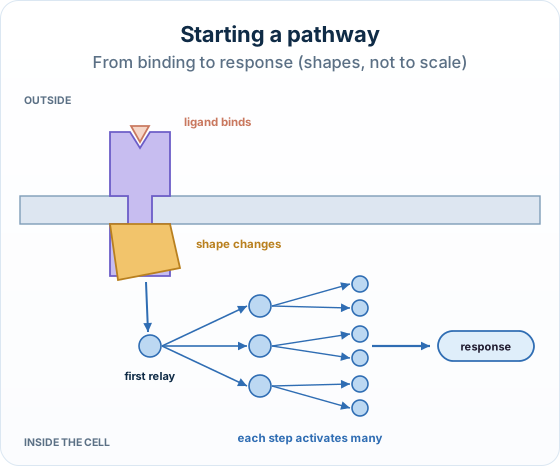
The big idea: When a ligand binds, the receptor changes shape (a conformational change). The changed receptor activates the first relay molecule inside the cell, which starts a signal transduction pathway: a chain of steps that ends in a response.
The points to remember
- The ligand binds the receptor's binding site.
- Binding causes a conformational change in the receptor.
- The change reaches the part inside the cell and activates a relay molecule.
- Each step activates the next, often many of the next: amplification.
- The end of the pathway is the response (an enzyme or a gene switched on).
Remember it as: Bind, change shape, pass it on.
Real example: adrenaline in the liver. Adrenaline binding its receptor changes the receptor's shape; the pathway it starts ends with enzymes breaking glycogen down to glucose.
Trap: The ligand does not carry the signal inside: the shape change of the receptor starts the pathway.
Memorize terms 3x faster
Smart flashcards show you cards right before you forget them. Perfect for definitions and key concepts.
How this is tested: A typical HL item is an Explain / Outline asking how a hydrophilic signal that cannot cross the membrane still produces a response inside the cell.
What to include
Bind
Ligand binds a transmembrane receptor on the surface.
Second messenger
The receptor makes a second messenger (cAMP) inside.
Cascade
A cascade of enzyme activations.
Response
A response (enzyme/gene switched on).
Relay
The signal is relayed and amplified without the ligand entering the cell.
Short items: You may be asked why the receptor is on the cell surface (the hydrophilic ligand can't cross the hydrophobic membrane), or to name a second messenger (cyclic AMP).
Exam-style question — how a hydrophilic hormone triggers a response without entering the cell
A hydrophilic hormone binds to the outside of a target cell but never enters it, yet it switches on an enzyme inside the cell. Explain how the signal is transmitted across the membrane and amplified. [6]
Step by step
- Why it binds outside. The hormone is hydrophilic, so it cannot cross the hydrophobic membrane; it binds a transmembrane receptor on the cell surface.
- Receptor activated. Binding makes the receptor change shape and activate an intracellular relay (e.g. a G protein).
- Second messenger. The relay causes a second messenger — cyclic AMP (cAMP) — to be made inside the cell.
- Cascade. cAMP sets off a cascade: it activates enzymes, each of which activates many of the next.
- Response. The cascade switches on the target enzyme (or switches on a gene) — the cell's response.
- Relay + amplification. The signal is relayed across the membrane without the ligand entering, and amplified — one ligand → many cAMP → a large response.
Final answer
The hormone is hydrophilic so it cannot cross the membrane; it binds a transmembrane receptor on the surface. The receptor changes shape and activates a relay that makes the second messenger cyclic AMP (cAMP) inside the cell. cAMP triggers a cascade of enzyme activations, each step activating many more, which switches the target enzyme (or a gene) on. The signal is relayed across the membrane without the ligand entering, and amplified — one ligand produces a large response.
Why this works: It explains why the ligand binds outside (hydrophilic → can't cross), names the transmembrane receptor, names the second messenger (cAMP), includes the cascade, states the response (enzyme/gene on), AND nails the two key ideas: the signal is relayed across the membrane without the ligand entering, and it is amplified (one ligand → many second-messenger molecules).
A hydrophilic ligand binds a transmembrane receptor on the cell surface; the activated receptor makes a second messenger (cyclic AMP), which sets off a cascade and a cellular response — the ligand itself never enters the cell.
Interactive diagram
Explore the labelled diagram, charts and maps for this topic in full study mode.
Another question in the papers' style:
Explain how the binding of a signalling chemical to a receptor starts a signal transduction pathway.
Model answer plan
See the answer broken into clear points, with guidance on how each point earns marks.