Two kinds of receptor at Higher Level: An AHL statement: where receptors sit, and why that depends on the signal's chemistry.
Practise this as you read
- Distinguish transmembrane from intracellular receptors.
- Explain why a steroid can use an intracellular receptor.
Free preview
This is the free notes preview
You're reading the free notes. Aimnova Pro unlocks the full study experience — and you can try it with your first topic free to keep:
- FlashcardsLock in vocabulary and key terms with spaced repetition.
- Practice questionsAnswer exam-style questions and get instant AI marking.
- Mock exams & past-paper vaultSit full mocks and see exactly how examiners award marks.
- Personalised study planA daily plan built around your exam date and weak areas.
Many hormones fall into two groups by solubility, and the chemistry of the hormone decides where its receptor has to be.
The one deciding property
- Can the hormone cross the cell membrane?
- Remember the membrane is a phospholipid bilayer — a water-loving outside with a fatty (hydrophobic) core.
- That core is the gatekeeper.
PEPTIDE / protein hormones (e.g. insulin) — surface receptors
- Peptide hormones are made of amino acids, so they are hydrophilic (water-soluble).
- The membrane's fatty core repels them — they cannot cross it.
- So they bind a transmembrane receptor sitting on the cell surface.
- Binding activates the receptor, which relays the message inside the cell — this is signal transduction (often using a second messenger).
- The response is fast (the machinery is already there) but short-lived.
The peptide arm: a hydrophilic hormone (e.g. insulin) cannot cross the membrane, so it binds a TRANSMEMBRANE receptor on the cell surface. The activated receptor relays the message inside via a second messenger — signal transduction — without the hormone ever entering the cell.
Interactive diagram
Explore the labelled diagram, charts and maps for this topic in full study mode.
STEROID hormones (e.g. oestrogen, testosterone) — receptors inside
- Steroid hormones are made from cholesterol, so they are lipid-soluble (fat-soluble).
- Being fat-soluble, they dissolve straight through the phospholipid membrane.
- Inside, they bind an intracellular receptor (in the cytoplasm or nucleus).
- The hormone–receptor complex acts in the nucleus, switching genes on or off so new proteins are made.
- The response is slower (proteins must be transcribed and translated) but longer-lasting.
The rule to remember: It all comes down to solubility versus the membrane.
Can't cross (hydrophilic peptide) → receptor must be on the surface → signal is transduced across the membrane.
Can cross (lipid-soluble steroid) → receptor can be inside → the hormone acts directly on the genes.
Picture it: A peptide hormone shouts through the wall and lets a relay carry the message in; a steroid hormone simply walks through the wall and delivers the message itself.
| Peptide / protein hormone | Steroid hormone | |
|---|---|---|
| Examples | Insulin, glucagon, adrenaline* | Oestrogen, testosterone, cortisol |
| Solubility | HYDROPHILIC (water-soluble) | LIPID-soluble (fat-soluble) |
| Can it cross the membrane? | NO — repelled by the lipid core | YES — dissolves straight through |
| Where is its receptor? | On the cell SURFACE (transmembrane receptor) | INSIDE the cell (intracellular receptor) |
| How it acts | Binds the surface receptor → signal transduction inside the cell | Diffuses in → binds its receptor → the complex acts in the NUCLEUS to switch genes on/off |
| Speed of response | FAST (seconds–minutes) | SLOWER (hours — new proteins must be made) |
| Duration of response | Short-lived | Longer-lasting |
Watch this trap — adrenaline: Adrenaline is not a steroid. It is an amino-acid-derived hydrophilic hormone, so it behaves like the peptide class: it binds a surface receptor and works through signal transduction (a fast 'fight-or-flight' response).
The take-home is the logic, not a memorised list: a water-soluble hormone uses a surface receptor; a fat-soluble one uses an intracellular receptor.
See how examiners mark answers
Answer exam-style questions with model answers. Learn exactly what earns marks and what doesn't.
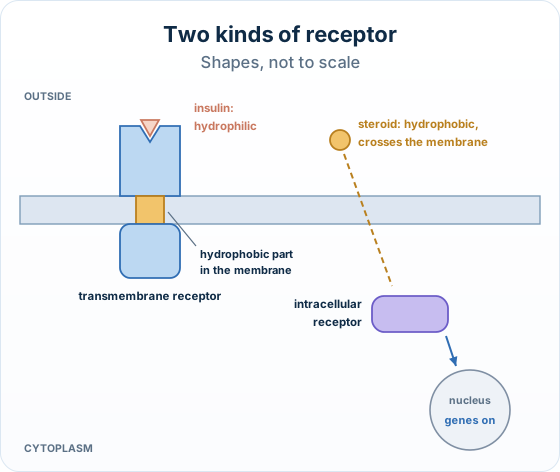
The big idea: A transmembrane receptor crosses the plasma membrane: hydrophobic amino acids sit in the membrane and its binding site faces outwards, for hydrophilic signals. An intracellular receptor sits in the cytoplasm or nucleus and binds hydrophobic signals that have crossed the membrane.
The points to remember
- Transmembrane: hydrophobic amino acids in the membrane, hydrophilic parts on each side.
- Its binding site is outside: ligands such as insulin never enter.
- Intracellular: in the cytoplasm or nucleus, a soluble protein.
- Its ligand is hydrophobic, such as a steroid, which crosses the membrane.
- The steroid-receptor complex changes gene expression.
Remember it as: Water-loving signal, door outside; fat-loving signal, door inside.
Real example: testosterone. Testosterone diffuses into muscle cells and binds a receptor in the cytoplasm; the complex enters the nucleus and switches on genes for muscle proteins.
Trap: The hydrophobic amino acids are in the receptor (where it crosses the membrane); the ligand of a transmembrane receptor is hydrophilic.
How this is tested: This HL topic is often a Compare/Distinguish question: contrast peptide and steroid hormones by solubility, receptor location and mechanism.
What to write
- Link each property to the next: solubility decides whether the hormone can cross the membrane, which decides where the receptor sits.
- You may also be asked to outline the modes of signalling (endocrine, paracrine, autocrine, neurotransmitter) and classify each by distance.
- In multiple choice, expect to identify which hormone class binds a surface receptor, or which acts on genes in the nucleus.
Exam-style question — compare peptide and steroid hormones
Compare and contrast how a peptide hormone and a steroid hormone bind to their receptors and act on a target cell. [6]
Step by step
- Solubility (the cause). A peptide hormone is hydrophilic (water-soluble); a steroid hormone is lipid-soluble (fat-soluble).
- Crossing the membrane. The peptide cannot cross the phospholipid membrane; the steroid can diffuse straight through it.
- Receptor location (the consequence). The peptide binds a transmembrane receptor on the cell surface; the steroid binds an intracellular receptor (inside the cell).
- Mechanism — peptide. The surface receptor triggers signal transduction inside the cell (relaying the message, often via a second messenger).
- Mechanism — steroid. The hormone–receptor complex acts in the nucleus to switch genes on/off, changing which proteins are made.
- A shared point + a contrast. Both work by a ligand binding a specific receptor (similarity). But the peptide response is fast and short-lived, while the steroid response is slower and longer-lasting (difference).
Final answer
A peptide hormone is hydrophilic, so it cannot cross the membrane and binds a transmembrane (surface) receptor, triggering signal transduction inside the cell — a fast, short-lived response. A steroid hormone is lipid-soluble, so it diffuses through the membrane and binds an intracellular receptor; the complex acts in the nucleus to switch genes on/off — a slower, longer-lasting response. Both rely on a ligand binding a specific receptor.
Why this works: It does what 'compare and contrast' demands: it gives both similarities (a ligand binds a specific receptor) and differences (surface vs intracellular receptor; transduction vs direct gene action; fast/short vs slow/long).
It explains the cause: Crucially it explains the cause — solubility decides whether the hormone crosses the membrane, which decides where the receptor sits. A list of facts without that link is not a comparison.
| Feature | Peptide hormone | Steroid hormone |
|---|---|---|
| Solubility | hydrophilic | lipid-soluble |
| Crosses membrane? | no | yes (diffuses through) |
| Receptor | surface (transmembrane) | intracellular |
| Acts by | signal transduction | switching genes on/off in the nucleus |
Another question in the papers' style:
Distinguish between transmembrane receptors and intracellular receptors.
Model answer plan
See the answer broken into clear points, with guidance on how each point earns marks.