Neurotransmitter receptors at Higher Level: An AHL statement: how a receptor that is a channel changes the membrane potential.
Practise this as you read
- Outline how acetylcholine changes the membrane potential.
- Explain excitatory and inhibitory responses.
Free preview
This is the free notes preview
You're reading the free notes. Aimnova Pro unlocks the full study experience — and you can try it with your first topic free to keep:
- FlashcardsLock in vocabulary and key terms with spaced repetition.
- Practice questionsAnswer exam-style questions and get instant AI marking.
- Mock exams & past-paper vaultSit full mocks and see exactly how examiners award marks.
- Personalised study planA daily plan built around your exam date and weak areas.
The big idea: Neurons don't quite touch. Where one neuron meets the next there is a tiny gap — the synapse — and a chemical signal called a neurotransmitter carries the message across.
The sequence is always the same
Release
An impulse arrives at the end of the first (presynaptic) neuron and makes it release neurotransmitter into the gap.
Diffuse
The neurotransmitter diffuses across the gap (the synaptic cleft).
Bind
It binds to receptors on the next (postsynaptic) membrane — and that binding is what triggers a response in the next neuron.
A neurotransmitter is released from the presynaptic neuron, diffuses across the synaptic cleft, and binds receptors on the postsynaptic membrane — that binding is what triggers a response.
Interactive diagram
Explore the labelled diagram, charts and maps for this topic in full study mode.
- Synapse
- The junction where one neuron passes a signal to the next; the cells are separated by a tiny gap.
- Neurotransmitter
- A chemical signal released from the presynaptic neuron that carries the message across the synapse.
- Synaptic cleft
- The narrow gap between the two neurons that the neurotransmitter diffuses across.
- Presynaptic neuron
- The neuron that releases the neurotransmitter (the 'sending' side).
- Postsynaptic neuron
- The neuron that receives the signal — its membrane carries the receptors.
- Receptor
- A protein on the postsynaptic membrane that the neurotransmitter binds to; binding is what produces a response.
The signal is the binding, not the chemical: A neurotransmitter floating in the cleft does nothing on its own.
The response only happens when it binds its receptor on the postsynaptic membrane.
So the message is really 'spoken' by the receptor — keep that idea, because it explains why the same neurotransmitter can mean different things in different places.
Know your predicted grade
Take timed mock exams and get detailed feedback on every answer. See exactly where you're losing marks.
When a neurotransmitter binds a receptor, the receptor usually opens an ion channel — and which ions move decides what happens next.
Read this as cause and effect
Bind
The neurotransmitter binds the receptor.
Open
A channel opens.
Move
Ions cross the membrane.
Result
The postsynaptic cell becomes either more or less likely to fire its own impulse.
An EXCITATORY response (pushes the next cell towards firing)
- Neurotransmitter binds an excitatory receptor.
- The receptor opens channels that let positive ions (e.g. Na⁺) into the cell.
- The inside becomes less negative — the membrane depolarises.
- This makes the postsynaptic neuron more likely to fire its own impulse.
An INHIBITORY response (holds the next cell back)
- Neurotransmitter binds an inhibitory receptor.
- The receptor opens channels that let Cl⁻ in (or K⁺ out).
- The inside becomes more negative — the membrane hyperpolarises.
- This makes the postsynaptic neuron less likely to fire its own impulse.
| Excitatory response | Inhibitory response | |
|---|---|---|
| What the receptor does | Opens channels that let positive ions (e.g. Na⁺) IN | Opens channels that let Cl⁻ in or K⁺ out |
| Effect on the postsynaptic membrane | Membrane becomes LESS negative (depolarises) | Membrane becomes MORE negative (hyperpolarises) |
| Effect on the next neuron | Makes it MORE likely to fire an impulse | Makes it LESS likely to fire an impulse |
| In one phrase | Pushes the postsynaptic cell TOWARDS firing | Holds the postsynaptic cell BACK from firing |
The same neurotransmitter can do BOTH: Here is the part that surprises people: a single neurotransmitter can be excitatory in one place and inhibitory in another. It depends entirely on the receptor it lands on — specifically, on which ion channel that receptor controls.
Key and lock: So the response is a property of the receptor, not of the signal. The neurotransmitter is just the key; the receptor is the lock that decides what the key actually opens.
| The signal | At receptor type 1 | At receptor type 2 | What decides the outcome |
|---|---|---|---|
| One neurotransmitter (e.g. acetylcholine) | Opens an excitatory channel → cell fires | Opens an inhibitory channel → cell is held back | The RECEPTOR (and the channel it controls), not the neurotransmitter |
Switching the signal OFF: A signal you can't stop is useless — it would jam the synapse 'on'. So as soon as it has acted, the neurotransmitter is removed from the cleft, in one of two ways.
| Way | What happens |
|---|---|
| Re-uptake | It is taken back into the presynaptic neuron to be reused. |
| Enzyme breakdown | An enzyme in the cleft breaks it down into inactive pieces. |
Why it matters: Either way the receptors empty and the signal stops. This off-switch is what makes the signal brief, controlled and repeatable — the synapse is reset, ready for the next impulse.
The signal lasts only as long as the neurotransmitter sits on its receptors. Once it is removed from the cleft — taken back up or broken down by an enzyme — the receptors empty and the signal switches OFF, ready for the next impulse.
Interactive diagram
Explore the labelled diagram, charts and maps for this topic in full study mode.
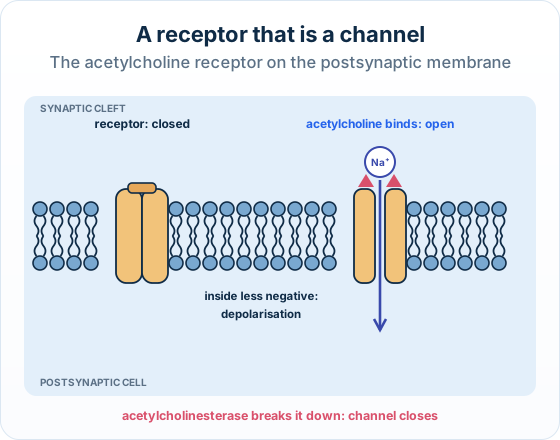
The big idea: The acetylcholine receptor is a transmembrane receptor that is also an ion channel. When acetylcholine binds, the channel opens, sodium ions diffuse in, and the inside of the postsynaptic cell becomes less negative: a change in membrane potential (depolarisation).
The points to remember
- The receptor is a channel protein in the postsynaptic membrane.
- Acetylcholine binds and the channel opens.
- Na⁺ diffuses in, down its concentration gradient.
- The membrane depolarises: the inside becomes less negative.
- Acetylcholinesterase breaks acetylcholine down, so the channel closes.
Remember it as: Bind, open, sodium in, less negative.
Real example: nerve to muscle. At the junction between a motor neuron and a skeletal muscle fibre, acetylcholine opens these channels; the fibre depolarises and contracts.
Trap: Sodium ions move by diffusion through the open channel; no ATP is used to let them in.
Get feedback like a real examiner
Submit your answers and get instant feedback — what you did well, what's missing, and exactly what to write to score full marks.
How this is tested: A common HL ask is to explain how a neurotransmitter produces a response at a synapse — release → diffuse across the cleft → bind receptor → open ion channel → excite or inhibit.
Also expect
- A favourite twist: why the same neurotransmitter can excite one cell and inhibit another — the answer is the receptor / ion channel, not the signal.
- Also how the signal is switched off (removal or breakdown of the neurotransmitter) and why that matters (it keeps signalling controlled).
Exam-style question — one neurotransmitter, two opposite effects
A neurotransmitter excites one postsynaptic neuron but inhibits another. Explain how the same chemical signal can produce opposite responses, and how the signal is then switched off. [5]
Step by step
- The signal binds a receptor. At each synapse the neurotransmitter diffuses across the cleft and binds a receptor on the postsynaptic membrane — nothing happens until it binds.
- Receptors open different channels. The receptor controls an ion channel, and different receptors open different channels, so the same signal can move different ions.
- Excitation. At an excitatory receptor, channels let positive ions (Na⁺) in → the membrane depolarises → the neuron is more likely to fire.
- Inhibition. At an inhibitory receptor, channels let Cl⁻ in (or K⁺ out) → the membrane hyperpolarises → the neuron is less likely to fire. So the response depends on the receptor, not the neurotransmitter.
- Switched off. The signal ends when the neurotransmitter is removed from the cleft — taken back up or broken down by an enzyme — so the receptors empty and signalling stops, keeping the response brief and controlled.
Final answer
The neurotransmitter binds receptors on each postsynaptic membrane. Different receptors open different ion channels: an excitatory receptor lets Na⁺ in (depolarises → more likely to fire), an inhibitory receptor lets Cl⁻ in / K⁺ out (hyperpolarises → less likely to fire). So the response depends on the receptor, not the signal. The signal is then switched off by re-uptake or enzyme breakdown of the neurotransmitter, which empties the receptors and stops signalling.
Why this works: It pins the response on the receptor / ion channel (the whole point of the question), describes both outcomes — Na⁺ in = excite, Cl⁻ in = inhibit — and adds the off-switch (removal or breakdown).
A common slip is to say the neurotransmitter is excitatory or inhibitory. It isn't — the receptor is. Say that explicitly.
Another question in the papers' style:
Outline how acetylcholine binding to its receptor changes the membrane potential of the postsynaptic cell.
Model answer plan
See the answer broken into clear points, with guidance on how each point earns marks.