Near and far at Higher Level: An AHL statement: how far a chemical signal acts, from the next cell to the whole body.
Practise this as you read
- Contrast local and distant effects.
- Identify which signals act locally.
Free preview
This is the free notes preview
You're reading the free notes. Aimnova Pro unlocks the full study experience — and you can try it with your first topic free to keep:
- FlashcardsLock in vocabulary and key terms with spaced repetition.
- Practice questionsAnswer exam-style questions and get instant AI marking.
- Mock exams & past-paper vaultSit full mocks and see exactly how examiners award marks.
- Personalised study planA daily plan built around your exam date and weak areas.
Start Studying Free Full access to Aimnova Pro · cancel anytime
The big idea: Cells coordinate with each other by releasing chemical signals. The same idea works over very different distances.
| Mode | How far the signal travels | How it gets there |
|---|---|---|
| Endocrine | Distant target cells (long range) | A hormone is released into the blood and carried there |
| Paracrine | Nearby cells (short range) | The signal acts locally |
| Autocrine | The cell itself | It binds its own receptors |
| Neurotransmitter | The adjacent cell (very short range) | Released across a synapse |
What every mode shares: Biologists name the modes by how far the signal travels. In every case a signal molecule (ligand) binds a matching receptor — only the distance and the delivery route differ.
| Mode | How far does the signal travel? | How it reaches the target | Example |
|---|---|---|---|
| Endocrine | Long range — anywhere in the body | A hormone is released into the BLOOD and carried to distant target cells | Insulin from the pancreas reaching the liver |
| Paracrine | Short range — neighbouring cells | The signal DIFFUSES locally to nearby cells | A growth factor acting on the cells next to it during healing |
| Autocrine | The cell itself | The cell releases a signal that binds its OWN receptors | An immune cell releasing a signal that drives its own division |
| Neurotransmitter | Very short range — across a synapse | Released into the synaptic gap onto the ADJACENT cell | Acetylcholine crossing a synapse to a muscle fibre |
- Chemical signalling
- Cells communicating by releasing molecules (ligands) that bind receptors on a target cell.
- Endocrine signalling
- A hormone is released into the bloodstream and travels long distances to reach distant target cells.
- Paracrine signalling
- A signal acts locally, diffusing only to neighbouring cells.
- Autocrine signalling
- A cell releases a signal that binds receptors on itself.
- Neurotransmitter signalling
- A signal released across a synapse onto the immediately adjacent cell — the shortest range of all.
- Hormone
- A signalling molecule, released by an endocrine gland, that travels in the blood to its target cells.
One easy way to keep the four straight: Think about who receives the message:
ENDO = the message goes far (into the blood). PARA = to the cell beside it. AUTO = back to itself. NEURO = across a synapse.
Distance shrinks as you go down the list: body-wide → neighbour → self → synaptic gap.
Get feedback like a real examiner
Submit your answers and get instant feedback — what you did well, what's missing, and exactly what to write to score full marks.
Try AI Tutor FreeYour first topic is free to keep • No credit card required
The big idea: Some signals have localized effects: neurotransmitters act on the next cell across a synapse, and cytokines on nearby cells. Hormones have distant effects: carried in the blood, they reach target cells anywhere in the body.
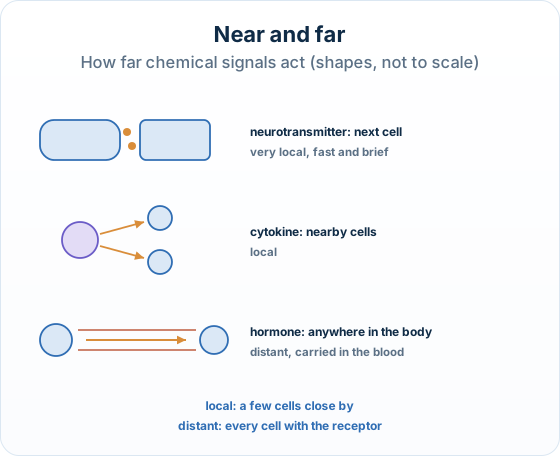
The points to remember
- Neurotransmitter: across a synapse, to one next cell.
- Cytokine: diffuses to nearby cells only.
- Hormone: in the blood, to distant cells.
- Local signals are fast and brief; hormone effects are usually slower and longer lasting.
- A hormone acts on every cell with its receptor, wherever it is.
Remember it as: Next door, nearby, or the whole body.
Real example: one gland, many organs. Adrenaline from the adrenal glands travels in the blood and makes the heart beat faster, the liver release glucose and the airways widen, all at once.
Trap: A hormone travels everywhere in the blood, but it only affects cells that have its receptor.
How it is asked: Expect a Contrast or Distinguish question on local and distant signals, or an MCQ asking which signal acts on nearby cells only.
IB-style questionContrast[3 marks]
Contrast the effects of neurotransmitters with the effects of hormones.
Model answer plan
See the answer broken into clear points, with guidance on how each point earns marks.