aımnova
DashboardMy LearningCrash CoursesStudy Plan

Aimnova site navigation

Stay in the loop

Get the latest study resources and updates

New features, study tips and exam insights — straight to your inbox.

IB Diploma

  • IB Past Papers
  • IB Study Notes
  • IB Question Bank
  • IB Mock Exams
  • IB Revision

IB Subjects

  • IB Math AA
  • IB Math AI
  • IB Economics
  • IB Business Management
  • IB Physics
  • IB Biology
  • View all IB subjects→

IB Past Papers

  • IB Math AA HL Past Papers
  • IB Math AA SL Past Papers
  • IB Math AI HL Past Papers
  • IB Math AI SL Past Papers
  • IB Economics HL Past Papers
  • IB Economics SL Past Papers
  • IB ESS Past Papers
  • View all past papers→

Study Resources

  • Study Notes
  • Question Bank
  • Mock Exams
  • Crash Courses
  • Flashcards
  • Revision Guide
  • Exam Skills
  • Command Terms
  • Grade Calculator
  • Exam Timetable 2026

Aimnova

  • Features
  • Pricing
  • For Teachers
  • For Schools
  • For Parents
  • About Us
  • Blog
  • Contact
aımnova

IB study, practice and feedback built around the real exam.

TermsPrivacyCookies·© 2026 Aimnova. All rights reserved.06bfe1b

Aimnova is not affiliated with or endorsed by the International Baccalaureate Organization (IB).

NotesBiology HLTopic 3.4Transmembrane receptors with tyrosine kinase activity
Back to Biology HL Topics
3.4.113 min read

Transmembrane receptors with tyrosine kinase activity (Biology HL)

IB Biology · Unit 3

AI-powered feedback

Stop guessing — know where you lost marks

Get instant, examiner-style feedback on every answer. See exactly how to improve and what the markscheme expects.

Try It Free

Contents

  1. 1Insulin receptors at Higher Level
  2. 2How insulin acts, step by step
  3. 3Exam-style question (step by step)
Insulin receptors at Higher Level: An AHL statement: a receptor that is also an enzyme.

Practise this as you read

  • Outline how insulin increases glucose uptake.
  • Identify the ligand of a tyrosine kinase receptor.

Free preview

This is the free notes preview

You're reading the free notes. Aimnova Pro unlocks the full study experience — and you can try it with your first topic free to keep:

  • FlashcardsLock in vocabulary and key terms with spaced repetition.
  • Practice questionsAnswer exam-style questions and get instant AI marking.
  • Mock exams & past-paper vaultSit full mocks and see exactly how examiners award marks.
  • Personalised study planA daily plan built around your exam date and weak areas.
Start Studying Free Full access to Aimnova Pro · cancel anytime
The big idea: The insulin receptor is a transmembrane receptor that is also an enzyme: its parts inside the cell are tyrosine kinases. When insulin binds, the receptor phosphorylates tyrosines on itself, using ATP. This starts a pathway that sends glucose transporters to the plasma membrane, so more glucose enters the cell.
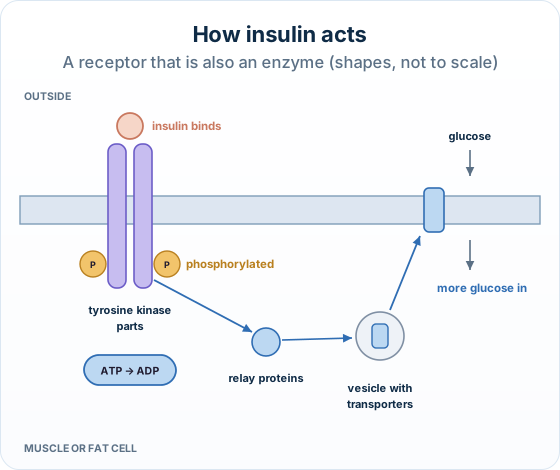
A muscle or fat cell drawn step by step: the insulin receptor across the membrane; insulin binding; phosphate groups added to the receptor's kinase parts from ATP; relay proteins activated; a vesicle carrying glucose transporters fusing with the membrane so more glucose enters
How insulin acts, step by step.

The points to remember

  • The insulin receptor is a pair of subunits across the membrane.
  • Its inside parts are tyrosine kinases: enzymes that add phosphate to tyrosine.
  • Insulin binds, and the receptor phosphorylates itself using ATP.
  • The phosphorylated receptor activates relay proteins.
  • Vesicles with glucose transporters fuse with the membrane: more glucose in.
Remember it as: Insulin binds, receptor phosphorylates itself, transporters arrive.

Real example: after a meal. After a meal, insulin from the pancreas reaches muscle and fat cells. Within minutes, more glucose transporters sit in their plasma membranes, and blood glucose falls.

Trap: A kinase adds phosphate; the receptor is the kinase here. There is no G protein in this pathway.

See how examiners mark answers

Answer exam-style questions with model answers. Learn exactly what earns marks and what doesn't.

Try Exam Vault FreeYour first topic is free to keep • No credit card required
How it is asked: Expect an MCQ asking which ligand uses a tyrosine kinase receptor, or an Outline question on how insulin increases glucose uptake.
IB-style questionOutline[4 marks]

Outline how insulin increases the uptake of glucose by a muscle cell.

Model answer plan

See the answer broken into clear points, with guidance on how each point earns marks.

Claim your free topic

Try an IB Exam Question — Free AI Feedback

Test yourself on Transmembrane receptors with tyrosine kinase activity. Write your answer and get instant AI feedback — just like a real IB examiner.

A mutant insulin receptor binds insulin normally but has no kinase activity.

the effect on glucose uptake by the cell, with a reason.
[2 marks]

Related Biology HL Topics

Continue learning with these related topics from the same unit:

3.1.1Enzymes as catalysts3.1.2Role of enzymes in metabolism3.1.3Anabolic and catabolic reactions3.1.4Enzymes as globular proteins with an active site for catalysis
View all Biology HL topics
Improve your exam techniqueCommand terms, paper structure, and mark-scheme tips for Biology HL
Previous3.4.10Mechanism of action of epinephrine (adrenaline) receptorsNextIntracellular receptors that affect gene expression3.4.12

6 questions to test your understanding

Reading is just the start. Students who tested themselves scored 82% on average — try IB-style questions with AI feedback.

Start FreeView All Biology HL Topics