Adrenaline at Higher Level: An AHL statement: a full signal transduction pathway, from receptor to response.
Practise this as you read
- Explain how adrenaline acts inside a cell.
- Identify the order of the steps.
Free preview
This is the free notes preview
You're reading the free notes. Aimnova Pro unlocks the full study experience — and you can try it with your first topic free to keep:
- FlashcardsLock in vocabulary and key terms with spaced repetition.
- Practice questionsAnswer exam-style questions and get instant AI marking.
- Mock exams & past-paper vaultSit full mocks and see exactly how examiners award marks.
- Personalised study planA daily plan built around your exam date and weak areas.
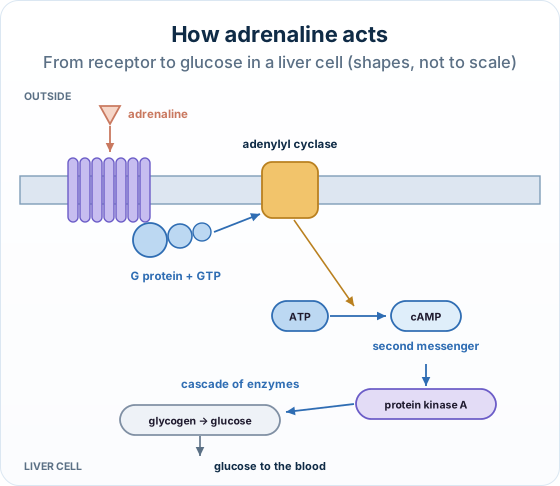
The big idea: Adrenaline (epinephrine) binds a G protein-coupled receptor. The G protein activates adenylyl cyclase, which turns ATP into cyclic AMP (cAMP), the second messenger. cAMP activates protein kinase A, which starts a cascade; in the liver this ends with glycogen broken down to glucose.
The points to remember
- Adrenaline binds a G protein-coupled receptor; it never enters the cell.
- The G protein swaps GDP for GTP and activates adenylyl cyclase.
- Adenylyl cyclase turns ATP into cAMP, the second messenger.
- cAMP activates protein kinase A, which phosphorylates other enzymes: a cascade.
- In the liver: glycogen to glucose, released into the blood.
Remember it as: Receptor, G protein, cyclase, cAMP, kinase.
Real example: a fright. In a sudden fright, adrenaline reaches the liver within seconds. Because each step activates many molecules of the next, a little adrenaline releases a lot of glucose for the muscles.
Trap: cAMP is the second messenger; adrenaline is the first. Adenylyl cyclase makes cAMP; protein kinase A is activated by it.
Two names, one hormone. Adrenaline (Latin ad + ren, at the kidney) and epinephrine (Greek epi + nephros, above the kidney) were both coined by researchers for the hormone of the adrenal gland. Both names are still used in different parts of the world, and scientists everywhere accept both: naming conventions are a form of international cooperation.
Know your predicted grade
Take timed mock exams and get detailed feedback on every answer. See exactly where you're losing marks.
How it is asked: Expect an MCQ on the order of the steps after adrenaline binds, or an Explain question on how adrenaline acts inside a cell.
Explain how adrenaline causes a liver cell to release glucose.
Model answer plan
See the answer broken into clear points, with guidance on how each point earns marks.