Receptors inside the cell at Higher Level: An AHL statement: how steroid hormones change gene expression.
Practise this as you read
- Outline how a steroid hormone changes gene expression.
- Explain why the response is slow but long-lasting.
Free preview
This is the free notes preview
You're reading the free notes. Aimnova Pro unlocks the full study experience — and you can try it with your first topic free to keep:
- FlashcardsLock in vocabulary and key terms with spaced repetition.
- Practice questionsAnswer exam-style questions and get instant AI marking.
- Mock exams & past-paper vaultSit full mocks and see exactly how examiners award marks.
- Personalised study planA daily plan built around your exam date and weak areas.
The big idea: Not every signalling molecule has to knock on the door. Some go straight in and switch genes on or off.
The inside route
Lipid-soluble signal
A steroid hormone (e.g. testosterone, oestrogen, cortisol) or thyroxine is lipid-soluble.
Enters
It dissolves through the plasma membrane and enters the cell.
Binds inside
It binds a receptor that is already in the cell — in the cytoplasm or the nucleus. These are intracellular receptors.
Payoff
The hormone-receptor pair switches genes on or off, changing which proteins the cell makes.
- Lipid-soluble (hydrophobic) signal
- A signalling molecule that dissolves in fats/lipids, so it can pass straight through the lipid plasma membrane. Steroid hormones and thyroxine are examples.
- Intracellular receptor
- A receptor located INSIDE the cell — in the cytoplasm or nucleus — rather than on the surface. It can only be reached by a signal that crosses the membrane.
- Steroid hormone
- A lipid-soluble hormone made from cholesterol (e.g. testosterone, oestrogen, cortisol). It enters target cells directly.
- Hormone-receptor complex
- The unit formed when the hormone binds its intracellular receptor; this complex is what acts on the DNA.
- Transcription factor
- A protein that binds DNA and controls whether a gene is transcribed (switched on) or not.
Why 'lipid-soluble' is the whole trick: The plasma membrane is mostly lipid. Like dissolves like, so a lipid-soluble signal slips through it easily.
A water-soluble signal cannot — it has to stay outside and use a surface receptor instead (that's the other route, covered next).
So the solubility of the signal decides which kind of receptor it uses.
Memorize terms 3x faster
Smart flashcards show you cards right before you forget them. Perfect for definitions and key concepts.
Follow the intracellular route as a chain of cause and effect — each step makes the next one happen, ending in a change to gene expression.
The intracellular signalling pathway (step by step)
- A lipid-soluble hormone (steroid or thyroxine) diffuses through the plasma membrane into the cell.
- Inside, it binds an intracellular receptor in the cytoplasm or nucleus, forming a hormone-receptor complex.
- The complex moves to the DNA in the nucleus (if it wasn't already there).
- The complex acts as a transcription factor — it binds specific genes on the DNA.
- This switches those genes ON (or, for some genes, off) — transcription is started or stopped.
- The cell makes new mRNA and new proteins, so which proteins the cell produces changes — and the effect lasts.
| Step | What happens |
|---|---|
| 1. Diffuse in | The lipid-soluble hormone passes straight through the plasma membrane |
| 2. Bind receptor | It binds an intracellular receptor in the cytoplasm or nucleus |
| 3. Form a complex | Together they form a hormone-receptor complex |
| 4. Act as transcription factor | The complex binds to DNA at specific genes |
| 5. Switch genes on/off | Transcription of those genes is turned ON (or off) |
| 6. Change the proteins made | New mRNA → new proteins → the cell's behaviour changes, and the effect lasts |
The key move: a hormone that controls genes: The clever part is step 4. The hormone-receptor complex itself acts as a transcription factor.
By binding the DNA it decides whether a gene is read or not — so it controls gene expression directly.
Because the response is new protein synthesis, it takes a while to get going but then persists: the cell genuinely behaves differently.
Now meet the other route — the FAST one: Water-soluble signals (most peptide hormones, adrenaline) can't cross the membrane. They bind a surface receptor that spans the membrane.
What happens next
- The receptor triggers a second messenger (e.g. cyclic AMP) inside the cell.
- This activates enzymes that already exist.
- Result: a response that is fast to start but short-lived — it stops once the signal is gone.
- No new genes need to be switched on.
The OTHER route, for comparison — the FAST pathway. A water-soluble signal cannot cross the membrane, so it binds a receptor ON the cell surface; the receptor relays the signal to a second messenger inside, giving a fast, short-lived response. Intracellular receptors work the opposite way: the signal goes straight in.
Interactive diagram
Explore the labelled diagram, charts and maps for this topic in full study mode.
Slow-but-lasting vs fast-but-fleeting: Intracellular receptors → changes gene expression → slower to start, but longer-lasting.
Surface receptors + second messengers → switch on existing proteins → fast to start, but short-lived.
Same job (passing a signal into the cell), but two opposite trade-offs of speed vs duration.
| Intracellular receptors | Surface (membrane) receptors | |
|---|---|---|
| Signal type | LIPID-soluble (steroid hormones, thyroxine) | WATER-soluble (e.g. peptide hormones, adrenaline) |
| Crosses the membrane? | YES — it diffuses straight through the phospholipid bilayer | NO — it stays outside and binds a receptor in the membrane |
| Where the receptor is | INSIDE the cell — in the cytoplasm or nucleus | ON the cell surface — spanning the plasma membrane |
| How the message gets in | The hormone itself carries the message into the cell | A second messenger (e.g. cyclic AMP) relays it inside |
| What happens at the end | Hormone-receptor complex binds DNA and switches GENES on/off | A relay/cascade activates existing enzymes in the cytoplasm |
| Speed to START | SLOWER (making new proteins takes time) | FAST (existing proteins are switched on at once) |
| How LONG it lasts | LONGER-lasting (changes which proteins the cell makes) | SHORT-lived (stops when the signal is removed) |
The big idea: Steroid hormones such as oestradiol, progesterone and testosterone cross the membrane and bind receptors inside the cell. The hormone-receptor complex binds DNA and acts as a transcription factor, so it changes which genes are expressed.
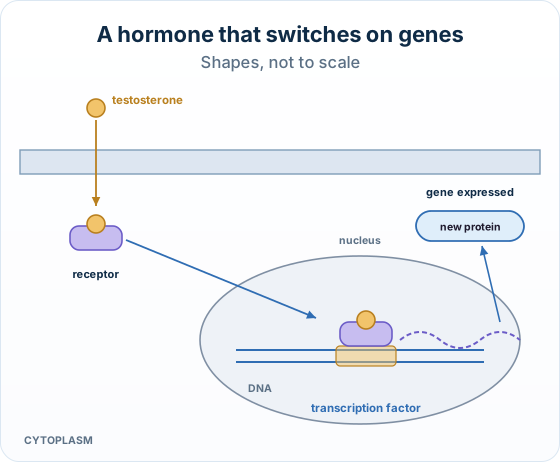
The points to remember
- Steroids are lipid-soluble: they diffuse through the membrane.
- They bind a receptor in the cytoplasm or nucleus.
- The hormone-receptor complex binds DNA at specific genes.
- It acts as a transcription factor: genes switched on (or off).
- New proteins are made: slow to start, long-lasting.
Remember it as: Through the membrane, onto the DNA.
Real example: testosterone in muscle. Testosterone binds receptors in muscle fibres; the complex switches on genes for muscle proteins, so muscle mass increases over weeks, not seconds.
Trap: The complex, not the hormone alone, binds the DNA, and it changes which genes are transcribed; it does not use a second messenger.
Know your predicted grade
Take timed mock exams and get detailed feedback on every answer. See exactly where you're losing marks.
How this is tested: A favourite HL outline/explain question asks how a steroid hormone (or thyroxine) changes a target cell.
What to include
Enter
Lipid-soluble → diffuses through the membrane.
Bind
Binds an intracellular receptor.
Transcription factor
The complex acts as a transcription factor → binds DNA.
Genes
Switches genes on/off → changes the proteins made.
Compare/distinguish questions: These contrast intracellular vs surface receptors. Focus on the speed vs duration trade-off (slow but lasting vs fast but short-lived) and where the receptor is (inside vs on the surface).
Watch the trap: A steroid does not use a second messenger, and a water-soluble signal does not enter the cell.
Exam-style question — how a steroid hormone changes a target cell
Cortisol is a steroid hormone. Explain how it changes the activity of a target cell, and state one way this differs from signalling by a water-soluble hormone. [6]
Step by step
- Lipid-soluble → enters. Cortisol is lipid-soluble, so it diffuses straight through the plasma membrane into the cell.
- Binds an intracellular receptor. Inside, it binds a receptor in the cytoplasm/nucleus, forming a hormone-receptor complex.
- Acts as a transcription factor. The complex binds to DNA and acts as a transcription factor.
- Switches genes on/off. This switches specific genes ON (or off), changing transcription.
- Changes the proteins made. New mRNA → new proteins, so which proteins the cell makes changes — a slower but longer-lasting effect.
- The difference. A water-soluble hormone cannot cross the membrane; it binds a surface receptor and uses a second messenger to switch on existing proteins — a fast, short-lived response.
Final answer
Cortisol is lipid-soluble, so it diffuses through the plasma membrane and binds an intracellular receptor. The hormone-receptor complex acts as a transcription factor, binding DNA and switching specific genes on or off, which changes the proteins the cell makes (a slow, long-lasting effect). A water-soluble hormone instead binds a surface receptor and uses a second messenger to give a fast, short-lived response without entering the cell.
Why this works: It tracks the whole intracellular chain (lipid-soluble → diffuses in → intracellular receptor → complex → transcription factor → genes on/off → new proteins) and nails the contrast the question asked for: surface receptor + second messenger = fast and short-lived.
Trap: Saying a steroid uses a second messenger — it does not. Second messengers belong to the surface-receptor route.
| Intracellular receptors | Surface (membrane) receptors | |
|---|---|---|
| Signal type | LIPID-soluble (steroid hormones, thyroxine) | WATER-soluble (e.g. peptide hormones, adrenaline) |
| Crosses the membrane? | YES — it diffuses straight through the phospholipid bilayer | NO — it stays outside and binds a receptor in the membrane |
| Where the receptor is | INSIDE the cell — in the cytoplasm or nucleus | ON the cell surface — spanning the plasma membrane |
| How the message gets in | The hormone itself carries the message into the cell | A second messenger (e.g. cyclic AMP) relays it inside |
| What happens at the end | Hormone-receptor complex binds DNA and switches GENES on/off | A relay/cascade activates existing enzymes in the cytoplasm |
| Speed to START | SLOWER (making new proteins takes time) | FAST (existing proteins are switched on at once) |
| How LONG it lasts | LONGER-lasting (changes which proteins the cell makes) | SHORT-lived (stops when the signal is removed) |
Another question in the papers' style:
Outline how oestradiol changes gene expression in a target cell.
Model answer plan
See the answer broken into clear points, with guidance on how each point earns marks.