NAD and oxidation: Higher Level only: This statement is Higher Level only. It is the key to the rest of the topic: every later stage either makes reduced NAD or uses it.
Practise this as you read
- Define oxidation and reduction in terms of hydrogen.
- State where reduced NAD is made.
Free preview
This is the free notes preview
You're reading the free notes. Aimnova Pro unlocks the full study experience — and you can try it with your first topic free to keep:
- FlashcardsLock in vocabulary and key terms with spaced repetition.
- Practice questionsAnswer exam-style questions and get instant AI marking.
- Mock exams & past-paper vaultSit full mocks and see exactly how examiners award marks.
- Personalised study planA daily plan built around your exam date and weak areas.
Start Studying Free Full access to Aimnova Pro · cancel anytime
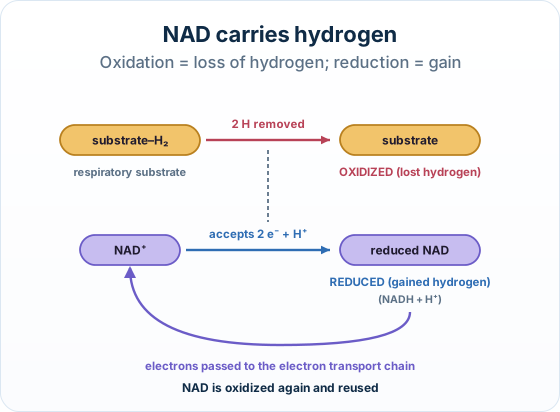
The big idea: In respiration, substrates are oxidized by removing hydrogen. Each hydrogen atom takes its electron with it. NAD accepts the hydrogen and becomes reduced NAD, which carries it to the electron transport chain.
The points to remember
- Oxidation = loss of hydrogen or electrons; reduction = gain of hydrogen or electrons.
- NAD accepts two electrons and one proton (from two hydrogen atoms) and becomes reduced NAD.
- Reduced NAD is made in glycolysis, the link reaction and the Krebs cycle.
- It carries the electrons to the electron transport chain, and is oxidized back to NAD.
Remember it as: Oxidation Is Loss, Reduction Is Gain (of electrons or hydrogen).
Real example: the energy is in the hydrogen. Most of the ATP from one glucose is made by the electron transport chain, using the electrons that reduced NAD (and reduced FAD) bring there.
Trap: When NAD is reduced, the substrate is oxidized: the two always happen together.
Learn what examiners really want
See exactly what to write to score full marks. Our AI shows you model answers and the key phrases examiners look for.
Try AI Feedback FreeYour first topic is free to keep • No credit card required
How it is asked: Expect questions on what oxidation means in respiration, on where reduced NAD is made, and comparisons with NADP in photosynthesis.
IB-style questionDistinguish[3 marks]
Distinguish between the roles of NAD in respiration and NADP in photosynthesis.
Model answer plan
See the answer broken into clear points, with guidance on how each point earns marks.