Glycolysis: Higher Level only: This statement is Higher Level only. Learn the four stages in order and the net yield.
Practise this as you read
- Outline the four stages of glycolysis.
- Identify where ATP is used and where it is made.
Free preview
This is the free notes preview
You're reading the free notes. Aimnova Pro unlocks the full study experience — and you can try it with your first topic free to keep:
- FlashcardsLock in vocabulary and key terms with spaced repetition.
- Practice questionsAnswer exam-style questions and get instant AI marking.
- Mock exams & past-paper vaultSit full mocks and see exactly how examiners award marks.
- Personalised study planA daily plan built around your exam date and weak areas.
Start Studying Free Full access to Aimnova Pro · cancel anytime
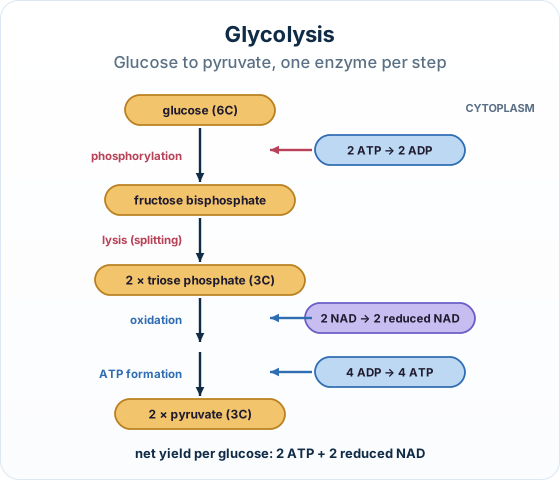
The big idea: Glycolysis turns one glucose into two pyruvate in the cytoplasm. It is a chain of small steps, each catalysed by its own enzyme: phosphorylation, lysis, oxidation and ATP formation. It needs no oxygen.
The points to remember
- Phosphorylation: 2 ATP add phosphate to glucose, making fructose bisphosphate (less stable).
- Lysis: it splits into two triose phosphates (3C).
- Oxidation: hydrogen is removed; 2 NAD become 2 reduced NAD.
- ATP formation: 4 ATP made as two pyruvate form, so the net yield is 2 ATP.
- All in the cytoplasm, with no oxygen needed.
Remember it as: Glycolysis in four words: Phosphorylate, Lyse, Oxidize, ATP.
Real example: sprinting muscle. In a 100 m sprint, muscle fibres depend heavily on glycolysis: it supplies ATP quickly, even when oxygen cannot reach the mitochondria fast enough.
Trap: Glycolysis makes 4 ATP but uses 2: the net yield is 2 ATP per glucose.
Get feedback like a real examiner
Submit your answers and get instant feedback — what you did well, what's missing, and exactly what to write to score full marks.
Try AI Tutor FreeYour first topic is free to keep • No credit card required
How it is asked: Expect labelling of a glycolysis diagram (where phosphorylation or oxidation happens), where it takes place, and an Outline of the whole pathway.
IB-style questionOutline[4 marks]
Outline how glucose is converted to pyruvate in glycolysis.
Model answer plan
See the answer broken into clear points, with guidance on how each point earns marks.