Respiration rate at Higher Level: The same statement as SL. HL data questions add calculations with π r² l, the role of the syringe and of soda lime, and predictions of how the liquid moves.
Practise this as you read
- Calculate a rate of oxygen uptake.
- Explain how a respirometer works and why it needs a control.
Free preview
This is the free notes preview
You're reading the free notes. Aimnova Pro unlocks the full study experience — and you can try it with your first topic free to keep:
- FlashcardsLock in vocabulary and key terms with spaced repetition.
- Practice questionsAnswer exam-style questions and get instant AI marking.
- Mock exams & past-paper vaultSit full mocks and see exactly how examiners award marks.
- Personalised study planA daily plan built around your exam date and weak areas.
The big idea: Cell respiration releases energy from glucose. In aerobic respiration it uses up oxygen and releases carbon dioxide.
What the rate means and how we measure it
- The respiration rate is simply how fast this happens, for example how much oxygen is used (or carbon dioxide is made) per minute.
- We can't see respiration directly, so we measure it indirectly by tracking one of the things that changes.
- Track the gases, the temperature, or the mass of the organism.
- Respiration rate
- How quickly an organism respires — usually measured as the volume of oxygen used, or carbon dioxide produced, in a given time (e.g. per minute).
- Respirometer
- A piece of apparatus that measures respiration rate by detecting the change in gas volume (usually the oxygen used up) as organisms respire.
- Indicator (variable)
- A measurable quantity that changes as respiration happens — oxygen used, carbon dioxide produced, temperature rise or mass lost — that lets us estimate the rate.
- Control (dead organisms)
- An identical set-up using non-respiring (dead or boiled) organisms, used to show that any change measured is caused by living respiration and not by something else.
Why we measure indirectly: You can't watch a cell respire. But every time it respires it takes in oxygen, gives out carbon dioxide, warms up slightly and loses a little mass (as carbon leaves in CO₂).
Each of these is something we can measure — so measuring any one of them tells us the respiration rate.
Practice with exam-style questions
Answer exam-style questions and get AI feedback that shows you exactly what examiners want to see in a full-marks response.
The classic way to measure respiration rate is a respirometer.
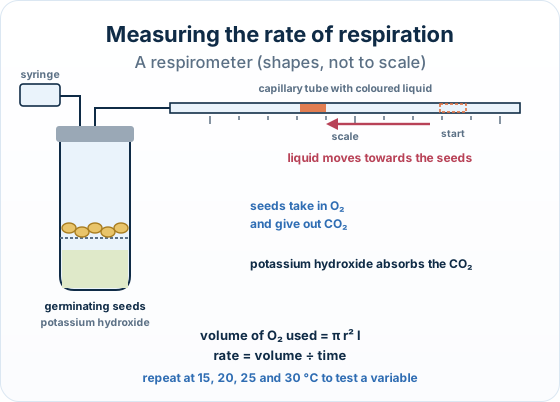
How the respirometer works
- A common school version uses germinating seeds (or small invertebrates) sealed in a tube.
- The tube is connected to a thin tube containing a drop of coloured liquid.
- As the seeds respire, they use up oxygen from the sealed air.
- This lowers the gas volume, so the coloured liquid moves towards the seeds.
- How far it moves in a set time measures the oxygen used: the respiration rate.
The role of potassium hydroxide (KOH): There's a problem: respiration uses oxygen but also releases carbon dioxide. If both gases changed, the volume might barely move and you couldn't tell what was happening.
How KOH fixes it
- A small amount of potassium hydroxide (KOH) is added.
- KOH absorbs all the carbon dioxide the seeds release.
- Now the only gas change left is the oxygen being used up.
- So the coloured liquid moves in cleanly, and its movement measures exactly that.
Why you need a dead-seed control: The coloured liquid could also move if the temperature or air pressure in the room changed, which has nothing to do with respiration.
How the control works
- To rule this out, an identical tube is set up with dead (boiled) seeds, which do not respire.
- If the liquid in the control tube stays still, you know any movement in the live tube is caused by respiration, not by the surroundings.
- This makes the experiment a fair test.
| Part of the set-up | Its job | What the data tells you |
|---|---|---|
| Germinating seeds (or small animals) | The living, respiring organisms | They use up oxygen, so the coloured liquid moves towards them |
| Potassium hydroxide (KOH) | Absorbs all the carbon dioxide released | Removes CO₂ so the ONLY gas change left is the oxygen used up |
| Coloured liquid in the tube | Shows the change in gas volume | Its movement measures how much oxygen was taken in over time |
| Dead (or boiled) seeds — the control | Identical set-up but not respiring | The liquid should NOT move; proves the movement is caused by living respiration, not temperature or pressure |
Germinating (live) seeds
- Respire — use up oxygen
- KOH absorbs the CO₂ they release
- Coloured liquid moves towards them
- Distance moved = respiration rate
Dead (boiled) seeds — control
- Do not respire
- No oxygen used, no CO₂ made
- Coloured liquid should not move
- Proves movement is caused by respiration
An easy way to remember: KOH absorbs CO₂: with that gas removed, the only change the respirometer detects is oxygen disappearing.
Liquid moves towards the seeds because oxygen is being used up (volume shrinks).
A respirometer tracks the gases of respiration: in aerobic organisms it uses up oxygen and releases carbon dioxide. Measuring how fast either gas changes tells you the respiration rate.
Interactive diagram
Explore the labelled diagram, charts and maps for this topic in full study mode.
The big idea: The rate of respiration can be measured as oxygen used per unit time. Changing one variable, such as temperature, and measuring the rate shows how that variable affects respiration.
The points to remember
- Distance moved by the liquid × cross-sectional area of the tube = volume of oxygen used (π r² l).
- Rate = volume ÷ time, for example mm³ per hour.
- Variables that affect the rate: temperature, oxygen and substrate supply, and how active the organism is.
- Keep other variables constant and use a control without living organisms.
Remember it as: Volume = π r² l; rate = volume ÷ time.
Real example: oxygen uptake in sport. Sports scientists measure an athlete's oxygen uptake while running on a treadmill. The rate rises with speed until it reaches a maximum, a measure of how fit the athlete is.
Trap: Without potassium hydroxide, the carbon dioxide given out would roughly replace the oxygen used, and the liquid would hardly move.
Feeling unprepared for exams?
Get a clear study plan, practice with real questions, and know exactly where you stand before exam day. No more guessing.
How this is tested: Respirometers are a data-question favourite. Expect these three question types.
The common formats
- Interpret, 1 mark: a respirometer with germinating versus dead seeds and KOH. Say what the moving coloured liquid demonstrates: living seeds use up oxygen as they respire.
- Suggest, inhibitor: how a graph shows an inhibitor (such as cyanide) slowing respiration. The liquid moves less, so less oxygen is used.
- Suggest, another quantity: propose another quantity that could measure respiration rate. Carbon dioxide produced, temperature rise or mass lost are all valid.
Exam-style question — interpret the respirometer
In a respirometer, germinating seeds with potassium hydroxide cause a drop of coloured liquid to move towards them, while an identical tube of dead seeds shows no movement. Explain what these results demonstrate. [3]
Step by step
- Say what the moving liquid means. The living seeds are using up oxygen as they respire, lowering the gas volume, so the coloured liquid is drawn towards them.
- Explain the role of KOH. The potassium hydroxide absorbs the carbon dioxide released, so the only gas change left is the oxygen being used — this is what the liquid's movement measures.
- Explain the dead-seed control. The dead seeds do not respire, so the liquid does not move; this shows the movement in the live tube is caused by respiration, not by temperature or pressure.
Final answer
The germinating seeds use up oxygen, so the liquid moves towards them; KOH absorbs the CO₂ so only the oxygen change is measured; the unmoving dead-seed control proves the movement is caused by living respiration.
Why this works: It links each observation to a reason: oxygen used → liquid moves; KOH → only oxygen is measured; dead control → movement must be respiration.
A common slip is to say the liquid moves 'because of carbon dioxide' — but KOH removes the CO₂, so it is the oxygen being used that moves the liquid.
| What you measure | What happens during respiration | How you detect it |
|---|---|---|
| Oxygen used up | Aerobic respiration consumes oxygen from the air | Gas volume falls, so coloured liquid in a respirometer moves towards the organism |
| Carbon dioxide produced | Respiration releases carbon dioxide | Detect with an indicator (e.g. hydrogencarbonate indicator turning yellow), or measure the gas given off |
| Temperature rise | Respiration releases some energy as heat | A thermometer or data-logger in an insulated flask shows the temperature climbing |
| Mass lost | Carbon leaves as carbon dioxide gas over time | Weigh the organisms (e.g. germinating seeds) before and after — dry mass falls |
Another question in the papers' style:
The coloured liquid in a respirometer moved 30 mm in 20 minutes. The capillary tube has a radius of 0.5 mm. Calculate the rate of oxygen uptake in mm³ per minute (π = 3.14).
Model answer plan
See the answer broken into clear points, with guidance on how each point earns marks.