Aerobic and anaerobic at Higher Level: The same statement as SL. At HL the differences are explained by the pathways: glycolysis in both, lactate to regenerate NAD, and the link reaction, Krebs cycle and electron transport chain only in aerobic respiration.
Practise this as you read
- Distinguish between aerobic and anaerobic respiration.
- Identify a similarity between them.
Free preview
This is the free notes preview
You're reading the free notes. Aimnova Pro unlocks the full study experience — and you can try it with your first topic free to keep:
- FlashcardsLock in vocabulary and key terms with spaced repetition.
- Practice questionsAnswer exam-style questions and get instant AI marking.
- Mock exams & past-paper vaultSit full mocks and see exactly how examiners award marks.
- Personalised study planA daily plan built around your exam date and weak areas.
The big idea: Cells release energy from glucose to make ATP. They can do this in two ways.
Aerobic respiration
- Uses oxygen
- Breaks glucose down fully
- Releases a lot of ATP
Anaerobic respiration
- Uses no oxygen
- Breaks glucose down only partly
- Releases only a little ATP
What decides which one: Which one a cell uses depends mainly on whether oxygen is available.
Glucose branches two ways: with oxygen → carbon dioxide + water + a lot of ATP (in the mitochondria); without oxygen → lactate in animals, or ethanol + carbon dioxide in yeast, with only a little ATP (in the cytoplasm).
Interactive diagram
Explore the labelled diagram, charts and maps for this topic in full study mode.
- Cell respiration
- The release of energy from glucose (or other carbon compounds) to make ATP, which powers the cell's processes.
- Aerobic respiration
- Respiration that uses oxygen. Glucose is broken down fully into carbon dioxide and water, releasing a lot of ATP.
- Anaerobic respiration
- Respiration that takes place without oxygen. Glucose is broken down only partly, releasing only a little ATP.
- ATP
- The cell's usable energy currency — the molecule respiration makes to power work in the cell.
- Lactate
- The product of anaerobic respiration in animals, including human muscle cells.
- Ethanol
- A product of anaerobic respiration in yeast (along with carbon dioxide); the basis of bioethanol fuel and brewing.
What the names tell you: Aerobic = with air (oxygen). An-aerobic = without air (no oxygen) — the 'an-' means 'without'.
So the single difference the names point to is simply: is oxygen used, or not?
Study smarter, not longer
Most students waste 40% of study time on topics they already know. Our AI tracks your progress and optimizes every minute.
The two types of respiration differ in five things you should be able to compare.
The five differences
- Oxygen use
- Where in the cell it happens
- How fully glucose is broken down
- The ATP yield
- The products
One cause behind them all: Work through them one at a time. The cause of every difference traces back to the same thing: whether oxygen is there to finish the job.
Why aerobic releases so much more ATP: Cause → effect: no oxygen → incomplete breakdown → far less ATP.
With oxygen
- Glucose is broken down all the way to carbon dioxide and water
- Almost all of its stored energy is released: a lot of ATP
Without oxygen
- Glucose is only partly broken down (into lactate, or ethanol + CO₂)
- Most of its energy is still locked inside that product: only a little ATP comes out
The products depend on the organism: Anaerobic respiration makes different products in different organisms:
In animals (including human muscle), the product is lactate.
In yeast (and plant cells), the products are ethanol + carbon dioxide — this is how bread, alcohol and bioethanol fuel are made.
Aerobic respiration, by contrast, gives the same products in all of them: carbon dioxide + water.
| Feature | Aerobic respiration | Anaerobic respiration |
|---|---|---|
| Oxygen needed? | Yes — uses oxygen | No — oxygen is absent |
| Where in the cell | Mitochondria (after the cytoplasm) | Cytoplasm only |
| How fully glucose is broken down | Fully broken down | Only partly broken down |
| ATP yield per glucose | A lot of ATP | Only a little ATP |
| Products in animals (incl. humans) | Carbon dioxide + water | Lactate |
| Products in yeast (and plants) | Carbon dioxide + water | Ethanol + carbon dioxide |
Aerobic
- Uses oxygen
- Happens in the mitochondria
- Glucose broken down fully
- Releases a lot of ATP
- Products: carbon dioxide + water
Anaerobic
- Uses no oxygen
- Happens in the cytoplasm
- Glucose broken down only partly
- Releases only a little ATP
- Products: lactate (animals) / ethanol + CO₂ (yeast)
An easy way to remember: Oxygen = more ATP. With oxygen the cell finishes the job and gets a big energy payout; without oxygen it stops early and gets a small one.
And for the products: Animals make lactate; yeast makes ethanol (think 'yeast → used in brewing').
The big idea: Both kinds of respiration release energy from glucose. Aerobic respiration needs oxygen and mitochondria and yields much more ATP; anaerobic respiration in humans makes lactate in the cytoplasm.
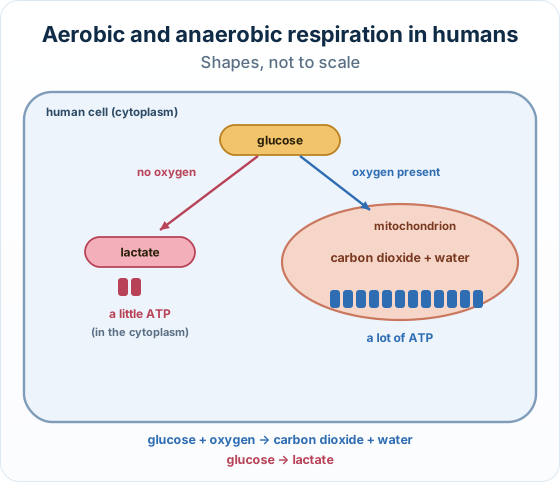
The points to remember
- Aerobic: glucose + oxygen → carbon dioxide + water; in the cytoplasm and mitochondria.
- Anaerobic (humans): glucose → lactate; in the cytoplasm only; no oxygen needed.
- Aerobic yields much more ATP per glucose than anaerobic.
- Aerobic can use glucose, fatty acids and other substrates; anaerobic uses only glucose (carbohydrate).
Remember it as: Oxygen and mitochondria: lots of ATP. No oxygen: lactate, a little ATP.
Real example: red blood cells. Mature red blood cells have no mitochondria, so they can only respire anaerobically. They convert glucose to lactate in the cytoplasm, even though they carry oxygen for the rest of the body.
Trap: Anaerobic respiration in humans makes no carbon dioxide. Carbon dioxide comes from aerobic respiration (and from yeast's anaerobic respiration).
Practice with exam-style questions
Answer exam-style questions and get AI feedback that shows you exactly what examiners want to see in a full-marks response.
How this is tested: Aerobic versus anaerobic respiration is tested in short recall items and in applied contexts. These are the usual forms.
The common formats
- Multiple choice, 1 mark: the product and location of anaerobic respiration in human cells. The answer is lactate, made in the cytoplasm.
- The contrast itself: state the waste products of aerobic versus anaerobic respiration, or identify what distinguishes the two (aerobic uses oxygen and yields far more ATP).
- Applied, muscle: how a muscle cell responds during intense exercise (oxygen runs low → anaerobic → lactate).
- Applied, bioethanol: how bioethanol is made (yeast respiring anaerobically → ethanol + CO₂).
Exam-style question — compare oxygen use, products and ATP yield
Compare aerobic and anaerobic respiration in human cells, referring to the use of oxygen, the products formed, and the amount of ATP released. [4]
Step by step
- Oxygen. Aerobic respiration uses oxygen, whereas anaerobic respiration takes place without oxygen.
- Products in human cells. Aerobic respiration produces carbon dioxide and water, whereas anaerobic respiration produces lactate.
- ATP yield. Aerobic respiration releases a lot of ATP per glucose, whereas anaerobic respiration releases only a little.
- Why. This is because with oxygen the glucose is fully broken down, releasing most of its energy.
Final answer
Aerobic uses oxygen, makes carbon dioxide + water and releases a lot of ATP; anaerobic uses no oxygen, makes lactate and releases only a little ATP — because without oxygen glucose is only partly broken down.
Why this works: A 'compare' answer needs each point set against its opposite — aerobic does X whereas anaerobic does Y.
Simply listing facts about one type (for example, only describing aerobic) is not a comparison, even if every fact is true.
| Organism | With oxygen (aerobic) | Without oxygen (anaerobic) |
|---|---|---|
| Human / animal muscle | carbon dioxide + water | lactate |
| Yeast (and plant cells) | carbon dioxide + water | ethanol + carbon dioxide |
Another question in the papers' style:
Distinguish between aerobic and anaerobic respiration in human muscle cells.
Model answer plan
See the answer broken into clear points, with guidance on how each point earns marks.