Measuring enzyme rates at Higher Level: The same statement as SL. HL data questions add inhibitors: you compare rates with and without them, read from graphs or tables.
Practise this as you read
- Calculate a rate from data.
- Justify a measurement and discuss the variables to control.
Free preview
This is the free notes preview
You're reading the free notes. Aimnova Pro unlocks the full study experience — and you can try it with your first topic free to keep:
- FlashcardsLock in vocabulary and key terms with spaced repetition.
- Practice questionsAnswer exam-style questions and get instant AI marking.
- Mock exams & past-paper vaultSit full mocks and see exactly how examiners award marks.
- Personalised study planA daily plan built around your exam date and weak areas.
The big idea: To study an enzyme you change one factor, keep everything else the same, and measure how fast the reaction goes.
Independent variable
- The factor you deliberately change
- For example temperature, pH or substrate concentration
Dependent variable
- What you measure
- Usually the rate of reaction
Controlled variables
- Every other factor that could affect the rate
- Must be held constant
- Without them the comparison is not fair
- Independent variable
- The one factor you deliberately change (e.g. temperature, pH, or substrate concentration).
- Dependent variable
- What you measure to see the effect — for an enzyme experiment this is usually the rate of reaction.
- Controlled variable
- A factor kept constant in every run so it does not affect the result and the comparison stays fair.
- Rate of reaction
- How fast substrate is used up or product is made — for example the amount of product formed per minute.
- Fair test
- An experiment in which only the independent variable changes, so any change in the result is due to that one factor.
How do you actually measure the rate?: You can't see an enzyme working, so you measure something that changes as the reaction happens, then time it. Whatever you choose must reliably reflect how much the enzyme has done: a valid measure (proxy) of enzyme activity.
Common choices
- The volume of gas released (e.g. oxygen bubbles)
- The colour change of an indicator
- The time for a substrate to disappear
- The amount of product formed
Why controls matter most: If you compare two runs at different temperatures and at different pH, you can't tell which factor caused the change.
Controlling every other variable is what makes the result trustworthy — data questions often ask you to discuss it.
Memorize terms 3x faster
Smart flashcards show you cards right before you forget them. Perfect for definitions and key concepts.
The big idea: The rate of an enzyme reaction is the amount of product made, or substrate used, per unit time. You can find it from your own experiment or from someone else's data.
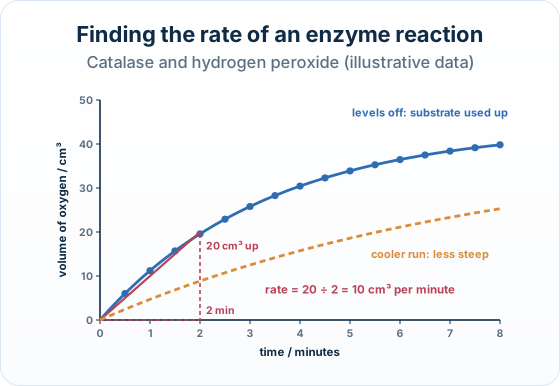
The points to remember
- Measure something that changes as the reaction happens: product formed or substrate used up.
- Rate = amount ÷ time, with units such as cm³ per minute.
- Use the steep start of the graph (the initial rate), before the substrate starts to run out.
- From secondary data, compare runs by their starting rates; a steeper start means a faster rate.
Remember it as: Rate = how much, how fast: amount ÷ time.
Real example: lipase and pH. When lipase digests fats, fatty acids are released and the pH falls. A pH probe or an indicator shows how fast the pH drops, which gives the rate of the reaction.
Trap: Do not use the flat end of the curve to compare rates. By then the substrate is used up, so every run looks the same.
How this is tested: Data questions on enzyme investigations are common, with short answers on methods.
| Type | What it can ask | What to give |
|---|---|---|
| Data question | A 2-mark Discuss: which variables must be controlled so a comparison (for example free versus immobilized enzyme) is fair. | Name them and say why. |
| Data question | A 3-mark Justify: why a chosen measurement (such as the amount of product released) is a valid measure of enzyme activity. | Why it reflects enzyme activity. |
| Short answer | A 1-mark State: one application of immobilized enzymes. | E.g. lactase for lactose-free milk. |
| Short answer | Outline how a practical method (low temperature, acid, wrapping) slows enzyme action. | How the method slows the enzyme. |
Exam-style question — variables to control in an enzyme investigation
A student compares how fast a free enzyme and an immobilized enzyme break down the same substrate. Discuss the variables that must be controlled so the comparison is valid. [2]
Step by step
- Name the variables to keep constant. Temperature, pH, substrate concentration, the amount (mass) of enzyme used, and the time the reaction is allowed to run must all be kept the same for both the free and the immobilized enzyme.
- Say why this matters. Each of these factors changes enzyme rate on its own, so if any of them differed between the two runs you could not tell whether a difference in rate was caused by immobilization or by the uncontrolled factor — keeping them constant makes the test fair.
Final answer
Keep temperature, pH, substrate concentration, amount of enzyme and reaction time the same for both — otherwise any difference in rate might be due to one of those factors rather than to immobilization, so the comparison would not be fair.
Why this works: The answer names the controlled variables and explains the purpose of controlling them (a fair, valid comparison).
A 'discuss' needs both halves: name the variables and give the reason.
| Variable | Why it changes enzyme rate | How to control it |
|---|---|---|
| Temperature | Higher temperature speeds the reaction up to the optimum, then denatures the enzyme | Use a water bath at one fixed temperature for every run |
| pH | Too acidic or too alkaline denatures the enzyme and slows the rate | Use the same buffer / pH in every run |
| Substrate concentration | More substrate gives a faster rate until the enzyme is saturated | Use the same starting substrate concentration each time |
| Amount of enzyme | More enzyme gives more active sites, so a faster rate | Use the same mass / volume of enzyme (or the same number of beads) |
| Time / reaction period | A longer time lets more product build up | Measure for the same length of time in every run |
Another question in the papers' style:
A gas syringe collected 24 cm³ of oxygen in the first 2 minutes of a catalase reaction. Calculate the initial rate of reaction, giving the units.
Model answer plan
See the answer broken into clear points, with guidance on how each point earns marks.