aımnova
DashboardMy LearningCrash CoursesStudy Plan

Aimnova site navigation

Stay in the loop

Get the latest study resources and updates

New features, study tips and exam insights — straight to your inbox.

IB Diploma

  • IB Past Papers
  • IB Study Notes
  • IB Question Bank
  • IB Mock Exams
  • IB Revision

IB Subjects

  • IB Math AA
  • IB Math AI
  • IB Economics
  • IB Business Management
  • IB Physics
  • IB Biology
  • View all IB subjects→

IB Past Papers

  • IB Math AA HL Past Papers
  • IB Math AA SL Past Papers
  • IB Math AI HL Past Papers
  • IB Math AI SL Past Papers
  • IB Economics HL Past Papers
  • IB Economics SL Past Papers
  • IB ESS Past Papers
  • View all past papers→

Study Resources

  • Study Notes
  • Question Bank
  • Mock Exams
  • Crash Courses
  • Flashcards
  • Revision Guide
  • Exam Skills
  • Command Terms
  • Grade Calculator
  • Exam Timetable 2026

Aimnova

  • Features
  • Pricing
  • For Teachers
  • For Schools
  • For Parents
  • About Us
  • Blog
  • Contact
aımnova

IB study, practice and feedback built around the real exam.

TermsPrivacyCookies·© 2026 Aimnova. All rights reserved.06bfe1b

Aimnova is not affiliated with or endorsed by the International Baccalaureate Organization (IB).

NotesBiology HLTopic 3.1Relationships between the structure of the active site, enzyme-substrate specificity and denaturation
Back to Biology HL Topics
3.1.73 min read

Relationships between the structure of the active site, enzyme-substrate specificity and denaturation (Biology HL)

IB Biology · Unit 3

Exam preparation

Practice the questions examiners actually ask

Our question bank mirrors real IB exam papers. Practice under timed conditions and track your progress across topics.

Start Practicing

Contents

  1. 1Specificity and denaturation at Higher Level
  2. 2Shape, specificity and denaturation
  3. 3Exam-style question (step by step)
Specificity and denaturation at Higher Level: The same statement as SL. HL long-answer questions join it to inhibitors: anything that changes the active site, heat, pH or an inhibitor binding elsewhere, changes activity.

Practise this as you read

  • Explain specificity and denaturation.
  • Explain the causes and consequences of changes to active sites.

Free preview

This is the free notes preview

You're reading the free notes. Aimnova Pro unlocks the full study experience — and you can try it with your first topic free to keep:

  • FlashcardsLock in vocabulary and key terms with spaced repetition.
  • Practice questionsAnswer exam-style questions and get instant AI marking.
  • Mock exams & past-paper vaultSit full mocks and see exactly how examiners award marks.
  • Personalised study planA daily plan built around your exam date and weak areas.
Start Studying Free Full access to Aimnova Pro · cancel anytime
The big idea: The shape and chemical properties of the active site make an enzyme specific. Anything that permanently changes that shape denatures the enzyme, and it stops working.
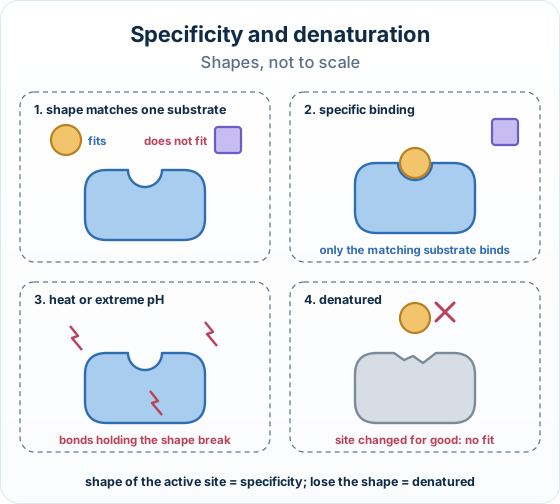
Four panels drawn step by step: an enzyme whose active site fits a round substrate but not a square one; the round substrate bound; heat or extreme pH breaking bonds in the enzyme; the enzyme with a misshapen active site that the substrate no longer fits
Specificity and denaturation, one step at a time.

The points to remember

  • Specificity: only a substrate whose shape and chemistry match the active site can bind.
  • The active site's shape is held by bonds between amino acids across the whole protein.
  • High temperature or extreme pH breaks these bonds, so the protein's shape changes.
  • Denaturation is a permanent change: the active site no longer fits the substrate, so activity is lost.
Remember it as: Shape gives specificity; lose the shape and the enzyme is denatured.

Real example: Taq polymerase. Most human enzymes begin to denature above about 45 °C. Taq polymerase, from bacteria in hot springs, keeps its shape at 95 °C, which is why it is used in PCR.

Trap: Never say enzymes are killed. Enzymes are molecules, not living things: they are denatured.

Know your predicted grade

Take timed mock exams and get detailed feedback on every answer. See exactly where you're losing marks.

Try Mock Exams FreeYour first topic is free to keep • No credit card required
How it is asked: Expect an explanation of why enzymes are specific, why they denature, or, at HL, a long answer on what changes active sites.
IB-style questionExplain[3 marks]

Explain how denaturation affects the activity of an enzyme.

Model answer plan

See the answer broken into clear points, with guidance on how each point earns marks.

Claim your free topic

IB Exam Questions on Relationships between the structure of the active site, enzyme-substrate specificity and denaturation

Practice with IB-style questions filtered to Topic 3.1.7. Get instant AI feedback on every answer.

Practice Topic 3.1.7 QuestionsBrowse All Biology HL Topics

How Relationships between the structure of the active site, enzyme-substrate specificity and denaturation Appears in IB Exams

Examiners use specific command terms when asking about this topic. Here's what to expect:

  • Define

    Give the precise meaning of key terms related to Relationships between the structure of the active site, enzyme-substrate specificity and denaturation.

    AO1
  • Describe

    Give a detailed account of processes or features in Relationships between the structure of the active site, enzyme-substrate specificity and denaturation.

    AO2
  • Explain

    Give reasons WHY — cause and effect within Relationships between the structure of the active site, enzyme-substrate specificity and denaturation.

    AO3
  • Evaluate

    Weigh strengths AND limitations of approaches in Relationships between the structure of the active site, enzyme-substrate specificity and denaturation.

    AO3
  • Discuss

    Present arguments FOR and AGAINST with a balanced conclusion.

    AO3

See the full IB Command Terms guide

Related Biology HL Topics

Continue learning with these related topics from the same unit:

3.1.1Enzymes as catalysts3.1.2Role of enzymes in metabolism3.1.3Anabolic and catabolic reactions3.1.4Enzymes as globular proteins with an active site for catalysis
View all Biology HL topics
Improve your exam techniqueCommand terms, paper structure, and mark-scheme tips for Biology HL
Previous3.1.6Role of molecular motion and substrate-active site collisions in enzyme catalysisNextEffects of temperature, pH and substrate concentration on the rate of enzyme activity3.1.8

10 practice questions on Relationships between the structure of the active site, enzyme-substrate specificity and denaturation

Students who practiced this topic on Aimnova scored 82% on average. Try free practice questions and get instant AI feedback.

Try 3 Free QuestionsView All Biology HL Topics