The big idea: The range of motion of a joint is the angle through which it can move. It is measured in degrees, in each direction the joint allows.
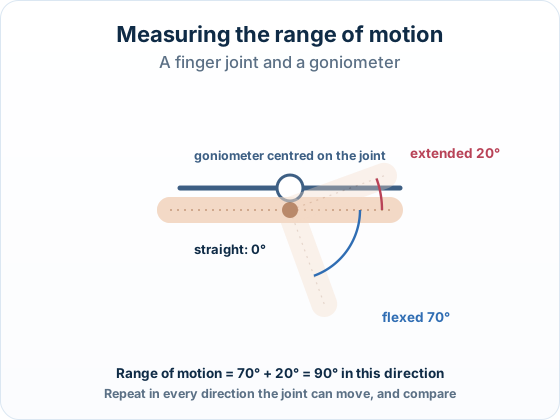
The points to remember
- Use a goniometer or a photo or video analysed on a computer or app (a protractor on an image).
- Line up the centre on the joint and an arm along each bone.
- Move the joint to its limit, then read the angle; straight counts as 0°.
- Repeat each reading, and measure the opposite direction too.
| Direction | Hip (ball and socket) | Knee (hinge) |
|---|---|---|
| Bending forwards (flexion) | about 120° | about 140° |
| Bending backwards (extension) | about 20° | about 0-5° |
| Out to the side | about 45° | almost none |
| Twisting (rotation) | about 45° each way | very little |
Remember it as: Centre on the joint, arms on the bones, straight = 0.
Real example: hip v knee. The hip moves in every direction, so its range is measured in several planes; the knee mostly bends one way, like a hinge.
Trap: A protractor alone cannot measure a living joint well: name a goniometer or computer analysis of images.
Free preview
This is the free notes preview
You're reading the free notes. Aimnova Pro unlocks the full study experience — and you can try it with your first topic free to keep:
- FlashcardsLock in vocabulary and key terms with spaced repetition.
- Practice questionsAnswer exam-style questions and get instant AI marking.
- Mock exams & past-paper vaultSit full mocks and see exactly how examiners award marks.
- Personalised study planA daily plan built around your exam date and weak areas.
The big idea: Joint-angle practicals are judged like any experiment: name the variable, read the graph, compare methods, and weigh up the design.
The points to remember
- The dependent variable is the joint angle; degrees is only its unit.
- On a box plot, the line is the median, the box the interquartile range; circles are outliers.
- Two methods agree when their medians and ranges are similar (box plots show medians, not means).
- A correlation coefficient near +1 (such as r = 0.8) is a strong positive correlation.
- Hypermobile joints bend backwards past straight, well beyond the normal range.
| Evaluate the design | Examples |
|---|---|
| Strengths | Large sample; several joints; variables controlled (same finger, healthy people); two methods compared |
| Limitations | Finger length or flexibility not taken into account; joint position judged by eye; one hand only |
Remember it as: Variable, graph, agreement, design.
Real example: diagnosis. Doctors judge hypermobility from how far joints, such as the little finger, bend backwards beyond the normal range.
Trap: When asked to evaluate the experiment, comment on its design (sample, controls, methods), not on what the results show.
Know your predicted grade
Take timed mock exams and get detailed feedback on every answer. See exactly where you're losing marks.
How it is asked: This is a practical: expect a data question on joint angles (variable, box plot or scatter graph, comparing methods, evaluating), and 'describe how to measure the range of motion'.
Measurements of the elbow show a smaller angle when the arm is straight than when it is bent. Explain this result.
Model answer plan
See the answer broken into clear points, with guidance on how each point earns marks.