A muscle's pull only becomes useful movement because of the skeleton it pulls on. Read this as a chain of structure → function.
Bones, tendons and joints
- Bones meet at a joint, which acts as a pivot.
- A muscle is joined to a bone by a tendon.
- When the muscle contracts, the bone turns about the joint — the limb works as a lever.
From pull to movement — the chain
- The muscle contracts and shortens.
- Its pull is carried to the bone by a tendon.
- The bone turns about the joint, which acts as a pivot.
- The limb works as a lever, so a small pull near the joint swings the far end through a much bigger movement.
- The antagonist later contracts to turn the bone back the other way.
Synovial joints — built for smooth movement: Freely moving joints (elbow, knee, hip, shoulder) are synovial joints. Each part has a job that keeps the movement smooth and safe.
| Part | Its job |
|---|---|
| Cartilage | Caps the bone ends and reduces friction. |
| Synovial fluid | Lubricates the joint so the surfaces slide. |
| Ligaments | Join bone to bone and stabilise the joint, holding it together and limiting it to safe movements. |
Don't confuse them: Ligaments join bone to bone; tendons join muscle to bone.
| Part of the joint | What it is | Its role in movement |
|---|---|---|
| Cartilage | A smooth layer capping the bone ends | REDUCES FRICTION between the bones and absorbs shock as they move |
| Synovial fluid | A slippery fluid inside the joint capsule | LUBRICATES the joint so the surfaces slide easily |
| Ligaments | Tough straps of tissue joining bone to bone | Hold the bones together and STABILISE the joint, limiting it to safe movements |
| Joint capsule | A sleeve enclosing the joint | Seals in the synovial fluid and supports the joint |
| Tendon | Cord joining MUSCLE to bone | Transmits the muscle's pull to the bone so the bone moves |
The shape of a joint sets how much and which way it can move. A hinge joint (elbow, knee) bends in one plane only; a ball-and-socket joint (hip, shoulder) moves in many directions and can rotate.
| Joint type | Examples | Range of movement |
|---|---|---|
| Hinge | Elbow, knee | Moves back and forth in ONE plane (bend / straighten only) — like a door hinge |
| Ball-and-socket | Hip, shoulder | Moves in MANY directions and can rotate — the rounded end sits in a cup |
The skeleton as a system of levers: Bones act as levers and joints act as pivots (fulcrums). A lever changes the range and force of a movement.
How the lever helps
- The muscle attaches close to the joint.
- So a short, strong pull is turned into a long, fast sweep of the far end of the limb.
- The same antagonistic muscles, working across different levers and joints, can produce a huge variety of controlled movements.
Free preview
This is the free notes preview
You're reading the free notes. Aimnova Pro unlocks the full study experience — and you can try it with your first topic free to keep:
- FlashcardsLock in vocabulary and key terms with spaced repetition.
- Practice questionsAnswer exam-style questions and get instant AI marking.
- Mock exams & past-paper vaultSit full mocks and see exactly how examiners award marks.
- Personalised study planA daily plan built around your exam date and weak areas.
The big idea: The hip is a synovial joint: the ball-shaped head of the femur turns in a socket in the pelvis. Every other part keeps that movement smooth, strong and controlled.
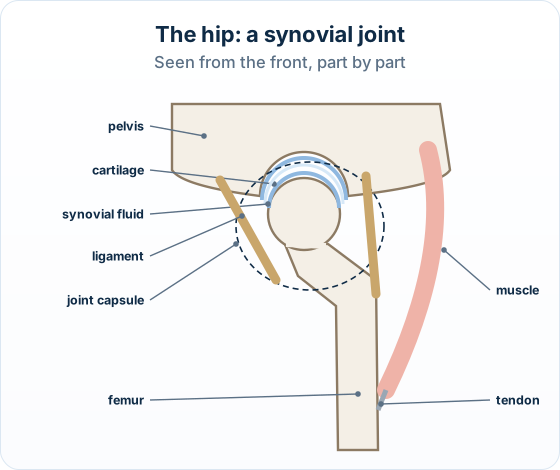
| Part | Its role in movement |
|---|---|
| Bones (femur, pelvis) | Rigid levers; the femur's head turns in the pelvis's socket |
| Cartilage | Smooth covering of the bone ends: reduces friction, absorbs shocks |
| Synovial fluid | Lubricates the joint, inside the joint capsule |
| Ligaments | Join bone to bone: hold the joint together, limit its movement |
| Muscles | Contract and pull on the bones, in antagonistic pairs |
| Tendons | Join muscle to bone: pass on the pull of contraction |
The points to remember
- Name the bones: the femur (thigh bone) and the pelvis (hip bone).
- Tendons transmit the force of contraction from muscle to bone.
- Ligaments stop the joint moving too far: loose ligaments mean loose joints.
Remember it as: Tendons: muscle to bone. Ligaments: bone to bone.
Real example: loose joints. In Ehlers-Danlos syndrome, faulty collagen makes the ligaments looser, so joints such as the fingers bend well beyond the normal range.
Trap: On a hip diagram, the socket belongs to the pelvis and the ball to the femur. A strap from bone to bone is a ligament, never a tendon.
Stop wasting time on topics you know
Our AI identifies your weak areas and focuses your study time where it matters. No more overstudying easy topics.
How it is asked: Expect a labelled hip to name (femur, pelvis, ligament), a 'role of a structure' item, or a short outline of the roles of the parts of a synovial joint.
Outline the roles of three structures at the hip joint in allowing a dancer to raise a leg smoothly.
Model answer plan
See the answer broken into clear points, with guidance on how each point earns marks.