The big idea: Muscles can only pull, so they need something rigid to pull on. That is the job of the skeleton: it anchors the muscles and acts as a set of levers.
The points to remember
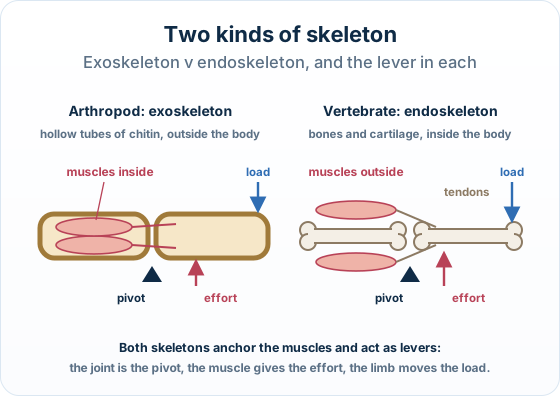
- Arthropods (insects, crabs, spiders) have an exoskeleton: a hard outer case made of chitin.
- Their muscles are inside the skeleton, anchored to its inner surface.
- Vertebrates have an endoskeleton of bone and cartilage inside the body.
- Their muscles are outside the bones, anchored to them by tendons.
- In both, a muscle is anchored on each side of a joint, so contracting it moves one part.
| Arthropod | Vertebrate | |
|---|---|---|
| Skeleton | Exoskeleton (outside) | Endoskeleton (inside) |
| Made of | Chitin | Bone and cartilage |
| Muscles | Inside the skeleton | Outside the bones, joined by tendons |
Remember it as: Exo: muscles in. Endo: muscles out.
Real example: a crab and a human. A crab's claw muscles fill the inside of its hard shell and pull on its inner surface; your biceps lies outside your arm bones and pulls on them through a tendon.
Trap: Each mark in a 'distinguish' answer needs both animals: 'arthropods have an exoskeleton, whereas vertebrates have an endoskeleton'.
Free preview
This is the free notes preview
You're reading the free notes. Aimnova Pro unlocks the full study experience — and you can try it with your first topic free to keep:
- FlashcardsLock in vocabulary and key terms with spaced repetition.
- Practice questionsAnswer exam-style questions and get instant AI marking.
- Mock exams & past-paper vaultSit full mocks and see exactly how examiners award marks.
- Personalised study planA daily plan built around your exam date and weak areas.
The big idea: A limb works as a lever: a rigid bar that turns about a pivot.
The points to remember
- The joint is the pivot: the point the limb turns about.
- The contracting muscle gives the effort, pulling on the skeleton near the joint.
- The far end of the limb moves the load, such as a foot pushing off or a weight in the hand.
- Because the muscle pulls close to the pivot, a short pull swings the end of the limb a long way, and fast.
- The rigid skeleton also gives each muscle a fixed anchor, so its pull moves the limb, not itself.
| Part of the lever | Human forearm | Locust hind leg |
|---|---|---|
| Pivot | Elbow joint | Knee joint |
| Effort | Biceps pulling on the forearm | Extensor muscle inside the femur pulling on the tibia |
| Load | Weight in the hand | The ground, as the leg pushes off to jump |
Remember it as: Joint = pivot, muscle = effort, end of the limb = load.
Real example: lifting a cup. The biceps is attached to the forearm only a few centimetres from the elbow, so as it shortens a little, your hand rises several times further.
Trap: The joint is the pivot, not the muscle. The muscle is the effort.
Get feedback like a real examiner
Submit your answers and get instant feedback — what you did well, what's missing, and exactly what to write to score full marks.
How it is asked: Expect 'distinguish between the skeletons of arthropods and vertebrates', and questions that name the pivot, effort and load of a limb.
Distinguish between the skeleton of a locust and the skeleton of a frog.
Model answer plan
See the answer broken into clear points, with guidance on how each point earns marks.