The big idea: Titin is an immense, elastic protein in every sarcomere. It works like a spring: it lets a relaxed muscle be stretched, then pulls it back.
The points to remember
- Titin is the largest protein in the body: one chain of over 34 000 amino acids.
- It joins each Z-disc to the myosin, holding the myosin in the centre of the sarcomere.
- When a relaxed muscle is stretched, titin is pulled out and stores potential energy.
- It resists further stretching, so the sarcomere is not overstretched.
- When the stretching stops, titin recoils, returning the sarcomere to its resting length.
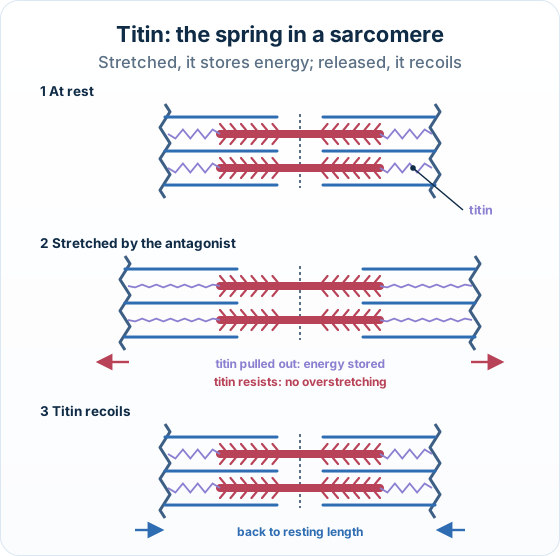
Remember it as: Titin: stretch, store, stop, spring back.
Real example: the heart. Faults in the titin gene (TTN) are the most common genetic cause of dilated cardiomyopathy, in which the heart's chambers become enlarged and the muscle pumps weakly.
Trap: Titin does not contract and uses no ATP. Its recoil is passive, like a stretched spring.
Free preview
This is the free notes preview
You're reading the free notes. Aimnova Pro unlocks the full study experience — and you can try it with your first topic free to keep:
- FlashcardsLock in vocabulary and key terms with spaced repetition.
- Practice questionsAnswer exam-style questions and get instant AI marking.
- Mock exams & past-paper vaultSit full mocks and see exactly how examiners award marks.
- Personalised study planA daily plan built around your exam date and weak areas.
The big idea: A muscle has only one trick: it can contract (pull). It cannot push, so muscles work in antagonistic pairs.
Why muscles need a partner
- When a muscle relaxes it just goes slack — it cannot push.
- So a single muscle could bend a joint, but it could never straighten it again.
- The fix is an antagonistic pair: two muscles on opposite sides of a joint.
- One contracts to make a movement; the other contracts to reverse it.
- While one pulls, its partner relaxes and is stretched ready for next time.
- The classic pair is the biceps and triceps at the elbow.
| Biceps | Triceps | |
|---|---|---|
| Where it sits | Front of the upper arm | Back of the upper arm |
| What it does to the elbow | FLEXES it — bends the arm (forearm comes up) | EXTENDS it — straightens the arm (forearm goes down) |
| To bend the arm | Contracts (pulls the forearm up) | Relaxes (is stretched) |
| To straighten the arm | Relaxes (is stretched) | Contracts (pulls the forearm down) |
| Term for the muscle that pulls | Agonist (the one contracting) | Antagonist (the one relaxing) |
- Antagonistic pair
- Two muscles on opposite sides of a joint with opposite actions — when one contracts, the other relaxes, and they swap to reverse the movement.
- Flexion / flexor
- Bending a joint (decreasing the angle). The biceps is the flexor at the elbow.
- Extension / extensor
- Straightening a joint (increasing the angle). The triceps is the extensor at the elbow.
- Agonist
- The muscle that contracts to produce a particular movement.
- Antagonist
- The muscle that relaxes (and is stretched) while the agonist contracts.
Why one muscle is never enough: Because a muscle can only pull, it can only move a bone in one direction.
To move the bone back, you need a second muscle pulling the other way — its antagonist.
An easy way to remember: Muscles are like tug-of-war partners on opposite ends of the rope — only one team pulls at a time, and the bone moves towards whoever is pulling.
Relaxing is not lengthening: When a muscle relaxes it stops pulling, but it cannot lengthen itself. Its antagonist contracts and stretches it. Inside its sarcomeres, titin stores the energy of that stretch, stops it going too far, and helps the muscle recoil.
Study smarter, not longer
Most students waste 40% of study time on topics they already know. Our AI tracks your progress and optimizes every minute.
How this is tested: A common ask is to explain why skeletal muscles must work in antagonistic pairs. The key point: a muscle can only pull, so a second muscle is needed to reverse the movement (one contracts while the other relaxes).
Other ways this topic is asked
- Outline the roles of the parts of a synovial joint (cartilage reduces friction; synovial fluid lubricates; ligaments stabilise).
- Compare a hinge joint with a ball-and-socket joint (range of movement).
- A 'diversity of movement' part may want a named example (e.g. insect flight, fish swimming) showing the same muscle–skeleton principle adapted to a different medium.
Exam-style question — explain antagonistic muscle action at the elbow
Explain how the biceps and triceps act as an antagonistic pair to bend and then straighten the arm at the elbow. [5]
How to score all five marks
- A muscle can only pull. A muscle produces force only by contracting (pulling); it cannot push, so one muscle alone cannot move the joint both ways.
- Bending the arm. To flex (bend) the elbow, the biceps contracts and pulls the forearm up; at the same time the triceps relaxes and is stretched.
- Straightening the arm. To extend (straighten) the elbow, the roles swap: the triceps contracts and pulls the forearm down while the biceps relaxes.
- Why a PAIR is needed. Because each muscle pulls in only one direction, a second muscle pulling the opposite way is needed to reverse the movement — they are an antagonistic pair.
- The joint and lever. The forearm turns about the elbow joint (the pivot), acting as a lever, so the muscle's pull becomes a large, controlled movement of the hand.
Final answer
Muscles can only pull, not push, so two are needed. To bend the elbow the biceps contracts and the triceps relaxes (is stretched); to straighten it the triceps contracts and the biceps relaxes. They are an antagonistic pair because each pulls the bone the opposite way. The forearm turns about the elbow joint as a lever, converting the pull into movement.
Why this scores full marks: It states the cause (a muscle can only pull), gives both halves of the cycle (biceps contracts / triceps relaxes, then the reverse), names the pair as antagonistic, and links it to the joint acting as a pivot/lever.
A common way to lose marks: Describing only the bending half. To score full marks you must also explain how the arm is straightened again.
| Animal / movement | Medium | How the muscle–skeleton system is used |
|---|---|---|
| Human walking / running | Land | Leg muscles pull on bones acting as LEVERS at the hip, knee and ankle to swing the limbs |
| Locust / insect flight | Air | Antagonistic flight muscles in the thorax contract in turn to beat the wings up and down |
| Fish swimming | Water | Blocks of muscle along the body contract alternately on each side, bending the body to push against the water |
A 2-mark Explain about titin, in the papers' style:
Explain the role of titin in the relaxation of a sprinter's thigh muscle between strides.
Model answer plan
See the answer broken into clear points, with guidance on how each point earns marks.