The big idea: Movement is a feature of every living thing. What differs is what moves: the whole organism, or only parts of it.
The points to remember
- Motile organisms move their whole body from place to place: this is locomotion.
- Sessile organisms stay fixed in one place, but they still move parts of their body.
- Plants are sessile, yet leaves and stems move: shoots bend towards light; Mimosa leaflets fold when touched.
- Inside every cell things move: cytoplasm streams, vesicles are carried, chromosomes are pulled apart.
- Many single cells swim: bacteria turn a flagellum; sperm beat a tail.
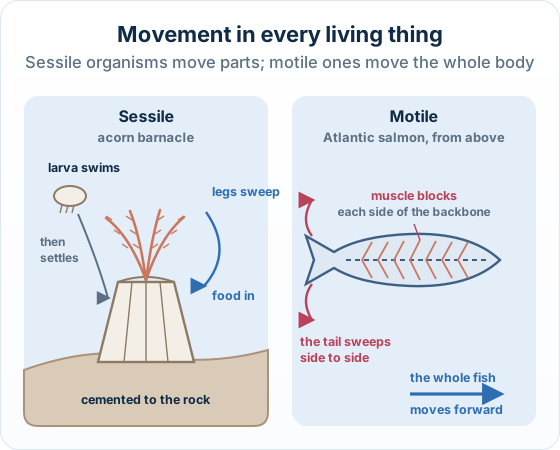
Sessile
- Fixed to one place as an adult
- Moves parts: tentacles, legs, leaves
- Often a motile larva spreads the species
- Examples: barnacles, corals, sea anemones, plants
Motile
- Moves the whole body from place to place
- Uses muscles pulling on a skeleton, or flagella and cilia
- Can reach food, mates and safety
- Examples: salmon, birds, insects, humans
Remember it as: Sessile moves parts; motile moves the whole body.
Real example: the acorn barnacle. On North Atlantic rocky shores, acorn barnacles are cemented to the rock for life. When the tide covers them, they open their shell plates and sweep feathery legs through the water to catch plankton.
Trap: Sessile does not mean no movement. A sessile organism moves parts of its body, and many have a stage of their life cycle that swims.
Free preview
This is the free notes preview
You're reading the free notes. Aimnova Pro unlocks the full study experience — and you can try it with your first topic free to keep:
- FlashcardsLock in vocabulary and key terms with spaced repetition.
- Practice questionsAnswer exam-style questions and get instant AI marking.
- Mock exams & past-paper vaultSit full mocks and see exactly how examiners award marks.
- Personalised study planA daily plan built around your exam date and weak areas.
The big idea: Animals move because muscles pull on a skeleton. Here is the catch that shapes the whole topic: a muscle can only do one thing. It can contract (shorten) and pull.
Why muscles work in pairs
- A muscle cannot push, and it cannot make itself longer again.
- So to move a bone back and forth, you need two muscles arranged on opposite sides of a joint.
- One pulls the bone one way; the other pulls it back.
- A pair that works like this is called an antagonistic pair.
- Muscle
- A tissue that produces movement by contracting — it can shorten and pull, but it cannot push or actively lengthen itself.
- Skeleton
- The framework of bones (or hard exoskeleton in insects) that muscles pull on; it anchors muscles and acts as a system of levers.
- Joint
- Where two bones meet and can move relative to each other — the pivot point of the lever.
- Antagonistic pair
- Two muscles on opposite sides of a joint with opposite effects — one bends the joint, the other straightens it.
- Tendon
- Tough connective tissue that attaches a muscle to a bone, so the muscle's pull moves the bone.
- Ligament
- Connective tissue that joins bone to bone and holds a joint together.
A muscle is a one-way machine: Picture pulling a door open with a rope. The rope can pull the door towards you, but you can't push the door shut with the same rope — you need a rope on the other side.
Muscles are exactly the same: one to pull the bone one way, an antagonist to pull it back.
Never wonder what to study next
Get a personalized daily plan based on your exam date, progress, and weak areas. We'll tell you exactly what to review each day.
The clearest example is your elbow. The biceps (front of the upper arm) and the triceps (back) form an antagonistic pair.
Read it as cause and effect
Biceps contracts
It pulls the forearm up, bending the elbow.
Triceps is stretched
Bending the elbow stretches the relaxed triceps.
Triceps contracts
To straighten the arm again, the triceps pulls the forearm back down.
Biceps is stretched
Straightening the arm stretches the now-relaxed biceps.
Neither muscle can reverse its own movement — only its partner can.
Bending then straightening the elbow
- Biceps contracts, triceps relaxes → the forearm is pulled up, the elbow bends (flexes).
- Bending the elbow stretches the relaxed triceps, getting it ready to pull the other way.
- Triceps contracts, biceps relaxes → the forearm is pulled back down, the elbow straightens (extends).
- Straightening the elbow stretches the relaxed biceps again — the pair has reset.
| Biceps | Triceps | |
|---|---|---|
| Position | Front of the upper arm | Back of the upper arm |
| What it does when it CONTRACTS | Pulls the forearm up → BENDS (flexes) the elbow | Pulls the forearm back → STRAIGHTENS (extends) the elbow |
| State during that movement | Contracting (shortening) | Relaxed (lengthened) |
| Role name | Flexor | Extensor |
The skeleton is a system of levers: A muscle's pull would be useless without something to pull on. The skeleton provides anchorage and acts as a system of levers.
| Part of the lever | At the elbow |
|---|---|
| Lever (rigid bar) | The forearm bone |
| Pivot (fulcrum) | The elbow |
| Effort (the pull) | The biceps |
| Load | Whatever is in your hand |
Why levers help: A small contraction near the joint swings the far end of the bone a long way, so muscles trade force for a bigger, faster movement of the limb.
| Tissue | What it joins | Why it matters |
|---|---|---|
| Tendon | Muscle → bone | Transmits the muscle's pull to the bone so the bone moves; tough and barely stretchy, so no pull is wasted |
| Ligament | Bone → bone | Holds a joint together and limits how far it can move, keeping the lever stable |
Adaptations for movement — different animals, same logic
- Human limb: bones as levers, muscles in antagonistic pairs at each joint (biceps/triceps at the elbow), letting us flex and extend with precision.
- Insect flight: flight muscles inside the thorax pull on the rigid exoskeleton; some act on antagonistic principles to raise and lower the wings rapidly.
- Fish swimming: blocks of muscle down each side of the body contract alternately, bending the body left then right against the backbone to push the fish forward.
The same rule everywhere: Different bodies, but the same rule everywhere: muscles pull on a skeleton, in opposing groups.
Where does that pull actually come from? Keep zooming into a muscle and you find the machinery the rest of this topic studies: a whole muscle is a bundle of muscle fibres (cells); each fibre is packed with myofibrils; each myofibril is a chain of sarcomeres — and the sarcomere is the unit that actually shortens.
| Level | What it is | Scale |
|---|---|---|
| Whole muscle | A bundle of many muscle fibres, wrapped in connective tissue and attached to bone by tendons (e.g. the biceps) | centimetres |
| Muscle fibre | A single muscle cell — long, multinucleate, packed with myofibrils | tens of micrometres wide |
| Myofibril | A long thread running the length of the fibre, made of sarcomeres joined end to end | ~1 micrometre wide |
| Sarcomere | The repeating CONTRACTILE UNIT — overlapping actin and myosin filaments between two Z-discs | ~2 micrometres long |
Keep zooming into a muscle — whole muscle → muscle fibre (cell) → myofibril → SARCOMERE — and you reach the contractile unit: overlapping thin (actin) and thick (myosin) filaments between two Z-discs. When it shortens, the muscle pulls.
Interactive diagram
Explore the labelled diagram, charts and maps for this topic in full study mode.
Why the levels matter: The sarcomere is the contractile unit: the smallest part that can shorten. When millions of sarcomeres shorten in series along every myofibril, the whole muscle shortens and pulls on its tendon.
What this micro builds: So everything in this topic (actin, myosin, calcium, ATP) is really about how one sarcomere shortens. This page builds the scaffold: muscle pulls, on a skeleton, in antagonistic pairs, made of sarcomeres.
How this is tested: Movement questions ask you to compare a motile and a sessile organism, or to explain how muscles pulling on a skeleton move an animal.
Where the marks live: The marks live in the logic: a muscle only pulls / cannot push, so a second muscle on the opposite side is needed to reverse the movement.
Other ways it is tested
- Outline how a named joint moves (e.g. the elbow): name the flexor and extensor, and state which contracts and which relaxes for each movement.
- In that outline, mention the tendon (muscle→bone) and the skeleton acting as a lever.
- A multiple-choice item may test the difference between a tendon and a ligament, or which muscle is contracting during a given movement.
Exam-style question — why antagonistic pairs are needed
Explain why skeletal muscles must work in antagonistic pairs to move a limb at a joint. Use the elbow as an example. [4]
How to score all four marks
- A muscle can only pull. A muscle produces movement by contracting (shortening); it cannot push or actively lengthen itself, so on its own it can move a bone in only one direction.
- One muscle bends the joint. At the elbow, when the biceps contracts it pulls the forearm up, bending (flexing) the joint — and this stretches the relaxed triceps.
- The partner reverses it. Because the biceps cannot push the arm back, the triceps (its antagonist on the opposite side) must contract to pull the forearm back down, straightening (extending) the joint and stretching the biceps.
- Conclusion. Two muscles with opposite effects are therefore needed so the limb can be moved both ways — this is what 'antagonistic pair' means.
Final answer
A muscle can only contract and pull, not push, so it can move a bone in one direction only. The biceps contracting bends the elbow; to straighten it again the triceps (its antagonist) must contract, because the biceps cannot push the arm back. Two muscles with opposite effects (an antagonistic pair) are needed to move the limb both ways.
Why this scores full marks: It states the key limitation (a muscle only pulls / cannot push), names both muscles of the pair and what each does, and finishes with the reason: opposite effects let the limb move in both directions.
A common way to lose marks: A frequent way to lose marks is to describe only the biceps bending the arm without explaining why a second muscle is needed to straighten it again.
Every level of a muscle exists to deliver one job — a PULL. The sarcomere (between the Z-discs) is where that pull is generated; millions of them in series shorten the whole muscle.
Interactive diagram
Explore the labelled diagram, charts and maps for this topic in full study mode.
A 3-mark Compare and contrast, in the papers' style:
Compare and contrast movement in a sessile organism and a motile organism, using a named example of each.
Model answer plan
See the answer broken into clear points, with guidance on how each point earns marks.