The big idea: Plants make sugar in their leaves by photosynthesis, but the sugar is needed everywhere — in growing roots, in flowers, in fruits and in stores.
Key terms
- The tissue that carries this sugar around the plant is the phloem
- The movement of dissolved sugar through it is called translocation
- Translocation always runs from a source (where sugar is made or released) to a sink (where sugar is used or stored)
Translocation in the phloem: sugar made at a SOURCE (leaf) is actively loaded into the sieve tube, water follows by osmosis, and the high pressure pushes the sugary sap by bulk flow to a SINK (root or fruit), where the sugar is unloaded.
Interactive diagram
Explore the labelled diagram, charts and maps for this topic in full study mode.
- Phloem
- The plant transport tissue that carries dissolved sugars (and some amino acids) around the plant. Its conducting cells are living sieve tubes.
- Translocation
- The movement of dissolved organic compounds — mainly the sugar sucrose — through the phloem from a source to a sink.
- Source
- Any part of the plant that makes or releases sugar — most often a photosynthesising leaf, but also a store such as a potato in spring.
- Sink
- Any part of the plant that uses or stores sugar — for example a growing root, a developing fruit or a store being built up.
- Sieve tube
- The long, living tube of cells, joined end to end through sieve plates, that the sap flows along inside the phloem.
Source and sink can swap: A part of the plant is not always a source or always a sink. A potato tuber shows this.
Summer: the tuber is a sink
- Sugar flows in
- It is stored as starch
Spring: the tuber is a source
- The new shoot grows
- The store is broken down and the sugar flows out
Up or down the plant: That is why translocation can run up or down the plant. It always goes from wherever sugar is high (source) to wherever it is needed (sink).
Free preview
This is the free notes preview
You're reading the free notes. Aimnova Pro unlocks the full study experience — and you can try it with your first topic free to keep:
- FlashcardsLock in vocabulary and key terms with spaced repetition.
- Practice questionsAnswer exam-style questions and get instant AI marking.
- Mock exams & past-paper vaultSit full mocks and see exactly how examiners award marks.
- Personalised study planA daily plan built around your exam date and weak areas.
Sugar does not just drift along the phloem — the plant has to load it in at the source and then push the sap along to the sink.
There are four steps. The key idea: the plant spends energy to load the sugar, and the water and pressure then do the moving.
The four steps of translocation
- Loading at the source. Sugar is moved into the sieve tube by active transport — this uses energy (ATP) supplied by the companion cell.
- Water follows. The high sugar concentration makes water move into the sieve tube by osmosis, from the nearby xylem.
- Pressure builds → bulk flow. The extra water raises the pressure at the source end, so the whole column of sap is pushed along — this mass movement is called bulk flow.
- Unloading at the sink. At the sink the sugar is removed (used in respiration, growth, or stored as starch), water leaves too, and the pressure drops — keeping the sap flowing towards the sink.
Why loading needs energy: Loading sugar into the sieve tube is active transport, so it needs ATP.
The companion cell does the work
- The companion cell is packed with mitochondria
- It does the energy-hungry work of pumping sugar into the sieve tube, which has lost most of its own contents
- That is why phloem is described as living tissue
- And why translocation stops if the cells are killed — unlike water transport in the dead xylem
Sieve tube structure follows its job: Each conducting cell is a sieve tube, built for flow. These features are exactly what the exam asks you to identify.
Sieve tube features
- The end walls are sieve plates full of pores, so sap passes from cell to cell
- The cell has little cytoplasm and no nucleus at maturity, leaving a clear channel
- A companion cell alongside keeps it alive and loads the sugar
| Feature of a phloem sieve tube | What it is | Why it helps translocation |
|---|---|---|
| Sieve plates with pores | Perforated end walls between sieve tube cells | Sugary sap can flow from one cell to the next along the tube |
| Little cytoplasm, no nucleus at maturity | The mature sieve tube cell loses most of its contents | Leaves a clear, open channel so sap flows with little resistance |
| Living companion cell alongside | A neighbouring cell packed with mitochondria and a nucleus | Keeps the sieve tube alive and supplies the energy to load sugar |
| Continuous columns of cells | Sieve tube cells joined end to end into long tubes | Forms an unbroken pathway from source to sink |
At the SOURCE
- Sugar is loaded in by active transport
- Uses energy (ATP) from the companion cell
- Water follows by osmosis
- Pressure rises → sap is pushed out
At the SINK
- Sugar is unloaded and used or stored
- Stored as starch or used in respiration/growth
- Water leaves the sieve tube
- Pressure falls → sap keeps flowing in
An easy way to remember: Load, follow, flow, unload. Sugar is loaded at the source, water follows in, pressure drives bulk flow, and sugar is unloaded at the sink.
The sugar moves because of pressure, not because the plant pumps the sap directly.
Get feedback like a real examiner
Submit your answers and get instant feedback — what you did well, what's missing, and exactly what to write to score full marks.
The big idea: A sieve tube element is built for flow; its companion cell is built for work. Plasmodesmata link the two.
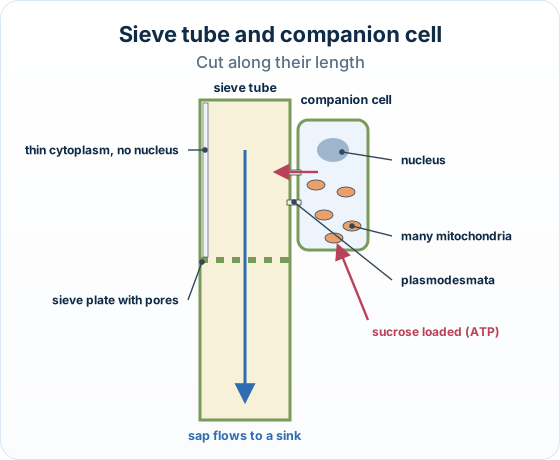
Sieve tube element
- Sieve plates with pores at each end
- Thin cytoplasm, few organelles
- No nucleus at maturity
- Open channel: sap flows easily
Companion cell
- Has a nucleus and dense cytoplasm
- Many mitochondria: ATP for active transport
- Loads sucrose at sources, unloads at sinks
- Keeps the sieve tube element alive
The points to remember
- Plasmodesmata are channels through the cell walls that join the companion cell to the sieve tube element.
- At a source, the companion cell actively loads sucrose; it passes through the plasmodesmata into the sieve tube.
- At a sink, sucrose is unloaded from the sieve tube, for use or storage.
Remember it as: Sieve tube: open pipe. Companion cell: power station. Plasmodesmata: the doors.
Real example: aphids. An aphid pushes its mouthparts into a single sieve tube; the pressure of the sap then forces it into the insect. Cut-off aphid mouthparts are used by scientists to collect pure phloem sap.
Trap: The mitochondria are in the companion cell, not the sieve tube element; the sieve tube element has reduced cytoplasm, not the companion cell.
How this is tested: Phloem questions ask you to identify sieve-tube features, describe translocation, or interpret transport data.
What the questions ask
- One mark: identify a structural feature of a phloem sieve tube cell — for example sieve plates with pores, or the companion cell that keeps it alive
- Outline or Explain: describe translocation — sugar actively loaded at a source, water following, and bulk flow of sap to a sink
- Data favourite: a result from a ringing experiment or a tracer / aphid-stylet study
- You deduce from it that sugar is moving in the living phloem
Exam-style question — identify sieve tube features
State two structural features of a phloem sieve tube cell and, for each, explain how it helps the cell transport sugar. [4]
How to score all four marks
- Feature 1 — sieve plates. The end walls are sieve plates with pores. Why it helps: the sugary sap can flow from one cell to the next along the tube without a solid wall blocking it.
- Feature 2 — companion cell. Each sieve tube has a living companion cell alongside it, packed with mitochondria. Why it helps: it supplies the energy (ATP) to load sugar into the sieve tube and keeps the sieve tube alive.
Final answer
Sieve plates with pores let sap flow from cell to cell; the companion cell supplies the energy to load sugar and keeps the sieve tube alive.
Why this scores full marks: Each feature is named AND linked to its job — that is what an 'explain how it helps' question wants.
Simply listing 'sieve plates, companion cell, no nucleus' with no explanation would only earn the identification marks, not the full four.
Translocation in the phloem: sugar made at a SOURCE (leaf) is actively loaded into the sieve tube, water follows by osmosis, and the high pressure pushes the sugary sap by bulk flow to a SINK (root or fruit), where the sugar is unloaded.
Interactive diagram
Explore the labelled diagram, charts and maps for this topic in full study mode.
A 1-mark item, in the papers' style:
How are phloem tissues adapted for transport?
Model answer plan
See the answer broken into clear points, with guidance on how each point earns marks.