aımnova
DashboardMy LearningCrash CoursesStudy Plan

Aimnova site navigation

Stay in the loop

Get the latest study resources and updates

New features, study tips and exam insights — straight to your inbox.

IB Diploma

  • IB Past Papers
  • IB Study Notes
  • IB Question Bank
  • IB Mock Exams
  • IB Revision

IB Subjects

  • IB Math AA
  • IB Math AI
  • IB Economics
  • IB Business Management
  • IB Physics
  • IB Biology
  • View all IB subjects→

IB Past Papers

  • IB Math AA HL Past Papers
  • IB Math AA SL Past Papers
  • IB Math AI HL Past Papers
  • IB Math AI SL Past Papers
  • IB Economics HL Past Papers
  • IB Economics SL Past Papers
  • IB ESS Past Papers
  • View all past papers→

Study Resources

  • Study Notes
  • Question Bank
  • Mock Exams
  • Crash Courses
  • Flashcards
  • Revision Guide
  • Exam Skills
  • Command Terms
  • Grade Calculator
  • Exam Timetable 2026

Aimnova

  • Features
  • Pricing
  • For Teachers
  • For Schools
  • For Parents
  • About Us
  • Blog
  • Contact
aımnova

IB study, practice and feedback built around the real exam.

TermsPrivacyCookies·© 2026 Aimnova. All rights reserved.c90f7ab

Aimnova is not affiliated with or endorsed by the International Baccalaureate Organization (IB).

NotesBiology HLTopic 2.7Adaptations of xylem vessels for transport of water
Back to Biology HL Topics
2.7.84 min read

Adaptations of xylem vessels for transport of water (Biology HL)

IB Biology · Unit 2

Smart study tools

Turn reading into results

Move beyond passive notes. Answer exam-style questions, get AI feedback, and build the skills that earn top marks.

Get Started Free

Contents

  1. 1Xylem vessels at Higher Level
  2. 2Built for water transport
  3. 3Exam-style question (step by step)
Xylem vessels at Higher Level: The same statement as SL. HL papers also ask how xylem supports the plant, and link the polar walls to adhesion and capillary action.

Practise this as you read

  • Outline two adaptations of xylem vessels for water transport.
  • Explain the adaptations of xylem for support and transport.

Free preview

This is the free notes preview

You're reading the free notes. Aimnova Pro unlocks the full study experience — and you can try it with your first topic free to keep:

  • FlashcardsLock in vocabulary and key terms with spaced repetition.
  • Practice questionsAnswer exam-style questions and get instant AI marking.
  • Mock exams & past-paper vaultSit full mocks and see exactly how examiners award marks.
  • Personalised study planA daily plan built around your exam date and weak areas.
Start Studying Free Full access to Aimnova Pro · cancel anytime
The big idea: A xylem vessel is a long, hollow, lignified tube of dead cells: water flows through it unimpeded, and the walls do not collapse under tension.

This only works because the xylem is built for the job. The pulling force (tension) is strong enough to collapse an ordinary tube, so xylem vessels are specially adapted.

How xylem vessels are adapted

  • Dead, hollow cells stacked end to end
  • The end walls are removed, so they form one long continuous pipe with nothing blocking the flow
  • Walls thickened with lignin (they are lignified) keep the vessel strong, so it does not collapse under the tension of the water column
  • Their narrow diameter helps keep the water column continuous
Xylem adaptationWhat it isWhy it helps water transport
Hollow, dead cellsThe cells lose their contents and die, leaving an empty tubeWater flows through with nothing blocking the way
No end wallsThe end walls between stacked cells break downThe cells join into one long, continuous pipe from root to leaf
Lignified wallsThe walls are thickened and strengthened with ligninThe vessel does not collapse under the tension (pull) of the water column
Narrow diameterEach vessel is a thin tubeHelps the water column stay continuous and supports cohesion

The points to remember

  • No cell contents: nothing gets in the way of the flow.
  • No end walls (or incomplete ones): one continuous tube from root to leaf.
  • Lignified walls: strong enough to withstand the tension without collapsing.
  • Pits: thin, unlignified patches that let water enter and leave sideways.
  • Walls are polar, so water adheres to them; a narrow tube helps capillary action.
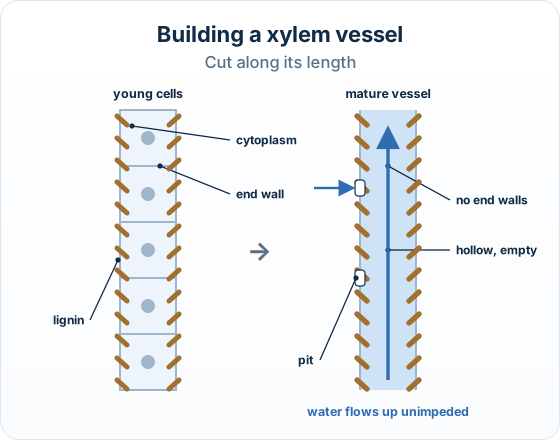
A xylem vessel built step by step: a column of living cells with end walls, lignin laid in the walls, contents and end walls gone leaving a hollow tube, pits in the wall, and water flowing up
From living cells to a hollow, lignified tube.
Remember it as: Empty, endless, strong, with doors: no contents, no end walls, lignin, pits.

Real example: growth rings. Each ring in a cut tree trunk is a year's new xylem: wide vessels grown in spring, narrow ones in summer. Counting the rings gives the age of the tree.

Two traps: Each adaptation needs its reason: 'lignified walls' alone does not score; 'lignified walls withstand tension' does.

It is lignin, not cellulose, that stops the vessel collapsing.

See how examiners mark answers

Answer exam-style questions with model answers. Learn exactly what earns marks and what doesn't.

Try Exam Vault FreeYour first topic is free to keep • No credit card required
How it is asked: Expect 'outline two adaptations of xylem vessels', often beside a micrograph of xylem, or 'explain the adaptations of xylem for its functions'.
IB-style questionExplain[3 marks]

Xylem supports a plant and transports water and minerals. Explain the adaptations of xylem for its functions.

Model answer plan

See the answer broken into clear points, with guidance on how each point earns marks.

Claim your free topic

IB Exam Questions on Adaptations of xylem vessels for transport of water

Practice with IB-style questions filtered to Topic 2.7.8. Get instant AI feedback on every answer.

Practice Topic 2.7.8 QuestionsBrowse All Biology HL Topics

How Adaptations of xylem vessels for transport of water Appears in IB Exams

Examiners use specific command terms when asking about this topic. Here's what to expect:

  • Define

    Give the precise meaning of key terms related to Adaptations of xylem vessels for transport of water.

    AO1
  • Describe

    Give a detailed account of processes or features in Adaptations of xylem vessels for transport of water.

    AO2
  • Explain

    Give reasons WHY — cause and effect within Adaptations of xylem vessels for transport of water.

    AO3
  • Evaluate

    Weigh strengths AND limitations of approaches in Adaptations of xylem vessels for transport of water.

    AO3
  • Discuss

    Present arguments FOR and AGAINST with a balanced conclusion.

    AO3

See the full IB Command Terms guide

Related Biology HL Topics

Continue learning with these related topics from the same unit:

2.1.1Chemical properties of carbon that allow diverse compounds2.1.2Production of macromolecules by condensation reactions2.1.3Digestion of polymers into monomers by hydrolysis reactions2.1.4Form and function of monosaccharides
View all Biology HL topics
Improve your exam techniqueCommand terms, paper structure, and mark-scheme tips for Biology HL
Previous2.7.7Transport of water from roots to leaves during transpirationNextDistribution of tissues in a transverse section of the stem of a dicotyledonous plant2.7.9

7 questions to test your understanding

Reading is just the start. Students who tested themselves scored 82% on average — try IB-style questions with AI feedback.

Start FreeView All Biology HL Topics