Stomatal density at Higher Level: The same statement as SL. HL papers build long data questions on stomatal density: error bars, trends, correlation, hypotheses and predictions.
Practise this as you read
- Deduce whether differences between means are significant.
- Predict, using evidence from the data, how stomatal density will change.
Free preview
This is the free notes preview
You're reading the free notes. Aimnova Pro unlocks the full study experience — and you can try it with your first topic free to keep:
- FlashcardsLock in vocabulary and key terms with spaced repetition.
- Practice questionsAnswer exam-style questions and get instant AI marking.
- Mock exams & past-paper vaultSit full mocks and see exactly how examiners award marks.
- Personalised study planA daily plan built around your exam date and weak areas.
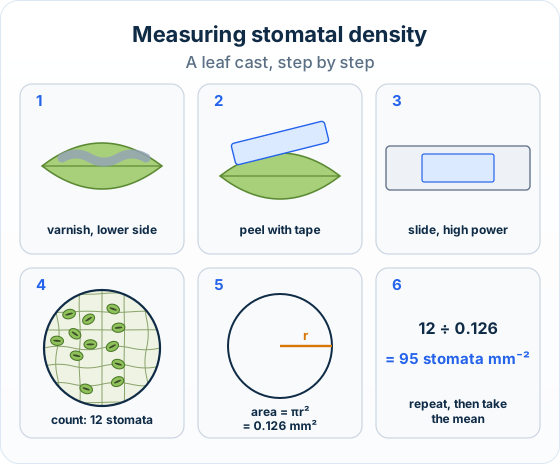
The big idea: Stomatal density is the number of stomata per unit area of leaf: count the stomata in a field of view of known area, then divide by that area.
The points to remember
- Make a leaf cast (clear nail varnish on the lower surface, peeled off with tape) or use a micrograph.
- Count the stomata in the field of view at high power: one stoma = one pore with its two guard cells.
- Area of a round field of view = πr², using the radius in mm.
- Density = number of stomata ÷ area, in stomata mm⁻².
Remember it as: Count, then divide by the area.
Two traps: Count stomata, not guard cells: two guard cells make one stoma.
A count alone is not a density: divide by the area and give the unit.
Memorize terms 3x faster
Smart flashcards show you cards right before you forget them. Perfect for definitions and key concepts.
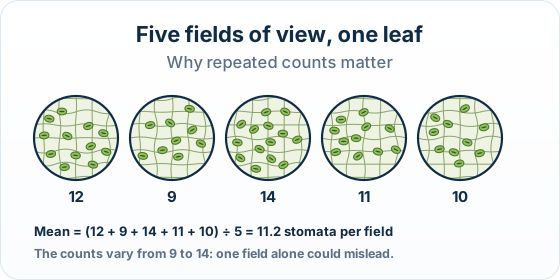
The big idea: Biological material varies, so one count can mislead. Repeat the count and use the mean.
The points to remember
- Count several fields of view on each leaf, and use several leaves.
- Calculate the mean: repeated counts make the result more reliable.
- The spread of the counts shows how much the material varies.
- Means shown with error bars (or ± standard error): if the bars of two means do not overlap, the difference is likely to be significant.
Trap: 'The means are different' is not enough to call a difference significant: compare the size of the error bars with the gap between the means.
The big idea: Stomatal density is a trade-off: more stomata let in more carbon dioxide and cool the leaf by transpiration, but lose more water.
| Condition | Stomatal density | Why it helps the plant |
|---|---|---|
| Hot habitat | Often higher | More transpiration cools the leaf; more carbon dioxide taken in |
| Dry habitat | Often lower | Less water lost |
| Raised carbon dioxide | Often lower | Enough carbon dioxide still enters, with less water lost |
The points to remember
- Other factors also matter: water supply, humidity, wind and light.
- Describe a scatter graph with the word correlation: 'a positive correlation between temperature and stomatal density'.
- Read values with their unit: 175 stomata mm⁻².
- A hypothesis is supported only where the data show the predicted change; one species may fit and another may not.
Trap: Say 'positive correlation', not 'positive relationship' or 'directly proportional'.
Real example: ginkgo leaves. Ginkgo trees have changed little for millions of years, so scientists compare the stomata on fossil ginkgo leaves with living ones to estimate how much carbon dioxide the air held in the past.
Know your predicted grade
Take timed mock exams and get detailed feedback on every answer. See exactly where you're losing marks.
How it is asked: Expect an image of a leaf cast, or tables and graphs of stomatal density to describe, compare and use as evidence.
Mean stomatal densities of a plant at three sites were 108 ± 5, 48 ± 4 and 29 ± 2 stomata mm⁻² (± standard error). Deduce with a reason whether the differences are likely to be statistically significant.
Model answer plan
See the answer broken into clear points, with guidance on how each point earns marks.