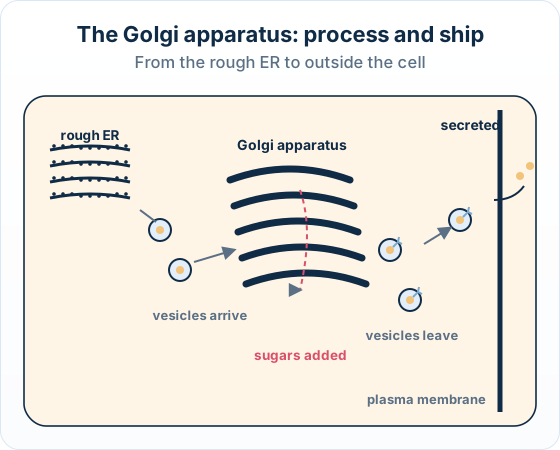
The big idea: The Golgi apparatus processes proteins made on the rough ER and packs them into vesicles for secretion.
The points to remember
- The Golgi apparatus is a stack of flattened, curved membrane sacs, with vesicles at its edges.
- Vesicles from the rough ER bring new protein and fuse with one side of the stack.
- As the protein passes through, it is processed: for example, sugar chains are added (glycoproteins).
- On the other side, the finished protein is packed into secretory vesicles.
- These fuse with the plasma membrane and release the protein (exocytosis).
Remember it as: Rough ER makes it, the Golgi finishes and ships it.
Real example: mucus: Goblet cells in the lining of the gut and airways have a large Golgi apparatus. It adds many sugar chains to the protein mucin before it is secreted as mucus.
Free preview
This is the free notes preview
You're reading the free notes. Aimnova Pro unlocks the full study experience — and you can try it with your first topic free to keep:
- FlashcardsLock in vocabulary and key terms with spaced repetition.
- Practice questionsAnswer exam-style questions and get instant AI marking.
- Mock exams & past-paper vaultSit full mocks and see exactly how examiners award marks.
- Personalised study planA daily plan built around your exam date and weak areas.
Start Studying Free Full access to Aimnova Pro · cancel anytime
How it is asked: Expect it inside a data question on labelled amino acids (the evidence that protein moves to the Golgi), a one-mark name of the organelle needed for secretion, or a short Describe of what the Golgi does.
IB-style questionOutline[1 mark]
A graph shows the percentage of labelled protein in the rough ER (X) and in the Golgi apparatus over time. Outline the evidence that the protein moves from X to the Golgi apparatus.
Model answer plan
See the answer broken into clear points, with guidance on how each point earns marks.
A three-mark Describe, in the Paper 2 style:
IB-style questionDescribe[3 marks]
Describe the role of the Golgi apparatus in a cell that secretes a protein.
Model answer plan
See the answer broken into clear points, with guidance on how each point earns marks.