The big idea: The double membrane of the nucleus keeps the DNA apart, but its pores let the right molecules through, and it can break into vesicles when the cell divides.
The points to remember
- The nuclear envelope is two membranes that keep the chromosomes apart from the cytoplasm.
- Nuclear pores pass through both membranes: mRNA leaves the nucleus through them.
- Proteins made in the cytoplasm that the nucleus needs (for example DNA polymerase) enter through pores.
- At the start of mitosis and meiosis the envelope breaks into vesicles, so spindle microtubules can reach the chromosomes.
- At the end, the vesicles fuse to rebuild a nuclear envelope around each new nucleus.
Remember it as: Pores for traffic, vesicles for division.
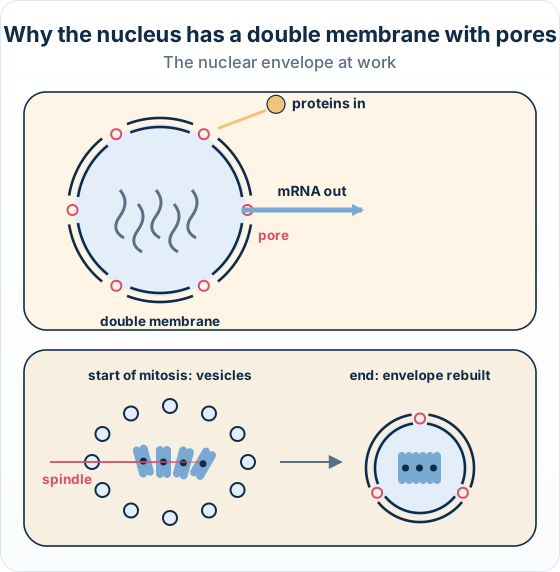
Real example: busy pores: A human cell nucleus has thousands of pores, each a large ring of proteins. Every minute, many thousands of molecules pass through them.
Free preview
This is the free notes preview
You're reading the free notes. Aimnova Pro unlocks the full study experience — and you can try it with your first topic free to keep:
- FlashcardsLock in vocabulary and key terms with spaced repetition.
- Practice questionsAnswer exam-style questions and get instant AI marking.
- Mock exams & past-paper vaultSit full mocks and see exactly how examiners award marks.
- Personalised study planA daily plan built around your exam date and weak areas.
Start Studying Free Full access to Aimnova Pro · cancel anytime
How it is asked: Expect a Paper 1A item on the benefit of the double membrane, or a short Outline of why the nucleus needs pores or why its membrane breaks up in mitosis.
IB-style questionOutline[2 marks]
Outline why the nuclear membrane breaks into vesicles at the start of mitosis.
Model answer plan
See the answer broken into clear points, with guidance on how each point earns marks.