The nucleus at Higher Level: The same statement as SL. At HL the double membrane and pores of the nucleus get their own page (2.4.6), and the modification of mRNA is studied with gene expression.
Practise this as you read
- Explain why transcription and translation are kept apart.
- Contrast eukaryotes with prokaryotes.
Free preview
This is the free notes preview
You're reading the free notes. Aimnova Pro unlocks the full study experience — and you can try it with your first topic free to keep:
- FlashcardsLock in vocabulary and key terms with spaced repetition.
- Practice questionsAnswer exam-style questions and get instant AI marking.
- Mock exams & past-paper vaultSit full mocks and see exactly how examiners award marks.
- Personalised study planA daily plan built around your exam date and weak areas.
Start Studying Free Full access to Aimnova Pro · cancel anytime
The big idea: In a eukaryotic cell transcription happens in the nucleus and translation in the cytoplasm, so the mRNA can be modified before any ribosome reads it.
The points to remember
- The nuclear membrane keeps the DNA and transcription inside the nucleus.
- Translation by ribosomes happens outside, in the cytoplasm.
- So there is time to modify the mRNA after transcription (for example, cutting out introns).
- Only the finished mRNA leaves through the nuclear pores to the ribosomes.
- Prokaryotes have no nucleus: ribosomes can join the mRNA at once, so it cannot be modified first.
Remember it as: Copy in the nucleus, edit, then read outside.
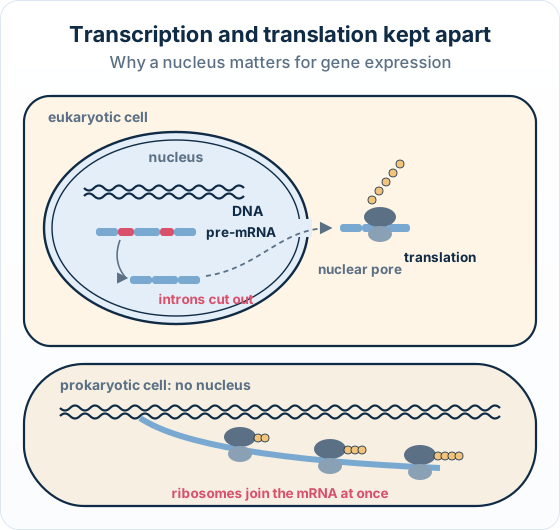
Real example: a bacterium in a hurry: In E. coli, ribosomes attach to an mRNA and start making protein while RNA polymerase is still copying the rest of the gene. Fast, but the mRNA cannot be edited first.
Get feedback like a real examiner
Submit your answers and get instant feedback — what you did well, what's missing, and exactly what to write to score full marks.
Try AI Tutor FreeYour first topic is free to keep • No credit card required
How it is asked: Expect it inside a question on compartments: an Explain [2] about the nucleus, or one point of a longer answer on why eukaryotic cells are divided up.
IB-style questionExplain[2 marks]
Explain one advantage to a eukaryotic cell of having its DNA inside a nucleus, separate from the cytoplasm.
Model answer plan
See the answer broken into clear points, with guidance on how each point earns marks.