Organelles at Higher Level: The same statement as SL. At HL each organelle then gets its own page later in this topic: the mitochondrion, chloroplast, nucleus, ribosomes and rough ER, Golgi apparatus and vesicles.
Practise this as you read
- State which structures are organelles and which are not.
- State the functions of labelled organelles in a micrograph.
Free preview
This is the free notes preview
You're reading the free notes. Aimnova Pro unlocks the full study experience — and you can try it with your first topic free to keep:
- FlashcardsLock in vocabulary and key terms with spaced repetition.
- Practice questionsAnswer exam-style questions and get instant AI marking.
- Mock exams & past-paper vaultSit full mocks and see exactly how examiners award marks.
- Personalised study planA daily plan built around your exam date and weak areas.
The big idea: An organelle is a tiny structure inside a cell that does a particular job — a bit like an organ does a job inside a body.
Key points
- A eukaryotic cell is divided into many organelles.
- Most of them are wrapped in their own membrane.
- To answer this topic you need to recognise each organelle in a diagram or micrograph and be able to state what it does.
Read the organelles off the eukaryotic cell on the right: the nucleus (holds DNA), mitochondrion, ribosomes, plasma membrane and cytoplasm are all labelled.
Interactive diagram
Explore the labelled diagram, charts and maps for this topic in full study mode.
- Organelle
- A specialised structure inside a cell that carries out a specific function (for example the nucleus or a mitochondrion).
- Membrane-bound organelle
- An organelle surrounded by its own membrane, which keeps its contents separate from the rest of the cell (e.g. nucleus, mitochondrion, Golgi apparatus).
- Nucleus
- The large organelle that holds the cell's DNA and controls the cell's activities.
- Mitochondrion
- The organelle where aerobic respiration takes place, releasing energy for the cell (plural: mitochondria).
- Ribosome
- A tiny organelle that builds proteins; it is the one organelle that is NOT surrounded by a membrane.
- Cytoplasm
- The jelly-like fluid filling the cell, in which the organelles sit.
Organelle = a 'little organ': The word organelle means 'little organ'.
Just as your heart, lungs and stomach each have a job in your body, each organelle has a job in the cell — and the exam wants you to match the organelle to its job.
Never wonder what to study next
Get a personalized daily plan based on your exam date, progress, and weak areas. We'll tell you exactly what to review each day.
The skill the exam tests most is simple: identify an organelle, then state its function.
Function follows structure: The function follows from the structure — so if you learn what each organelle does, you can usually work out the rest.
The organelles you must know
- Nucleus — holds the DNA and controls the cell.
- Mitochondrion — site of aerobic respiration; releases energy (makes ATP).
- Ribosome — builds proteins (protein synthesis); the only organelle with no membrane.
- Rough endoplasmic reticulum (rough ER) — makes and transports proteins.
- Golgi apparatus — modifies, packages and sorts proteins into vesicles for export.
- Vesicle — a small sac that transports materials around or out of the cell.
| Organelle | What it looks like | Its main function |
|---|---|---|
| Nucleus | Large, round, with a double membrane (envelope) | Holds the cell's DNA and controls the cell's activities |
| Mitochondrion | Oval, with a folded inner membrane | Site of aerobic respiration — releases energy (makes ATP) |
| Ribosome | Tiny dot, NOT membrane-bound | Builds proteins by joining amino acids (protein synthesis) |
| Rough endoplasmic reticulum | Folded membranes studded with ribosomes | Makes and transports proteins |
| Golgi apparatus | Stack of flattened membrane sacs | Modifies, packages and sorts proteins into vesicles for export |
| Vesicle | Small membrane-bound sac | Transports materials around or out of the cell |
| Chloroplast (plant cells) | Green oval containing stacks of membranes | Site of photosynthesis — captures light to make food |
| Vacuole (large, in plant cells) | Large fluid-filled sac | Stores water and keeps the cell firm (turgid) |
The protein-export production line
Ribosomes build it
Ribosomes (on the rough ER) build the protein.
Rough ER transports it
The rough ER transports the protein.
Golgi packages it
The Golgi apparatus modifies it and packages it into a vesicle.
Vesicle releases it
The vesicle carries it to the membrane to be released.
Three organelles work together to make and export proteins — a favourite exam link.
Spot the Golgi: When a question describes a structure that packages and modifies polypeptides into vesicles, the answer is the Golgi apparatus.
Membrane-bound or not?: Almost every organelle is membrane-bound — wrapped in its own membrane.
The big exception is the ribosome, which has no membrane.
This matters because prokaryotes have no membrane-bound organelles at all, but they do have ribosomes. So a structure that is clearly membrane-bound can only belong to a eukaryotic cell.
| Feature | Membrane-bound organelles | Ribosomes |
|---|---|---|
| Surrounded by a membrane? | Yes — wrapped in their own membrane | No — they are not membrane-bound |
| Examples | Nucleus, mitochondrion, Golgi, ER, chloroplast, vacuole | Ribosomes (the only non-membrane organelle) |
| Found in eukaryotes? | Yes | Yes |
| Found in prokaryotes? | No (prokaryotes have no membrane-bound organelles) | Yes — prokaryotes do have ribosomes |
| Visible as | A structure with its own outline / compartment | Tiny dots scattered in the cytoplasm |
Energy & control organelles
- Nucleus — holds DNA, controls the cell
- Mitochondrion — aerobic respiration → energy
- Chloroplast (plants) — photosynthesis → food
- All are membrane-bound
Protein-making organelles
- Ribosome — builds proteins (no membrane)
- Rough ER — makes & transports proteins
- Golgi apparatus — packages proteins into vesicles
- Vesicle — carries proteins out of the cell
An easy way to remember: Mighty-chondria make energy. The nucle-us is the boss (it holds the DNA). Ribo-somes build the bodies of proteins.
And: lots of an organelle = lots of that job. A cell packed with mitochondria needs lots of energy; a cell packed with ribosomes and Golgi makes lots of protein.
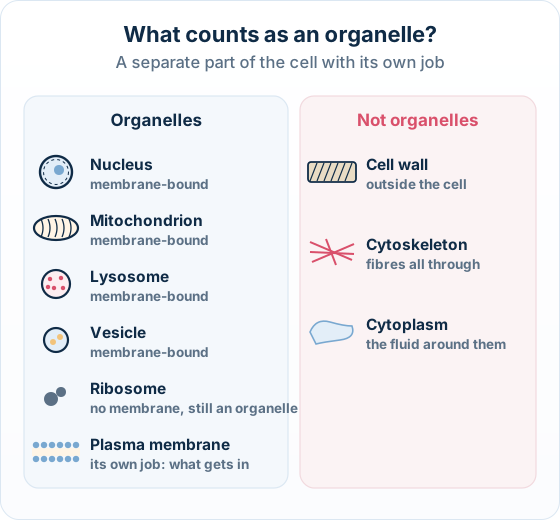
The big idea: An organelle is a discrete subunit of a cell: a separate part with its own structure, adapted to one job.
The points to remember
- Organelles: the nucleus, mitochondria, chloroplasts, lysosomes, vesicles, ribosomes and the plasma membrane.
- Ribosomes have no membrane, but they are still organelles.
- Not organelles: the cell wall (outside the cell), the cytoskeleton and the cytoplasm.
- Organelles that hold base pairs: the nucleus, mitochondria and chloroplasts (DNA), and ribosomes (RNA).
- Each organelle's structure suits its job, so its shape helps you name it.
- Watch for microtubules in a list: they are part of the cytoskeleton, so that list is not all organelles.
Remember it as: A separate part with its own job = an organelle.
Real example: sperm cells: A sperm cell keeps only the organelles it needs: a nucleus with the father's DNA, many mitochondria in the midpiece to power the tail, and a large vesicle of enzymes at the tip.
Stop wasting time on topics you know
Our AI identifies your weak areas and focuses your study time where it matters. No more overstudying easy topics.
The big idea: The job of each organelle could only be studied once scientists could separate one kind of organelle from all the others.
The points to remember
- Cell fractionation: cells are broken open, then spun in a centrifuge.
- Heavier organelles sink first: nuclei at a slow spin, then mitochondria, then ribosomes at a very fast spin in an ultracentrifuge.
- Each pellet holds one kind of organelle, so its function can be tested on its own.
- Progress in science often follows a new technique: here, the ultracentrifuge.
Remember it as: Spin faster, catch smaller.
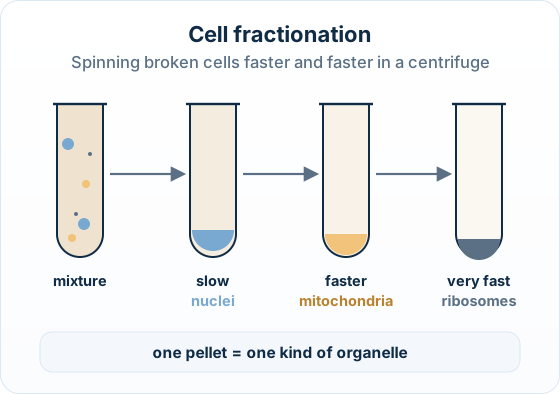
Real example: the first separations: In the 1940s Albert Claude used a centrifuge to separate the parts of broken cells and then studied each part with an electron microscope.
How this is tested: Most questions give you a cell diagram or micrograph. You identify organelles and state what they do.
What you may be asked
- The classic format: a labelled cell diagram or electron micrograph. Identify organelles (often two or three labelled X, Y, I, II, III) and state a function for each — typically 1 mark for the name and 1 mark for the function.
- A 1-mark version may describe a job ('packages and modifies polypeptides into vesicles') and ask you to name the organelle — here, the Golgi apparatus.
- A 2-mark Deduce version shows an unfamiliar cell (e.g. a fungus). It asks what the labelled membrane-bound structures could be, with a reason — so you must justify your answer, not just name it.
Exam-style question — identify a labelled organelle
An electron micrograph of a pancreas cell shows an oval structure (labelled X) with a folded inner membrane. Identify organelle X and state its function. [2]
How to score both marks
- Identify it from the clue. An oval structure with a folded inner membrane is a mitochondrion. (Mark 1: mitochondrion.)
- State its function. The mitochondrion is the site of aerobic respiration, releasing energy (in the form of ATP) for the cell to use. (Mark 2: aerobic respiration / releases energy / makes ATP.)
- Tie the structure to the function. The folded inner membrane gives a large surface area for the respiration reactions — a neat way to show you understand, though the two marks come from the name and the function.
Final answer
Organelle X is a mitochondrion; its function is aerobic respiration, releasing energy (ATP) for the cell.
Why this scores full marks: There are two separate scoring points: the name of the organelle and a correct function.
A common slip is naming the organelle but giving a vague function ('it helps the cell') — the function must be specific (aerobic respiration / releases energy).
| Organelle | What it looks like | Its main function |
|---|---|---|
| Nucleus | Large, round, with a double membrane (envelope) | Holds the cell's DNA and controls the cell's activities |
| Mitochondrion | Oval, with a folded inner membrane | Site of aerobic respiration — releases energy (makes ATP) |
| Ribosome | Tiny dot, NOT membrane-bound | Builds proteins by joining amino acids (protein synthesis) |
| Rough endoplasmic reticulum | Folded membranes studded with ribosomes | Makes and transports proteins |
| Golgi apparatus | Stack of flattened membrane sacs | Modifies, packages and sorts proteins into vesicles for export |
| Vesicle | Small membrane-bound sac | Transports materials around or out of the cell |
| Chloroplast (plant cells) | Green oval containing stacks of membranes | Site of photosynthesis — captures light to make food |
| Vacuole (large, in plant cells) | Large fluid-filled sac | Stores water and keeps the cell firm (turgid) |
A two-mark State on a labelled cell drawing:
A drawing of a cell from the pancreas shows structure X, flattened sacs covered in ribosomes, and structure Y, a curved stack of flattened sacs with small vesicles beside it. State a function for structures X and Y.
Model answer plan
See the answer broken into clear points, with guidance on how each point earns marks.