aımnova
DashboardMy LearningCrash CoursesStudy Plan

Aimnova site navigation

Stay in the loop

Get the latest study resources and updates

New features, study tips and exam insights — straight to your inbox.

IB Diploma

  • IB Past Papers
  • IB Study Notes
  • IB Question Bank
  • IB Mock Exams
  • IB Revision

IB Subjects

  • IB Math AA
  • IB Math AI
  • IB Economics
  • IB Business Management
  • IB Physics
  • IB Biology
  • View all IB subjects→

IB Past Papers

  • IB Math AA HL Past Papers
  • IB Math AA SL Past Papers
  • IB Math AI HL Past Papers
  • IB Math AI SL Past Papers
  • IB Economics HL Past Papers
  • IB Economics SL Past Papers
  • IB ESS Past Papers
  • View all past papers→

Study Resources

  • Study Notes
  • Question Bank
  • Mock Exams
  • Crash Courses
  • Flashcards
  • Revision Guide
  • Exam Skills
  • Command Terms
  • Grade Calculator
  • Exam Timetable 2026

Aimnova

  • Features
  • Pricing
  • For Teachers
  • For Schools
  • For Parents
  • About Us
  • Blog
  • Contact
aımnova

IB study, practice and feedback built around the real exam.

TermsPrivacyCookies·© 2026 Aimnova. All rights reserved.c90f7ab

Aimnova is not affiliated with or endorsed by the International Baccalaureate Organization (IB).

NotesBiology HLTopic 2.3Integral and peripheral proteins in membranes
Back to Biology HL Topics
2.3.43 min read

Integral and peripheral proteins in membranes (Biology HL)

IB Biology · Unit 2

Exam preparation

Practice the questions examiners actually ask

Our question bank mirrors real IB exam papers. Practice under timed conditions and track your progress across topics.

Start Practicing

Contents

  1. 1Membrane proteins at Higher Level
  2. 2Integral and peripheral proteins
  3. 3Many shapes, many jobs
  4. 4Exam-style question (step by step)
Membrane proteins at Higher Level: The same statement as SL. At HL it links back to protein structure: the non-polar amino acids of an integral protein sit in the hydrophobic core, and forward to the channels, pumps and adhesion molecules of this topic.

Practise this as you read

  • Identify integral and peripheral proteins on a membrane diagram.
  • Explain what holds an integral protein in the membrane.

Free preview

This is the free notes preview

You're reading the free notes. Aimnova Pro unlocks the full study experience — and you can try it with your first topic free to keep:

  • FlashcardsLock in vocabulary and key terms with spaced repetition.
  • Practice questionsAnswer exam-style questions and get instant AI marking.
  • Mock exams & past-paper vaultSit full mocks and see exactly how examiners award marks.
  • Personalised study planA daily plan built around your exam date and weak areas.
Start Studying Free Full access to Aimnova Pro · cancel anytime
The big idea: Proteins sit in or on the bilayer. Integral proteins are embedded in it; peripheral proteins are attached to one of its surfaces.

The points to remember

  • Integral proteins are embedded in one or both lipid layers.
  • Some integral proteins pass right through both layers: they are transmembrane proteins.
  • Integral proteins have hydrophobic parts where they touch the core, which hold them in place.
  • Peripheral proteins are attached to one surface, outer or inner; they do not enter the core.
  • Peripheral proteins are often attached to integral proteins or to the phosphate heads.
Remember it as: Integral: in it. Peripheral: on it.
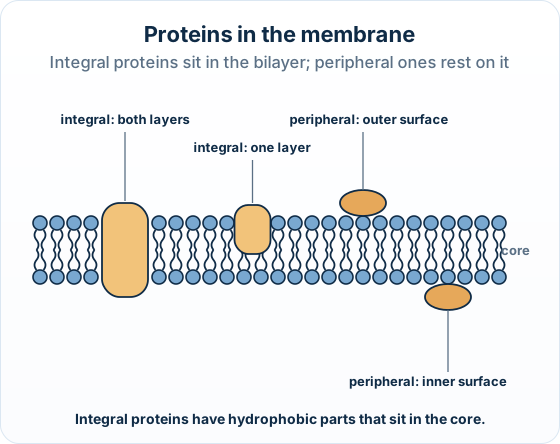
A phospholipid bilayer with an integral protein passing through both layers, an integral protein in the outer layer only, a peripheral protein on the outer surface and one on the inner surface
Integral proteins are in the bilayer; peripheral proteins are on it.

Study smarter, not longer

Most students waste 40% of study time on topics they already know. Our AI tracks your progress and optimizes every minute.

Try Smart Study FreeYour first topic is free to keep • No credit card required
The big idea: Membrane proteins are very diverse: different shapes, different places in the membrane, different jobs.

Moving things across

  • Channel proteins: a pore for ions or water
  • Pump proteins: use ATP
  • Carrier proteins: change shape

Signals and recognition

  • Receptors bind hormones such as insulin
  • Glycoproteins let cells recognise each other

Other jobs

  • Enzymes, such as those on gut cells that digest sugars
  • Adhesion: holding cells together
Real example: cytochrome c: Cytochrome c is a small peripheral protein on the outer face of the inner mitochondrial membrane. It carries electrons between two large integral protein complexes.

Most transport proteins and receptors are integral, because they must reach both sides of the membrane.

How it is asked: Paper 1A shows a drawn membrane with two structures lettered and asks what they are. Paper 2 can ask you to distinguish the two kinds of protein.
IB-style questionIdentify[1 mark]

A membrane diagram shows X: a protein with a branched chain on the outside, passing through both layers; and Y: a protein resting on the inner surface. What are X and Y?

Model answer plan

See the answer broken into clear points, with guidance on how each point earns marks.

Claim your free topic

And a two-mark Distinguish:

IB-style questionDistinguish[2 marks]

Distinguish between integral and peripheral proteins.

Model answer plan

See the answer broken into clear points, with guidance on how each point earns marks.

Claim your free topic

Try an IB Exam Question — Free AI Feedback

Test yourself on Integral and peripheral proteins in membranes. Write your answer and get instant AI feedback — just like a real IB examiner.

The membrane of a nerve cell contains integral proteins, such as sodium channels, and peripheral proteins.

between integral and peripheral proteins.
[2 marks]

Related Biology HL Topics

Continue learning with these related topics from the same unit:

2.1.1Chemical properties of carbon that allow diverse compounds2.1.2Production of macromolecules by condensation reactions2.1.3Digestion of polymers into monomers by hydrolysis reactions2.1.4Form and function of monosaccharides
View all Biology HL topics
Improve your exam techniqueCommand terms, paper structure, and mark-scheme tips for Biology HL
Previous2.3.3Simple diffusion across membranesNextMovement of water molecules across membranes by osmosis and the role of aquaporins2.3.5

5 questions to test your understanding

Reading is just the start. Students who tested themselves scored 82% on average — try IB-style questions with AI feedback.

Start FreeView All Biology HL Topics