aımnova
DashboardMy LearningCrash CoursesStudy Plan

Aimnova site navigation

Stay in the loop

Get the latest study resources and updates

New features, study tips and exam insights — straight to your inbox.

IB Diploma

  • IB Past Papers
  • IB Study Notes
  • IB Question Bank
  • IB Mock Exams
  • IB Revision

IB Subjects

  • IB Math AA
  • IB Math AI
  • IB Economics
  • IB Business Management
  • IB Physics
  • IB Biology
  • View all IB subjects→

IB Past Papers

  • IB Math AA HL Past Papers
  • IB Math AA SL Past Papers
  • IB Math AI HL Past Papers
  • IB Math AI SL Past Papers
  • IB Economics HL Past Papers
  • IB Economics SL Past Papers
  • IB ESS Past Papers
  • View all past papers→

Study Resources

  • Study Notes
  • Question Bank
  • Mock Exams
  • Crash Courses
  • Flashcards
  • Revision Guide
  • Exam Skills
  • Command Terms
  • Grade Calculator
  • Exam Timetable 2026

Aimnova

  • Features
  • Pricing
  • For Teachers
  • For Schools
  • For Parents
  • About Us
  • Blog
  • Contact
aımnova

IB study, practice and feedback built around the real exam.

TermsPrivacyCookies·© 2026 Aimnova. All rights reserved.c90f7ab

Aimnova is not affiliated with or endorsed by the International Baccalaureate Organization (IB).

NotesBiology HLTopic 2.3Movement of water molecules across membranes by osmosis and the role of aquaporins
Back to Biology HL Topics
2.3.55 min read

Movement of water molecules across membranes by osmosis and the role of aquaporins (Biology HL)

IB Biology · Unit 2

IB exam ready

Study like the top scorers do

Access a smart study planner, AI tutor, and exam vault — everything you need to hit your target grade.

Start Free

Contents

  1. 1Osmosis at Higher Level
  2. 2Osmosis: water moves towards more solute
  3. 3Aquaporins: channels for water
  4. 4Reading the frog egg experiment
  5. 5Exam-style question (step by step)
Osmosis at Higher Level: The same statement as SL. HL questions on the frog egg experiment go one step further: why cells given the mRNA end up with more aquaporins, and what that does to the rate of osmosis.

Practise this as you read

  • Explain osmosis with random movement and solute concentration.
  • Explain the reasons for the results of an aquaporin experiment.

Free preview

This is the free notes preview

You're reading the free notes. Aimnova Pro unlocks the full study experience — and you can try it with your first topic free to keep:

  • FlashcardsLock in vocabulary and key terms with spaced repetition.
  • Practice questionsAnswer exam-style questions and get instant AI marking.
  • Mock exams & past-paper vaultSit full mocks and see exactly how examiners award marks.
  • Personalised study planA daily plan built around your exam date and weak areas.
Start Studying Free Full access to Aimnova Pro · cancel anytime
The big idea: Water crosses membranes on its own, towards the side with more dissolved solute. This is osmosis.

The points to remember

  • Osmosis is the net movement of water across a partially permeable membrane, towards the higher solute concentration.
  • Water molecules move at random, crossing the membrane in both directions.
  • The membrane is impermeable to the solutes, so they cannot cross to even out the difference.
  • Fewer water molecules are free to cross from the side with more solute, so more water crosses towards it than away from it.
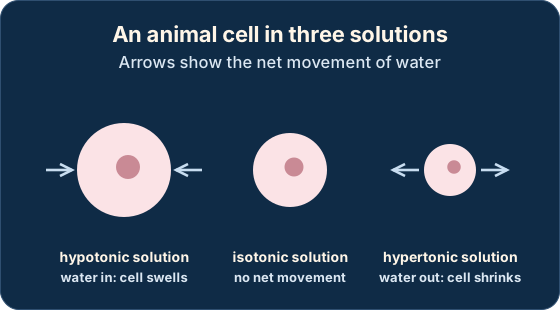
  • Hypotonic: lower solute concentration than the cell, water enters. Hypertonic: higher, water leaves. Isotonic: equal, no net movement.
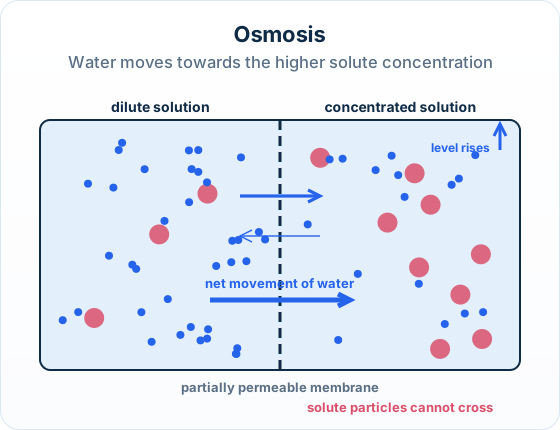
A container divided by a partially permeable membrane: a dilute solution on the left with few large solute particles, a concentrated one on the right with many; small water molecules cross both ways with a larger net arrow towards the concentrated side, where the level rises
Osmosis: the net movement of water towards the higher solute concentration.
Get the direction right: Water moves towards the more concentrated solution, from hypotonic to hypertonic. Name the solute, not 'the concentration', when you explain it.
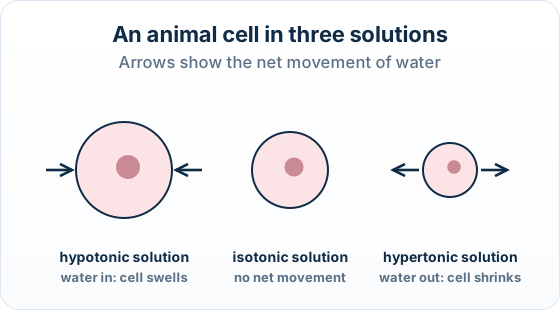
Three animal cells: a swollen cell in a hypotonic solution with arrows pointing in, a normal cell in an isotonic solution, a shrunken cell in a hypertonic solution with arrows pointing outThree animal cells: a swollen cell in a hypotonic solution with arrows pointing in, a normal cell in an isotonic solution, a shrunken cell in a hypertonic solution with arrows pointing out
Hypotonic: water in. Isotonic: no net movement. Hypertonic: water out.
Real example: Paramecium: Paramecium lives in fresh pond water, which is hypotonic to its cytoplasm. Water keeps entering by osmosis, and contractile vacuoles pump it back out so the cell does not burst.

Get feedback like a real examiner

Submit your answers and get instant feedback — what you did well, what's missing, and exactly what to write to score full marks.

Try AI Tutor FreeYour first topic is free to keep • No credit card required
The big idea: Water is polar, so it crosses the bilayer only slowly. Aquaporins are channel proteins that let water through much faster.

The points to remember

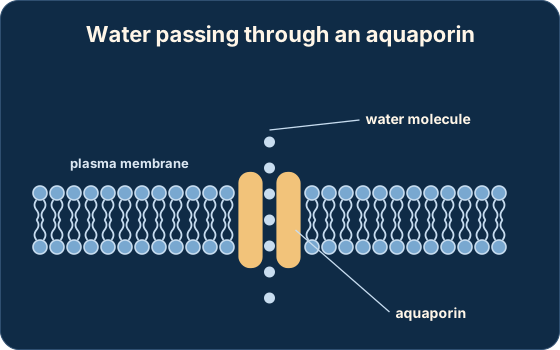
  • An aquaporin is an integral channel protein with a narrow pore through the membrane.
  • Water molecules pass through the pore in single file; ions are held back.
  • Aquaporins increase the permeability of the membrane to water, so osmosis is faster.
  • It is still osmosis: passive, no ATP; water follows the difference in solute concentration.
  • Each aquaporin carries water quite slowly, so cells that move a lot of water have many: kidney collecting ducts, root cells, gland cells that secrete fluid.
Remember it as: Aquaporin: a water-only door, one molecule at a time.
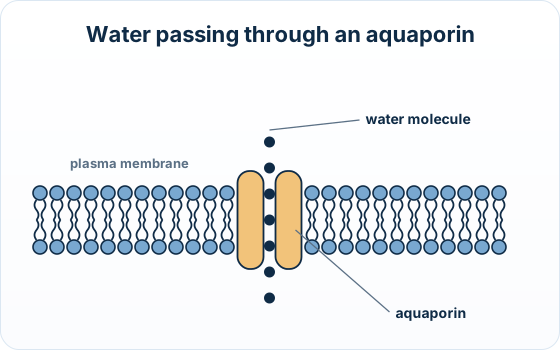
A phospholipid bilayer with an aquaporin, a channel protein of two halves, and a line of water molecules passing through its pore in single fileA phospholipid bilayer with an aquaporin, a channel protein of two halves, and a line of water molecules passing through its pore in single file
An aquaporin: a channel for water.
Real example: the discovery: In the early 1990s, Peter Agre's team put the gene message (mRNA) for a membrane protein into frog egg cells, which normally let little water in. In water the eggs swelled and burst: the protein was a water channel. He shared the 2003 Nobel Prize in Chemistry.
The big idea: Data questions on osmosis show a change in volume or mass over time. Read the direction first, then compare the lines, then explain.
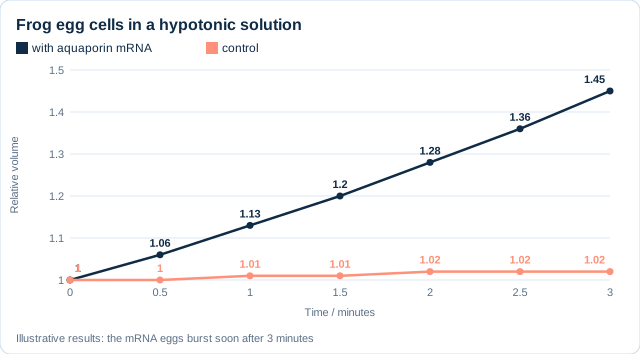
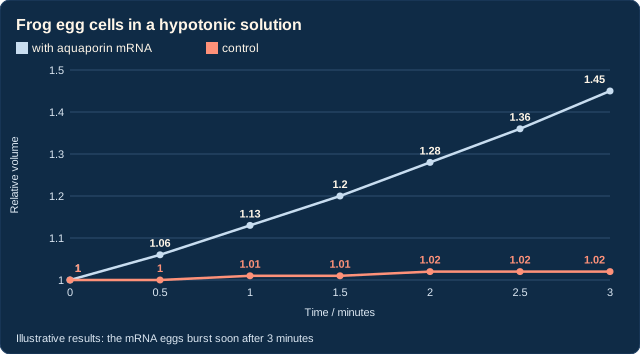
Line graph of relative volume against time: frog eggs with aquaporin mRNA rise steadily from 1.0 to 1.45 in 3 minutes, control eggs stay close to 1.0Line graph of relative volume against time: frog eggs with aquaporin mRNA rise steadily from 1.0 to 1.45 in 3 minutes, control eggs stay close to 1.0
Illustrative results of the frog egg experiment.

How to answer

  • Direction: the volume rises, so the net movement of water is into the cells.
  • Compare with a comparative word: the mRNA eggs swell faster and more, and burst; the controls hardly change.
  • Explain: the solution is hypotonic, so water moves in by osmosis towards the higher solute concentration inside.
  • Reasons for the difference: the mRNA is translated into aquaporins, which are put into the egg's membrane; they increase its permeability to water, so more water enters and the eggs burst.
Numbers alone do not compare: Write 'larger' or 'faster', not just the two values. And say 'more permeable' or 'faster', not only 'aquaporins let water in'.

Learn what examiners really want

See exactly what to write to score full marks. Our AI shows you model answers and the key phrases examiners look for.

Try AI Feedback FreeYour first topic is free to keep • No credit card required
How it is asked: Paper 1B gives a volume graph of cells with and without aquaporins and asks for the direction and the reasons for the difference. Paper 1A asks what aquaporins are.
IB-style questionExplain[2 marks]

Red blood cells from mice that lack the gene for aquaporin-1 swell much more slowly in a hypotonic solution than cells from normal mice. Explain the reasons for this difference.

Model answer plan

See the answer broken into clear points, with guidance on how each point earns marks.

Claim your free topic

Try an IB Exam Question — Free AI Feedback

Test yourself on Movement of water molecules across membranes by osmosis and the role of aquaporins. Write your answer and get instant AI feedback — just like a real IB examiner.

A cell is placed in a solution and its mass steadily decreases over the next four minutes.

the net direction of water movement across the plasma membrane.
[1 mark]

Related Biology HL Topics

Continue learning with these related topics from the same unit:

2.1.1Chemical properties of carbon that allow diverse compounds2.1.2Production of macromolecules by condensation reactions2.1.3Digestion of polymers into monomers by hydrolysis reactions2.1.4Form and function of monosaccharides
View all Biology HL topics
Improve your exam techniqueCommand terms, paper structure, and mark-scheme tips for Biology HL
Previous2.3.4Integral and peripheral proteins in membranesNextChannel proteins for facilitated diffusion2.3.6

16 practice questions on Movement of water molecules across membranes by osmosis and the role of aquaporins

Students who practiced this topic on Aimnova scored 82% on average. Try free practice questions and get instant AI feedback.

Try 3 Free QuestionsView All Biology HL Topics