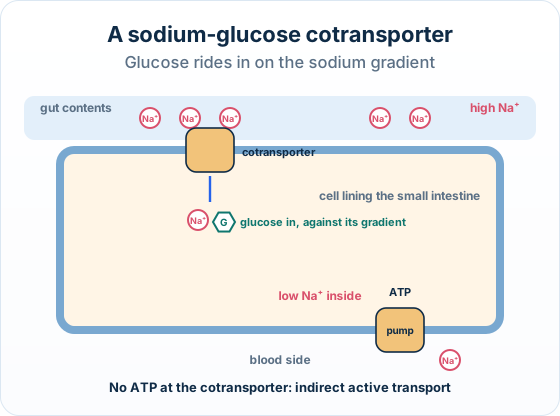
The big idea: A cotransporter moves two things at once: Na⁺ down its gradient and glucose against its gradient. The energy comes from the sodium gradient, not directly from ATP.
The points to remember
- The sodium-potassium pump uses ATP to keep the Na⁺ concentration low inside the cell.
- So Na⁺ tends to diffuse into the cell from outside.
- A sodium-glucose cotransporter lets Na⁺ in only together with glucose.
- Na⁺ moving down its gradient pulls glucose in against its gradient.
- The cotransporter uses no ATP itself: this is indirect active transport.
Remember it as: The pump pays; the cotransporter rides.
Free preview
This is the free notes preview
You're reading the free notes. Aimnova Pro unlocks the full study experience — and you can try it with your first topic free to keep:
- FlashcardsLock in vocabulary and key terms with spaced repetition.
- Practice questionsAnswer exam-style questions and get instant AI marking.
- Mock exams & past-paper vaultSit full mocks and see exactly how examiners award marks.
- Personalised study planA daily plan built around your exam date and weak areas.
Start Studying Free Full access to Aimnova Pro · cancel anytime
The big idea: Two organs need to take up almost all the glucose they meet, even when there is more inside the cells than outside.
Small intestine
- Cells lining the villi absorb glucose from digested food
- Even the last traces are taken up
Kidney nephron
- Cells of the tubule reabsorb glucose from the filtrate
- Normally none is lost in urine
Real example: oral rehydration salts: Oral rehydration drinks for diarrhoea contain both salt and glucose. Sodium-glucose cotransport takes them in together, and water follows by osmosis.
Learn what examiners really want
See exactly what to write to score full marks. Our AI shows you model answers and the key phrases examiners look for.
Try AI Feedback FreeYour first topic is free to keep • No credit card required
How it is asked: Expect an Explain on why the process is called indirect active transport, or data on glucose uptake with and without sodium.
IB-style questionExplain[3 marks]
Explain why the uptake of glucose by sodium-glucose cotransporters is described as indirect active transport.
Model answer plan
See the answer broken into clear points, with guidance on how each point earns marks.