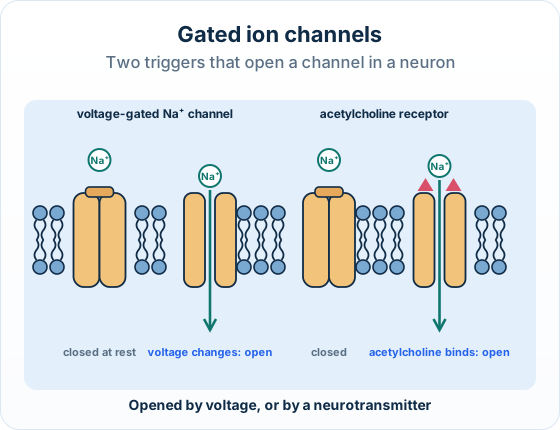
The big idea: Many channels in neurons have a gate. What opens the gate differs: a change in voltage, or a neurotransmitter binding.
The points to remember
- Gated channels open and close, so ions can cross only at certain moments.
- Voltage-gated channels open when the voltage across the membrane changes: sodium and potassium channels in neurons.
- Neurotransmitter-gated (ligand-gated) channels open when a chemical binds to them.
- The nicotinic acetylcholine receptor opens when acetylcholine binds, letting Na⁺ in.
- Some channels are mechanically gated: they open when the membrane is stretched or pressed.
- Once open, ions diffuse through, down their gradient: still passive.
Remember it as: Volts or a chemical key: two ways to open a gate.
Real example: nicotine: Nicotine fits the same receptor as acetylcholine and opens it too. That is why these receptors are called nicotinic.
Free preview
This is the free notes preview
You're reading the free notes. Aimnova Pro unlocks the full study experience — and you can try it with your first topic free to keep:
- FlashcardsLock in vocabulary and key terms with spaced repetition.
- Practice questionsAnswer exam-style questions and get instant AI marking.
- Mock exams & past-paper vaultSit full mocks and see exactly how examiners award marks.
- Personalised study planA daily plan built around your exam date and weak areas.
Start Studying Free Full access to Aimnova Pro · cancel anytime
How it is asked: Paper 1A gives a table of channels and asks how each is gated. Paper 2 asks you to state a type of gated channel other than the one shown.
IB-style questionState[1 mark]
A diagram shows a voltage-gated potassium channel. State another type of gated ion channel.
Model answer plan
See the answer broken into clear points, with guidance on how each point earns marks.