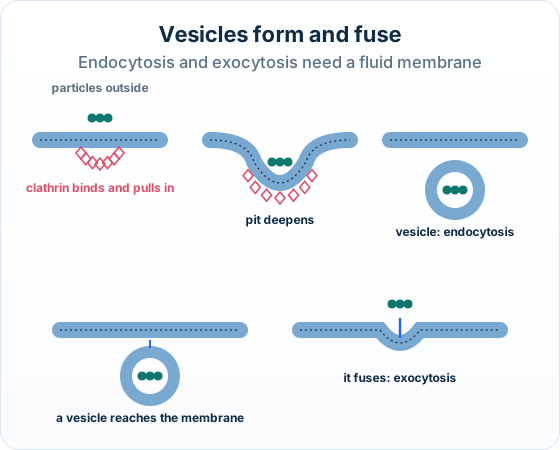
The big idea: Because the membrane is fluid, it can bend, pinch off into vesicles and fuse with them again. That is how cells move large materials in and out.
The points to remember
- Endocytosis: the membrane folds inwards round material and pinches off a vesicle inside the cell.
- Clathrin proteins bind to the inner face of the membrane and to each other, pulling it in so it indents: they help vesicles form.
- Exocytosis: a vesicle moves to the plasma membrane and fuses with it, releasing its contents outside.
- Both need a fluid membrane, which can reseal without leaking.
- Both use energy from ATP.
Remember it as: Endo: in, pinched off. Exo: out, fused on.
Free preview
This is the free notes preview
You're reading the free notes. Aimnova Pro unlocks the full study experience — and you can try it with your first topic free to keep:
- FlashcardsLock in vocabulary and key terms with spaced repetition.
- Practice questionsAnswer exam-style questions and get instant AI marking.
- Mock exams & past-paper vaultSit full mocks and see exactly how examiners award marks.
- Personalised study planA daily plan built around your exam date and weak areas.
Start Studying Free Full access to Aimnova Pro · cancel anytime
The big idea: Every cell uses vesicles; some cells depend on them.
Endocytosis (in)
- White blood cells engulf bacteria into a vesicle (phagocytosis)
- Cells take in cholesterol carried in the blood by clathrin-coated vesicles
Exocytosis (out)
- Pancreas cells release insulin
- Nerve endings release neurotransmitter into the synapse
Real example: insulin: Insulin is made in pancreas cells and stored in vesicles. When blood glucose rises, the vesicles fuse with the plasma membrane and release insulin into the blood within minutes.
Exocytosis adds membrane to the cell surface and endocytosis takes it back, so membrane is constantly recycled.
See how examiners mark answers
Answer exam-style questions with model answers. Learn exactly what earns marks and what doesn't.
Try Exam Vault FreeYour first topic is free to keep • No credit card required
How it is asked: Paper 1A asks for the role of clathrin. Paper 2 asks you to describe endocytosis or exocytosis with an example, or to link them to membrane fluidity.
IB-style questionDescribe[3 marks]
Describe how a white blood cell takes in a bacterium by endocytosis.
Model answer plan
See the answer broken into clear points, with guidance on how each point earns marks.