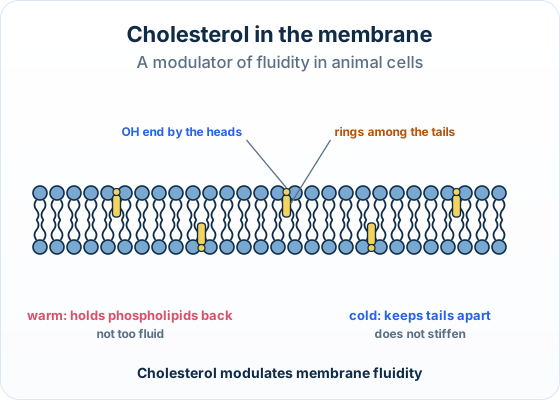
The big idea: Cholesterol keeps an animal cell's membrane at the right fluidity whatever the temperature: it is a modulator of fluidity.
The points to remember
- Cholesterol sits between the phospholipids in animal cell membranes.
- Its small OH group lies by the phosphate heads; its rigid rings lie among the fatty acid tails.
- At higher temperatures it restrains the phospholipids, so the membrane does not become too fluid or leaky: it stabilises the membrane.
- At lower temperatures it keeps the tails apart, so the membrane does not stiffen.
- So it modulates (adjusts) fluidity in both directions.
Remember it as: Cholesterol: a brake when warm, a spacer when cold.
Real example: red blood cells: Nearly half of the lipid molecules in a red blood cell's membrane are cholesterol. The membrane stays flexible enough to squeeze through capillaries, yet strong enough not to burst.
Free preview
This is the free notes preview
You're reading the free notes. Aimnova Pro unlocks the full study experience — and you can try it with your first topic free to keep:
- FlashcardsLock in vocabulary and key terms with spaced repetition.
- Practice questionsAnswer exam-style questions and get instant AI marking.
- Mock exams & past-paper vaultSit full mocks and see exactly how examiners award marks.
- Personalised study planA daily plan built around your exam date and weak areas.
Start Studying Free Full access to Aimnova Pro · cancel anytime
How it is asked: Paper 2 asks for the effect of cholesterol on fluidity [1], often next to a question on fatty acids, or as part of how membranes are adapted to temperature.
IB-style questionOutline[1 mark]
Outline the effect of cholesterol on the fluidity of the membranes of a lizard's cells.
Model answer plan
See the answer broken into clear points, with guidance on how each point earns marks.
And a two-mark Explain:
IB-style questionExplain[2 marks]
Explain why plant cell membranes are not described as containing cholesterol as a modulator.
Model answer plan
See the answer broken into clear points, with guidance on how each point earns marks.