aımnova
DashboardMy LearningCrash CoursesStudy Plan

Aimnova site navigation

Stay in the loop

Get the latest study resources and updates

New features, study tips and exam insights — straight to your inbox.

IB Diploma

  • IB Past Papers
  • IB Study Notes
  • IB Question Bank
  • IB Mock Exams
  • IB Revision

IB Subjects

  • IB Math AA
  • IB Math AI
  • IB Economics
  • IB Business Management
  • IB Physics
  • IB Biology
  • View all IB subjects→

IB Past Papers

  • IB Math AA HL Past Papers
  • IB Math AA SL Past Papers
  • IB Math AI HL Past Papers
  • IB Math AI SL Past Papers
  • IB Economics HL Past Papers
  • IB Economics SL Past Papers
  • IB ESS Past Papers
  • View all past papers→

Study Resources

  • Study Notes
  • Question Bank
  • Mock Exams
  • Crash Courses
  • Flashcards
  • Revision Guide
  • Exam Skills
  • Command Terms
  • Grade Calculator
  • Exam Timetable 2026

Aimnova

  • Features
  • Pricing
  • For Teachers
  • For Schools
  • For Parents
  • About Us
  • Blog
  • Contact
aımnova

IB study, practice and feedback built around the real exam.

TermsPrivacyCookies·© 2026 Aimnova. All rights reserved.c90f7ab

Aimnova is not affiliated with or endorsed by the International Baccalaureate Organization (IB).

NotesBiology HLTopic 2.3Relationships between fatty acid composition of lipid bilayers and their fluidity
Back to Biology HL Topics
2.3.113 min read

Relationships between fatty acid composition of lipid bilayers and their fluidity (Biology HL)

IB Biology · Unit 2

Smart study tools

Turn reading into results

Move beyond passive notes. Answer exam-style questions, get AI feedback, and build the skills that earn top marks.

Get Started Free

Contents

  1. 1Straight and kinked tails
  2. 2Membranes matched to habitat
  3. 3Exam-style question (step by step)
The big idea: How fluid a membrane is depends on its fatty acid tails. Straight tails pack tightly; kinked tails cannot.

The points to remember

  • Saturated fatty acids have no C=C double bonds: straight tails that pack tightly.
  • Tight packing gives a higher melting point: the membrane is stiffer and stays strong at higher temperatures.
  • Unsaturated fatty acids have a kink at each C=C double bond, so their tails cannot pack tightly.
  • Loose packing gives a lower melting point: the membrane stays fluid and flexible at low temperatures.
  • More unsaturated = more fluid; more saturated = less fluid.
Remember it as: Kinks keep it fluid in the cold; straight tails keep it firm in the heat.
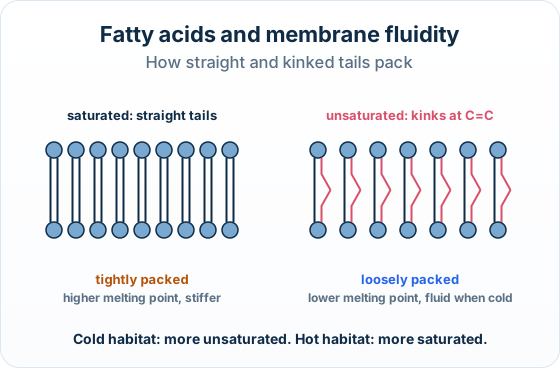
Two bilayers side by side: one with straight saturated tails packed tightly, labelled higher melting point and stiffer; one with tails kinked at a C=C double bond, loosely packed, labelled lower melting point and fluid when cold
Straight tails pack; kinked tails do not.

Free preview

This is the free notes preview

You're reading the free notes. Aimnova Pro unlocks the full study experience — and you can try it with your first topic free to keep:

  • FlashcardsLock in vocabulary and key terms with spaced repetition.
  • Practice questionsAnswer exam-style questions and get instant AI marking.
  • Mock exams & past-paper vaultSit full mocks and see exactly how examiners award marks.
  • Personalised study planA daily plan built around your exam date and weak areas.
Start Studying Free Full access to Aimnova Pro · cancel anytime
The big idea: A membrane must stay fluid enough to work, but not so fluid that it leaks. Organisms adjust their fatty acids to the temperature they live at.

Bacteria grown cold

  • E. coli grown at low temperature makes more unsaturated fatty acids
  • Its membranes stay fluid in the cold

Reindeer legs

  • Cells near the hooves, which get very cold, have more unsaturated fatty acids
  • Than cells near the warm body

Hot springs

  • Bacteria that live in hot springs have more saturated fatty acids
  • Their membranes stay strong when hot
Say which way and why: Name the type of fatty acid AND the temperature: unsaturated for cold, saturated for warm. Add that cholesterol also adjusts fluidity in animal cells.

Memorize terms 3x faster

Smart flashcards show you cards right before you forget them. Perfect for definitions and key concepts.

Try Flashcards FreeYour first topic is free to keep • No credit card required
How it is asked: Paper 2 asks for the effect of fatty acids on fluidity [1], or how membranes are adapted to different temperatures [3]. Paper 1A gives a table of possible changes for a cold habitat.
IB-style questionOutline[3 marks]

Fish living in the Antarctic Ocean, at about −1.8 °C, have cell membranes that still work. Outline how membranes can be adapted to different temperatures.

Model answer plan

See the answer broken into clear points, with guidance on how each point earns marks.

Claim your free topic

Try an IB Exam Question — Free AI Feedback

Test yourself on Relationships between fatty acid composition of lipid bilayers and their fluidity. Write your answer and get instant AI feedback — just like a real IB examiner.

The membranes of fish from warm tropical waters contain more saturated fatty acids than those of polar fish.

the effect of fatty acids on the fluidity of membranes.
[1 mark]

Related Biology HL Topics

Continue learning with these related topics from the same unit:

2.1.1Chemical properties of carbon that allow diverse compounds2.1.2Production of macromolecules by condensation reactions2.1.3Digestion of polymers into monomers by hydrolysis reactions2.1.4Form and function of monosaccharides
View all Biology HL topics
Improve your exam techniqueCommand terms, paper structure, and mark-scheme tips for Biology HL
Previous2.3.10Fluid mosaic model of membrane structureNextCholesterol and membrane fluidity in animal cells2.3.12

9 practice questions on Relationships between fatty acid composition of lipid bilayers and their fluidity

Students who practiced this topic on Aimnova scored 82% on average. Try free practice questions and get instant AI feedback.

Try 3 Free QuestionsView All Biology HL Topics