aımnova
DashboardMy LearningCrash CoursesStudy Plan

Aimnova site navigation

Stay in the loop

Get the latest study resources and updates

New features, study tips and exam insights — straight to your inbox.

IB Diploma

  • IB Past Papers
  • IB Study Notes
  • IB Question Bank
  • IB Mock Exams
  • IB Revision

IB Subjects

  • IB Math AA
  • IB Math AI
  • IB Economics
  • IB Business Management
  • IB Physics
  • IB Biology
  • View all IB subjects→

IB Past Papers

  • IB Math AA HL Past Papers
  • IB Math AA SL Past Papers
  • IB Math AI HL Past Papers
  • IB Math AI SL Past Papers
  • IB Economics HL Past Papers
  • IB Economics SL Past Papers
  • IB ESS Past Papers
  • View all past papers→

Study Resources

  • Study Notes
  • Question Bank
  • Mock Exams
  • Crash Courses
  • Flashcards
  • Revision Guide
  • Exam Skills
  • Command Terms
  • Grade Calculator
  • Exam Timetable 2026

Aimnova

  • Features
  • Pricing
  • For Teachers
  • For Schools
  • For Parents
  • About Us
  • Blog
  • Contact
aımnova

IB study, practice and feedback built around the real exam.

TermsPrivacyCookies·© 2026 Aimnova. All rights reserved.c90f7ab

Aimnova is not affiliated with or endorsed by the International Baccalaureate Organization (IB).

NotesBiology HLTopic 2.2Bonds and interactions that stabilise tertiary structure
Back to Biology HL Topics
2.2.93 min read

Bonds and interactions that stabilise tertiary structure (Biology HL)

IB Biology · Unit 2

Smart study tools

Turn reading into results

Move beyond passive notes. Answer exam-style questions, get AI feedback, and build the skills that earn top marks.

Get Started Free

Contents

  1. 1Four ways R-groups hold the fold
  2. 2How R-groups become charged
  3. 3Exam-style question (step by step)
The big idea: When a chain folds, R-groups from far apart in the sequence end up next to each other. Four kinds of bond between them lock the fold in place.

The points to remember

  • Tertiary structure is the way the whole chain folds into its 3-D shape.
  • Hydrogen bonds form between polar R-groups.
  • Ionic bonds form between R-groups with opposite charges.
  • Disulfide bonds are covalent bonds between two cysteines: the strongest of the four.
  • Hydrophobic interactions hold non-polar R-groups together, away from water.
Remember it as: H, ionic, S-S and hydrophobic: four ways R-groups hold on.
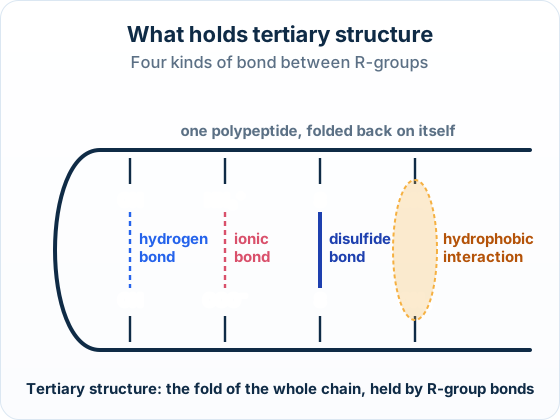
A chain folded back on itself with R-groups facing each other: a dashed hydrogen bond between two OH groups, a dashed ionic bond between NH3+ and COO-, a solid disulfide bond between two S atoms, and a shaded hydrophobic interaction between two CH3 groups
The four bonds that hold tertiary structure.
Bond or interactionBetweenStrength
Hydrogen bondpolar R-groupsweak
Ionic bondpositive and negative R-groupsweak
Disulfide bondthe S atoms of two cysteinesstrong (covalent)
Hydrophobic interactionnon-polar R-groupsweak
Bond or interaction?: Say hydrophobic interactions, not hydrophobic bonds, and hydrogen bonds, ionic bonds and disulfide bonds as bonds.

Free preview

This is the free notes preview

You're reading the free notes. Aimnova Pro unlocks the full study experience — and you can try it with your first topic free to keep:

  • FlashcardsLock in vocabulary and key terms with spaced repetition.
  • Practice questionsAnswer exam-style questions and get instant AI marking.
  • Mock exams & past-paper vaultSit full mocks and see exactly how examiners award marks.
  • Personalised study planA daily plan built around your exam date and weak areas.
Start Studying Free Full access to Aimnova Pro · cancel anytime
The big idea: Some R-groups contain an amine or a carboxyl group. Gaining or losing a hydrogen ion gives them a charge, and charged R-groups can form ionic bonds.

The points to remember

  • An amine group in an R-group can gain H⁺ and become positive: NH₂ → NH₃⁺.
  • A carboxyl group in an R-group can lose H⁺ and become negative: COOH → COO⁻.
  • Opposite charges attract: NH₃⁺ and COO⁻ form an ionic bond.
  • pH sets how many H⁺ ions there are, so a change in pH changes the charges and can break ionic bonds.
Remember it as: Amine gains H⁺: plus. Carboxyl loses H⁺: minus.

Amine group in an R-group

  • Gains H⁺
  • NH₂ becomes NH₃⁺
  • Positive charge

Carboxyl group in an R-group

  • Loses H⁺
  • COOH becomes COO⁻
  • Negative charge
Real example: hair perms: Hair is the protein keratin, rich in disulfide bonds. A perm lotion breaks them, the hair is set on rollers, and a second lotion forms new disulfide bonds that hold the new curl.

Memorize terms 3x faster

Smart flashcards show you cards right before you forget them. Perfect for definitions and key concepts.

Try Flashcards FreeYour first topic is free to keep • No credit card required
How it is asked: A two-mark List of R-group interactions, and multiple-choice items that match each level of structure to the bonds that hold it.
IB-style questionList[2 marks]

Interactions between R-groups in different parts of a polypeptide help to determine the tertiary structure of a protein. List two types of interaction between R-groups.

Model answer plan

See the answer broken into clear points, with guidance on how each point earns marks.

Claim your free topic

And the level-and-bond match from Paper 1A:

IB-style questionIdentify[1 mark]

Which level of protein structure is stabilised by disulfide, hydrogen and ionic bonds between R-groups?

Model answer plan

See the answer broken into clear points, with guidance on how each point earns marks.

Claim your free topic

Try an IB Exam Question — Free AI Feedback

Test yourself on Bonds and interactions that stabilise tertiary structure. Write your answer and get instant AI feedback — just like a real IB examiner.

Keratin in hair is a protein whose shape is held by interactions between R-groups.

two types of interaction between R-groups.
[2 marks]

Related Biology HL Topics

Continue learning with these related topics from the same unit:

2.1.1Chemical properties of carbon that allow diverse compounds2.1.2Production of macromolecules by condensation reactions2.1.3Digestion of polymers into monomers by hydrolysis reactions2.1.4Form and function of monosaccharides
View all Biology HL topics
Improve your exam techniqueCommand terms, paper structure, and mark-scheme tips for Biology HL
Previous2.2.8Pleating and coiling of secondary structureNextEffect of polar and non-polar amino acids on tertiary structure2.2.10

6 questions to test your understanding

Reading is just the start. Students who tested themselves scored 82% on average — try IB-style questions with AI feedback.

Start FreeView All Biology HL Topics