aımnova
DashboardMy LearningCrash CoursesStudy Plan

Aimnova site navigation

Stay in the loop

Get the latest study resources and updates

New features, study tips and exam insights — straight to your inbox.

IB Diploma

  • IB Past Papers
  • IB Study Notes
  • IB Question Bank
  • IB Mock Exams
  • IB Revision

IB Subjects

  • IB Math AA
  • IB Math AI
  • IB Economics
  • IB Business Management
  • IB Physics
  • IB Biology
  • View all IB subjects→

IB Past Papers

  • IB Math AA HL Past Papers
  • IB Math AA SL Past Papers
  • IB Math AI HL Past Papers
  • IB Math AI SL Past Papers
  • IB Economics HL Past Papers
  • IB Economics SL Past Papers
  • IB ESS Past Papers
  • View all past papers→

Study Resources

  • Study Notes
  • Question Bank
  • Mock Exams
  • Crash Courses
  • Flashcards
  • Revision Guide
  • Exam Skills
  • Command Terms
  • Grade Calculator
  • Exam Timetable 2026

Aimnova

  • Features
  • Pricing
  • For Teachers
  • For Schools
  • For Parents
  • About Us
  • Blog
  • Contact
aımnova

IB study, practice and feedback built around the real exam.

TermsPrivacyCookies·© 2026 Aimnova. All rights reserved.c90f7ab

Aimnova is not affiliated with or endorsed by the International Baccalaureate Organization (IB).

NotesBiology HLTopic 2.2Effect of polar and non-polar amino acids on tertiary structure
Back to Biology HL Topics
2.2.104 min read

Effect of polar and non-polar amino acids on tertiary structure (Biology HL)

IB Biology · Unit 2

Your first topic is free to keep

Know exactly what to write for full marks

Practice with exam questions and get AI feedback that shows you the perfect answer — what examiners want to see.

Start Free

Contents

  1. 1Soluble proteins: polar outside, non-polar core
  2. 2Integral proteins in membranes
  3. 3Exam-style question (step by step)
The big idea: A chain folds so that each R-group ends up where it is most stable: non-polar ones away from water, polar ones in contact with it.

The points to remember

  • In a soluble globular protein, the chain folds so non-polar R-groups cluster in the core.
  • Polar R-groups end up on the surface, where they form hydrogen bonds with water.
  • That is why such proteins dissolve in water: in blood plasma or in the cytoplasm.
  • The hydrophobic core also helps hold the fold together.
Remember it as: Oil in the middle, water-lovers on the skin.
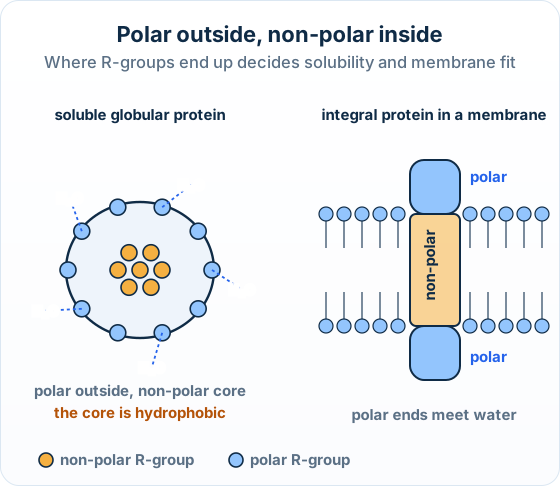
Left: a globular protein with polar R-groups on its surface bonded to water molecules and non-polar R-groups clustered in its core. Right: an integral protein crossing a phospholipid bilayer, its middle region non-polar beside the tails and its two ends polar, facing water
Where polar and non-polar R-groups end up.
Real example: myoglobin: Myoglobin, the oxygen store in muscle, has almost all its non-polar R-groups on the inside and its polar R-groups on the outside, so it dissolves in the watery cytoplasm of muscle cells.

Free preview

This is the free notes preview

You're reading the free notes. Aimnova Pro unlocks the full study experience — and you can try it with your first topic free to keep:

  • FlashcardsLock in vocabulary and key terms with spaced repetition.
  • Practice questionsAnswer exam-style questions and get instant AI marking.
  • Mock exams & past-paper vaultSit full mocks and see exactly how examiners award marks.
  • Personalised study planA daily plan built around your exam date and weak areas.
Start Studying Free Full access to Aimnova Pro · cancel anytime
The big idea: A membrane is the opposite of water inside: its middle is hydrophobic. Proteins that sit in it have a matching hydrophobic belt.

The points to remember

  • An integral protein is embedded in a membrane, crossing the phospholipid bilayer.
  • The part inside the membrane has non-polar R-groups, in contact with the hydrophobic fatty acid tails.
  • The parts outside have polar R-groups, in contact with water on each side.
  • So hydrophobic regions hold the protein in the membrane, the way the core holds a soluble protein together.
Remember it as: A non-polar belt for the tails, polar ends for the water.

Soluble globular protein

  • Non-polar R-groups in the core
  • Polar R-groups on the surface
  • Dissolves in water

Integral membrane protein

  • Non-polar R-groups where it crosses the membrane
  • Polar R-groups at the ends
  • Stays embedded in the bilayer
Real example: aquaporins: Aquaporins, the water channels in kidney cells, cross the membrane several times. Each crossing has a band of non-polar R-groups that sits among the fatty acid tails.

Memorize terms 3x faster

Smart flashcards show you cards right before you forget them. Perfect for definitions and key concepts.

Try Flashcards FreeYour first topic is free to keep • No credit card required
How it is asked: Paper 1A gives a protein whose polar and non-polar R-groups are placed, and asks what can be deduced. Paper 2 can ask how integral proteins stay in the membrane.
IB-style questionDeduce[1 mark]

In a globular protein, nearly all the non-polar R-groups point inwards and the polar R-groups are on the outside. What can be deduced?

Model answer plan

See the answer broken into clear points, with guidance on how each point earns marks.

Claim your free topic

And a three-mark Explain on integral proteins:

IB-style questionExplain[3 marks]

Explain how the distribution of amino acids allows an integral protein to stay embedded in a membrane.

Model answer plan

See the answer broken into clear points, with guidance on how each point earns marks.

Claim your free topic

Try an IB Exam Question — Free AI Feedback

Test yourself on Effect of polar and non-polar amino acids on tertiary structure. Write your answer and get instant AI feedback — just like a real IB examiner.

where the hydrophobic amino acids are found in a protein that is soluble in water. [1 mark]

Related Biology HL Topics

Continue learning with these related topics from the same unit:

2.1.1Chemical properties of carbon that allow diverse compounds2.1.2Production of macromolecules by condensation reactions2.1.3Digestion of polymers into monomers by hydrolysis reactions2.1.4Form and function of monosaccharides
View all Biology HL topics
Improve your exam techniqueCommand terms, paper structure, and mark-scheme tips for Biology HL
Previous2.2.9Bonds and interactions that stabilise tertiary structureNextQuaternary structure of non-conjugated and conjugated proteins2.2.11

5 practice questions on Effect of polar and non-polar amino acids on tertiary structure

Students who practiced this topic on Aimnova scored 82% on average. Try free practice questions and get instant AI feedback.

Try 3 Free QuestionsView All Biology HL Topics