Denaturation at Higher Level: The same statement as SL. At HL the bonds that heat and pH break are named: hydrogen bonds, ionic bonds and hydrophobic interactions between R-groups (2.2.9); disulfide bonds are covalent and more resistant.
Practise this as you read
- Explain how heat and extreme pH denature a protein.
- Outline why denaturation is usually permanent.
Free preview
This is the free notes preview
You're reading the free notes. Aimnova Pro unlocks the full study experience — and you can try it with your first topic free to keep:
- FlashcardsLock in vocabulary and key terms with spaced repetition.
- Practice questionsAnswer exam-style questions and get instant AI marking.
- Mock exams & past-paper vaultSit full mocks and see exactly how examiners award marks.
- Personalised study planA daily plan built around your exam date and weak areas.
The big idea: A protein is a chain of amino acids that folds up into a precise 3D shape, its conformation.
From sequence to function
A chain
A protein is a chain of amino acids, but it does not stay as a straight chain.
It folds
It folds up into a precise 3D shape. We call this folded shape the protein's conformation.
Shape is set by order
The shape is not random — it is decided by the order of the amino acids in the chain.
Shape sets the job
Because a protein's job depends on its shape, the sequence determines the function.
Sequence → shape → function
The four levels of protein structure: primary (sequence) → secondary (α-helices and β-pleated sheets) → tertiary (one chain folded into a 3D shape) → quaternary (two or more chains together). The sequence determines every higher level.
Interactive diagram
Explore the labelled diagram, charts and maps for this topic in full study mode.
- Amino acid
- The small subunit (monomer) that proteins are built from. Different amino acids have different side groups (R-groups).
- Polypeptide
- A chain of many amino acids joined by peptide bonds. One or more polypeptides make up a protein.
- Conformation
- The specific folded 3D shape a protein takes. The protein only works correctly in its normal conformation.
- Primary structure
- The sequence (order) of amino acids in a polypeptide chain.
Sequence decides shape: The single most important idea here: the amino acid sequence (primary structure) determines the protein's conformation.
Change the sequence and you change the folding — which can change, or destroy, what the protein does.
Feeling unprepared for exams?
Get a clear study plan, practice with real questions, and know exactly where you stand before exam day. No more guessing.
Biologists describe protein folding at four levels. Each level builds on the one before it, starting from the simple chain and ending with the finished protein.
You should be able to name each level and say what it is.
- Primary structure
- The sequence (order) of amino acids in the chain, joined by peptide bonds.
- Secondary structure
- Local folding of the chain into α-helices (coils) and β-pleated sheets, held by hydrogen bonds along the backbone.
- Tertiary structure
- The way the whole single chain folds into one overall 3D shape, held by bonds between the R-groups.
- Quaternary structure
- The way two or more folded polypeptide chains (subunits) fit together to make one functional protein (for example haemoglobin's four chains).
| Level | What it is | What holds it together |
|---|---|---|
| Primary | The order (sequence) of amino acids in the chain | Peptide bonds (formed by condensation) |
| Secondary | Local folding into α-helices (coils) and β-pleated sheets | Hydrogen bonds between parts of the backbone |
| Tertiary | The whole single chain folds into a precise 3D shape | Bonds between R-groups (e.g. hydrogen bonds, ionic bonds, disulfide bridges) |
| Quaternary | Two or more folded chains (subunits) join into one protein | The same R-group interactions, now between subunits |
Single-chain proteins
- Made of one polypeptide chain
- Have primary, secondary and tertiary structure
- Do not have quaternary structure
- Example: lysozyme (one folded chain)
Multi-chain proteins
- Made of two or more polypeptide chains
- Have primary, secondary, tertiary and quaternary structure
- The subunits fit together into one protein
- Example: haemoglobin (four chains together)
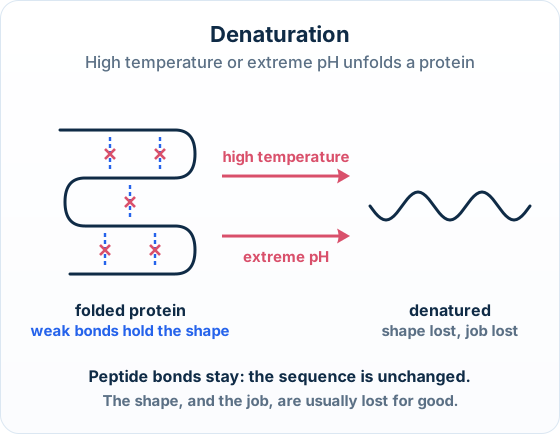
Denaturation — losing the shape: High temperature or extreme pH unfolds a protein and stops it working. This is called denaturation.
What happens in denaturation
Weak bonds hold the shape
The folded shape is held mostly by weak bonds (hydrogen bonds, ionic bonds).
The bonds break
High temperature or extreme pH breaks these weak bonds, so the chain unfolds and loses its 3D shape.
The job is lost
A denatured protein can no longer do its job — for example, a denatured enzyme stops catalysing its reaction.
The peptide bonds stay intact (the sequence is unchanged), but the conformation is lost.
| Cause of denaturation | What happens to the bonds | Effect on the protein |
|---|---|---|
| High temperature | Atoms vibrate more, breaking the weak hydrogen and ionic bonds that hold the folded shape | The chain unfolds — its 3D shape (conformation) is lost |
| Extreme pH (very acidic or alkaline) | Extra H⁺ or OH⁻ ions interfere with the charged R-groups, breaking ionic and hydrogen bonds | The chain unfolds — its 3D shape is lost |
| Result | Only the weak bonds break — the peptide bonds (primary sequence) stay intact | The protein can no longer do its job (e.g. an enzyme stops working) |
Why denaturation usually can't be undone: Because the sequence still depends on the order of amino acids, denaturation does not break the chain itself.
But the protein often cannot re-fold into exactly the right shape, so the loss of function is usually permanent (think of how a cooked egg white never turns runny again).
The big idea: A protein works only while it keeps its shape. Heat and extreme pH both break the weak bonds that hold that shape, and the protein is denatured.
The points to remember
- A protein keeps its shape only within a range of temperature and pH.
- High temperature: more vibration breaks the hydrogen bonds and other weak bonds between R-groups.
- Extreme pH: extra H⁺ or OH⁻ ions change the charges on R-groups, so ionic and hydrogen bonds break.
- The chain unfolds: denaturation. The peptide bonds, and so the sequence, stay the same.
- Denaturation is usually permanent, and denatured proteins often become insoluble.
Remember it as: Heat shakes the bonds apart; pH changes the charges.
Real example: Taq polymerase: Taq polymerase, from bacteria that live in hot springs, keeps its shape at 72 °C, a temperature that denatures most human proteins.
Memorize terms 3x faster
Smart flashcards show you cards right before you forget them. Perfect for definitions and key concepts.
How this is tested: Protein structure comes up as a Paper 2 Outline, a Paper 1 multiple-choice item and a short denaturation question.
| Where | What you are asked | What scores |
|---|---|---|
| Paper 2 (4 marks, Outline) | Outline the structure of proteins | The four levels as four separate scoring points (primary = sequence; secondary = α-helix / β-pleated sheet; tertiary = whole chain folds into a 3D shape; quaternary = two or more chains together) |
| Paper 1 (multiple choice) | Select the correct statements describing protein structure | The key true statement: the amino acid sequence determines the conformation |
| Short question on denaturation | Name what high temperature or extreme pH does to a protein's shape | It unfolds it / denatures it |
Exam-style question — outline the structure of proteins
Outline the structure of proteins. [4]
How to score all four marks
- Primary structure. The sequence (order) of amino acids in the polypeptide chain, joined by peptide bonds.
- Secondary structure. The chain coils and folds locally into α-helices and β-pleated sheets, held by hydrogen bonds.
- Tertiary structure. The whole single chain folds into a precise 3D shape (conformation), held by bonds between the R-groups.
- Quaternary structure. Two or more folded chains (subunits) join together to make one functional protein. (Award 1 mark for each level correctly described, up to 4.)
Final answer
Primary = sequence of amino acids; secondary = α-helices and β-pleated sheets held by hydrogen bonds; tertiary = the whole chain folded into a 3D shape; quaternary = two or more chains joined together.
The four levels of protein structure: primary (sequence) → secondary (α-helices and β-pleated sheets) → tertiary (one chain folded into a 3D shape) → quaternary (two or more chains together). The sequence determines every higher level.
Interactive diagram
Explore the labelled diagram, charts and maps for this topic in full study mode.
Why this scores full marks: Each of the four levels is a separate, distinct point — primary, secondary, tertiary, quaternary.
An 'outline' worth 4 marks needs four scoring points. Do not write 'it folds into a shape' three different ways — name each level and say what it is.
A three-mark Explain on pH, in the Paper 2 style:
Pepsin works in the stomach at about pH 2. Explain why it stops working in the alkaline small intestine.
Model answer plan
See the answer broken into clear points, with guidance on how each point earns marks.