aımnova
DashboardMy LearningCrash CoursesStudy Plan

Aimnova site navigation

Stay in the loop

Get the latest study resources and updates

New features, study tips and exam insights — straight to your inbox.

IB Diploma

  • IB Past Papers
  • IB Study Notes
  • IB Question Bank
  • IB Mock Exams
  • IB Revision

IB Subjects

  • IB Math AA
  • IB Math AI
  • IB Economics
  • IB Business Management
  • IB Physics
  • IB Biology
  • View all IB subjects→

IB Past Papers

  • IB Math AA HL Past Papers
  • IB Math AA SL Past Papers
  • IB Math AI HL Past Papers
  • IB Math AI SL Past Papers
  • IB Economics HL Past Papers
  • IB Economics SL Past Papers
  • IB ESS Past Papers
  • View all past papers→

Study Resources

  • Study Notes
  • Question Bank
  • Mock Exams
  • Crash Courses
  • Flashcards
  • Revision Guide
  • Exam Skills
  • Command Terms
  • Grade Calculator
  • Exam Timetable 2026

Aimnova

  • Features
  • Pricing
  • For Teachers
  • For Schools
  • For Parents
  • About Us
  • Blog
  • Contact
aımnova

IB study, practice and feedback built around the real exam.

TermsPrivacyCookies·© 2026 Aimnova. All rights reserved.c90f7ab

Aimnova is not affiliated with or endorsed by the International Baccalaureate Organization (IB).

NotesBiology HLTopic 2.2Form and function of globular and fibrous proteins
Back to Biology HL Topics
2.2.124 min read

Form and function of globular and fibrous proteins (Biology HL)

IB Biology · Unit 2

Smart study tools

Turn reading into results

Move beyond passive notes. Answer exam-style questions, get AI feedback, and build the skills that earn top marks.

Get Started Free

Contents

  1. 1Compact or long
  2. 2Insulin and collagen: shape suits job
  3. 3Exam-style question (step by step)
The big idea: Proteins come in two broad shapes. Compact, rounded globular proteins do precise chemical jobs; long, fibrous proteins give strength.

The points to remember

  • Globular proteins fold into a compact, rounded shape.
  • They are usually soluble, with polar R-groups on the surface, and have a precise shape that binds specific molecules.
  • Fibrous proteins are long and narrow: chains lie side by side, often in repeating patterns.
  • They are usually insoluble and strong, so they give support and strength.
Remember it as: Globular: a ball that dissolves. Fibrous: a rope that holds.
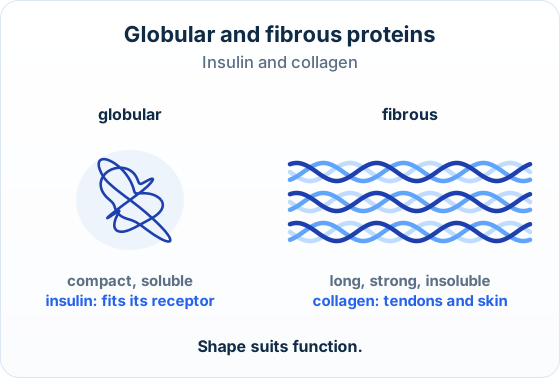
Left: a globular protein, a compact rounded fold, labelled soluble, insulin fits its receptor. Right: a fibrous protein, three triple helices packed side by side, labelled long, strong, insoluble, collagen in tendons and skin
Globular and fibrous proteins.
FeatureGlobular (insulin)Fibrous (collagen)
Shapecompact, roundedlong, narrow fibres
In watersolubleinsoluble
Sequencevaried, no simple repeatsrepeating sequence
Jobsignalling, catalysis, transportstrength and support

Free preview

This is the free notes preview

You're reading the free notes. Aimnova Pro unlocks the full study experience — and you can try it with your first topic free to keep:

  • FlashcardsLock in vocabulary and key terms with spaced repetition.
  • Practice questionsAnswer exam-style questions and get instant AI marking.
  • Mock exams & past-paper vaultSit full mocks and see exactly how examiners award marks.
  • Personalised study planA daily plan built around your exam date and weak areas.
Start Studying Free Full access to Aimnova Pro · cancel anytime
The big idea: Insulin and collagen show how shape suits function: one must dissolve and fit a receptor, the other must resist being pulled.

The points to remember

  • Insulin is globular: small and soluble, so it travels in blood plasma.
  • Its precise shape fits the insulin receptor on target cells, so it can signal them to take up glucose.
  • Collagen is fibrous: three chains wind into a triple helix, and many helices pack side by side.
  • That makes it strong under tension and insoluble: ideal for tendons, ligaments, skin and bone.
Remember it as: Insulin fits; collagen holds.

Insulin (globular)

  • Compact, soluble
  • Carried in blood plasma
  • Precise shape binds its receptor

Collagen (fibrous)

  • Long triple helices
  • Insoluble, strong under tension
  • Tendons, ligaments, skin, bone
Real example: scurvy: Without vitamin C, the body cannot make stable collagen. In scurvy, gums bleed and wounds fail to heal, because the tissues lose the strength that collagen fibres give them.

See how examiners mark answers

Answer exam-style questions with model answers. Learn exactly what earns marks and what doesn't.

Try Exam Vault FreeYour first topic is free to keep • No credit card required
How it is asked: Paper 1A shows diagrams of proteins and asks you to describe each (globular, fibrous, conjugated, a level of structure). Paper 2 can ask you to compare insulin and collagen.
IB-style questionIdentify[1 mark]

Three protein diagrams: one is four subunits each with a small non-protein group, one is a long triple helix, one is a compact folded chain. Which row describes them?

Model answer plan

See the answer broken into clear points, with guidance on how each point earns marks.

Claim your free topic

And a three-mark Compare and contrast:

IB-style questionCompare and contrast[3 marks]

Compare and contrast the structure of insulin and collagen.

Model answer plan

See the answer broken into clear points, with guidance on how each point earns marks.

Claim your free topic

IB Exam Questions on Form and function of globular and fibrous proteins

Practice with IB-style questions filtered to Topic 2.2.12. Get instant AI feedback on every answer.

Practice Topic 2.2.12 QuestionsBrowse All Biology HL Topics

How Form and function of globular and fibrous proteins Appears in IB Exams

Examiners use specific command terms when asking about this topic. Here's what to expect:

  • Define

    Give the precise meaning of key terms related to Form and function of globular and fibrous proteins.

    AO1
  • Describe

    Give a detailed account of processes or features in Form and function of globular and fibrous proteins.

    AO2
  • Explain

    Give reasons WHY — cause and effect within Form and function of globular and fibrous proteins.

    AO3
  • Evaluate

    Weigh strengths AND limitations of approaches in Form and function of globular and fibrous proteins.

    AO3
  • Discuss

    Present arguments FOR and AGAINST with a balanced conclusion.

    AO3

See the full IB Command Terms guide

Related Biology HL Topics

Continue learning with these related topics from the same unit:

2.1.1Chemical properties of carbon that allow diverse compounds2.1.2Production of macromolecules by condensation reactions2.1.3Digestion of polymers into monomers by hydrolysis reactions2.1.4Form and function of monosaccharides
View all Biology HL topics
Improve your exam techniqueCommand terms, paper structure, and mark-scheme tips for Biology HL
Previous2.2.11Quaternary structure of non-conjugated and conjugated proteinsNextLipid bilayers as the basis of cell membranes2.3.1

4 exam-style questions ready for you

Students who practice on Aimnova improve their scores by 15% on average. Get instant feedback that shows exactly how to improve your answers.

Practice Now — FreeView All Biology HL Topics