Triglycerides and phospholipids at Higher Level: The same statement as SL. HL papers test it on drawn structures: name the bond and the reaction, find the glycerol, and pick out a phospholipid from look-alike molecules, then link its structure to membranes.
Practise this as you read
- Draw a triglyceride with its ester bonds.
- Identify glycerol, an ester bond and the reaction that forms it.
- Distinguish a phospholipid from a triglyceride.
Free preview
This is the free notes preview
You're reading the free notes. Aimnova Pro unlocks the full study experience — and you can try it with your first topic free to keep:
- FlashcardsLock in vocabulary and key terms with spaced repetition.
- Practice questionsAnswer exam-style questions and get instant AI marking.
- Mock exams & past-paper vaultSit full mocks and see exactly how examiners award marks.
- Personalised study planA daily plan built around your exam date and weak areas.
The big idea: A triglyceride is the main kind of fat and oil in living things. It is built from two kinds of smaller molecule: one glycerol plus three fatty acids.
The name is a clue: Tri (three) + glyceride (built on glycerol) = three fatty acids attached to one glycerol.
| Part of a triglyceride | What it is | How many |
|---|---|---|
| Glycerol | A small 3-carbon molecule with three —OH (hydroxyl) groups | 1 — the backbone |
| Fatty acid | A long hydrocarbon chain ending in a —COOH (carboxyl) group | 3 — one per —OH |
| Ester bond | The bond formed where a fatty acid joins the glycerol | 3 — one per fatty acid |
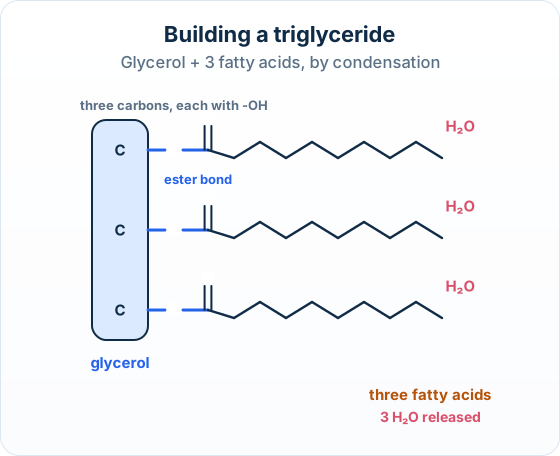
The labelled triglyceride: glycerol backbone on the left, three fatty-acid tails, and the three ester bonds where they join.
Interactive diagram
Explore the labelled diagram, charts and maps for this topic in full study mode.
- Triglyceride
- A lipid made of one glycerol joined to three fatty acids. Triglycerides are the fats (solid) and oils (liquid) of living things.
- Glycerol
- A small 3-carbon molecule that forms the backbone of a triglyceride. It has three hydroxyl (—OH) groups, one for each fatty acid.
- Fatty acid
- A long chain of carbon and hydrogen (a hydrocarbon tail) ending in a carboxyl (—COOH) group, which is where it joins the glycerol.
Picture one triglyceride: Think of an E shape: a short glycerol backbone down the side, with three long fatty-acid tails sticking out.
Each tail joins the backbone at one point — so there are three joins in total.
Practice with exam-style questions
Answer exam-style questions and get AI feedback that shows you exactly what examiners want to see in a full-marks response.
Glycerol and the fatty acids join by a reaction called condensation.
What happens in condensation
- Each time a fatty acid joins the glycerol, one water molecule (H₂O) is removed.
- A new bond called an ester bond forms.
- A triglyceride has three fatty acids, so three ester bonds form.
- Three water molecules are released in total.
- Condensation
- A reaction that joins two molecules together and removes a molecule of water (H₂O) as it forms the new bond.
- Ester bond
- The bond formed between a fatty acid and glycerol in a triglyceride. It is made by condensation (and broken by hydrolysis).
- Hydrolysis
- The reverse of condensation: a reaction that splits a molecule apart by adding water (H₂O). 'Hydro' = water, 'lysis' = splitting.
A triglyceride: one glycerol backbone joined to three fatty acids by three ester bonds. Building it is condensation (3 H₂O removed); breaking it is hydrolysis (3 H₂O added).
Interactive diagram
Explore the labelled diagram, charts and maps for this topic in full study mode.
Condensation builds, hydrolysis breaks: Building a triglyceride = condensation. Three ester bonds form; three H₂O are removed (one per ester bond).
Breaking a triglyceride = hydrolysis. Three H₂O are added back, the three ester bonds break, and you get the original glycerol + three fatty acids again.
So the products of hydrolysing one triglyceride are 1 glycerol and 3 fatty acids.
Saturated vs unsaturated fatty acids: Fatty-acid tails come in two types, depending on the bonds between their carbon atoms.
A saturated fatty acid has only single bonds (C–C) between its carbons. It is 'saturated' with as many hydrogens as it can hold, and the chain is straight.
Unsaturated means kinked: An unsaturated fatty acid has one or more double bonds (C=C) between carbons. Each double bond puts a kink (bend) in the chain.
Saturated fatty acid (straight chain, single C–C bonds only) vs unsaturated fatty acid (a C=C double bond puts a kink in the chain).
Interactive diagram
Explore the labelled diagram, charts and maps for this topic in full study mode.
Saturated fatty acid
- No C=C double bonds — only single C–C bonds
- Holds the maximum number of hydrogen atoms
- Chain is straight — molecules pack closely
- Tends to be solid at room temperature (e.g. butter, animal fat)
Unsaturated fatty acid
- Has one or more C=C double bonds
- Holds fewer hydrogens (not full / not 'saturated')
- Each double bond puts a kink — molecules pack loosely
- Tends to be liquid at room temperature (e.g. olive oil, plant oils)
An easy way to remember: Saturated = Straight + Solid (think butter).
Unsaturated = the double bond Undoes the straightness — a kinked, usually liquid oil (think olive oil).
The big idea: A triglyceride is built in three condensation reactions: each fatty acid joins glycerol by an ester bond, and each join releases water.
The points to remember
- Glycerol has three carbons, each with an -OH group.
- A fatty acid has a -COOH group at one end of a hydrocarbon chain.
- The -OH of glycerol and the -COOH of a fatty acid join by condensation.
- Each join makes an ester bond and releases one water molecule.
- Three fatty acids: three ester bonds, three water molecules: a triglyceride.
Remember it as: Three joins, three ester bonds, three waters.
Real example: olive oil: Olive oil is mostly triglycerides whose three fatty acids include oleic acid, made in the olive fruit by exactly these condensation reactions.
Feeling unprepared for exams?
Get a clear study plan, practice with real questions, and know exactly where you stand before exam day. No more guessing.
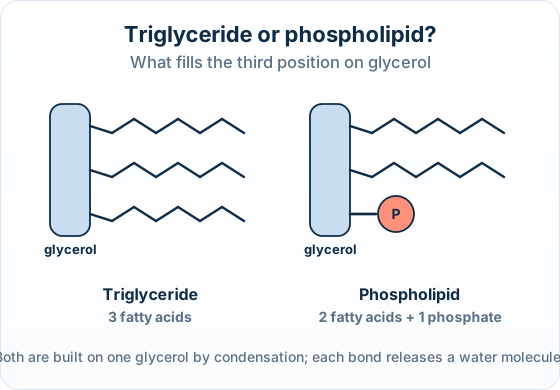
The big idea: Swap one fatty acid for a phosphate group and a triglyceride becomes a phospholipid, the molecule that builds membranes.
The points to remember
- A phospholipid is built on one glycerol, like a triglyceride.
- Two positions hold fatty acids; the third holds a phosphate group.
- All three bonds form by condensation, each releasing water.
- The phosphate end is hydrophilic; the two fatty acid tails are hydrophobic.
- Phospholipids contain phosphorus; triglycerides contain only carbon, hydrogen and oxygen.
A quick way to tell them apart from a list of elements:
Phosphorus is the clue: If a lipid contains phosphorus, it is a phospholipid. A triglyceride has no phosphate and only C, H and O.
How this is tested: Expect a labelled triglyceride diagram on Paper 2, and short identify questions on Paper 1A.
What you may be asked
- Paper 2: identify the ester bond and name the reaction that formed it (condensation).
- Paper 2: identify the glycerol backbone.
- Paper 2: state whether a fatty acid is saturated or unsaturated by looking for a C=C double bond in its chain.
- Paper 1A: identify the products of hydrolysing a triglyceride (glycerol + 3 fatty acids).
- Paper 1A: pick which broken-down molecule came from an unsaturated fat (the one with a double bond).
Exam-style question — a labelled triglyceride
A diagram shows a triglyceride: a short backbone on the left joined to three long chains, one chain containing a C=C double bond. (a) Name the molecule that forms the backbone. (b) Name the reaction that forms the bonds joining the chains to the backbone. (c) State the type of fatty acid shown by the chain containing the double bond. [3]
How to score all three marks
- (a) Backbone = glycerol. The short 3-carbon molecule that the three chains attach to is glycerol. (It is the part with the three —OH groups before the bonds form.)
- (b) Reaction = condensation. The fatty-acid chains join the glycerol by condensation, which forms an ester bond and removes a water molecule each time. (Naming it 'condensation' scores the mark; 'esterification' is also accepted.)
- (c) Fatty acid type = unsaturated. A chain containing a C=C double bond is an unsaturated fatty acid. (A chain with only single C–C bonds would be saturated.)
Final answer
(a) Glycerol. (b) Condensation (forming ester bonds). (c) Unsaturated, because the chain contains a C=C double bond.
The labelled triglyceride: glycerol backbone on the left, three fatty-acid tails, and the three ester bonds where they join.
Interactive diagram
Explore the labelled diagram, charts and maps for this topic in full study mode.
What the diagram should show: Make sure you can point to each part: the glycerol backbone, the three fatty-acid tails, and the three ester bonds where they join.
A straight tail = saturated; a tail with a kink at a C=C = unsaturated.
A four-mark Paper 2 version asks about phospholipids:
Outline the structure and properties of phospholipid molecules.
Model answer plan
See the answer broken into clear points, with guidance on how each point earns marks.