Fatty acids at Higher Level: The same statement as SL. HL papers show two fatty acids as full structures and ask you to compare them: count the double bonds, predict the melting point, and say where each is more likely to be found.
Practise this as you read
- Classify a fatty acid from a structure.
- Predict which of two fatty acids melts at a lower temperature.
- Relate oils to plants and fats to endotherms.
Free preview
This is the free notes preview
You're reading the free notes. Aimnova Pro unlocks the full study experience — and you can try it with your first topic free to keep:
- FlashcardsLock in vocabulary and key terms with spaced repetition.
- Practice questionsAnswer exam-style questions and get instant AI marking.
- Mock exams & past-paper vaultSit full mocks and see exactly how examiners award marks.
- Personalised study planA daily plan built around your exam date and weak areas.
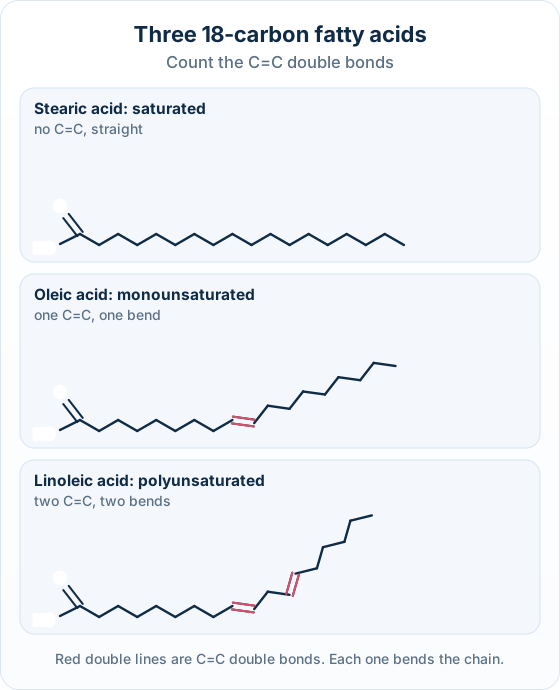
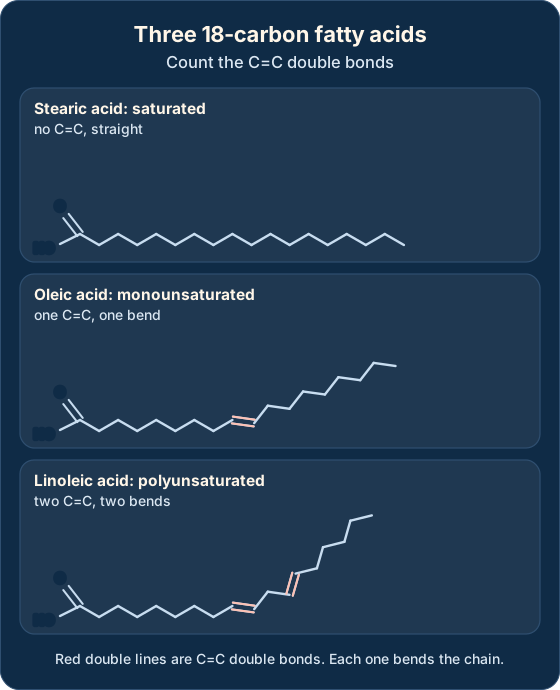
The big idea: Fatty acids are named by how many C=C double bonds their carbon chain has: none, one, or more than one.
The points to remember
- Saturated: no C=C double bonds; every carbon holds as many hydrogens as it can.
- Monounsaturated: one C=C double bond.
- Polyunsaturated: two or more C=C double bonds.
- To classify a fatty acid from a diagram, count the double bonds in the carbon chain.
Remember it as: Saturated: none. Mono: one. Poly: many.
Real example: linseed oil: Linseed oil, from flax seeds, is mostly linolenic acid, which has three C=C double bonds: a polyunsaturated fatty acid.
Feeling unprepared for exams?
Get a clear study plan, practice with real questions, and know exactly where you stand before exam day. No more guessing.
The big idea: Double bonds bend the chains, so they cannot pack closely. The more double bonds, the lower the melting point.
The points to remember
- A C=C double bond puts a bend in the chain.
- Straight saturated chains pack closely; bent unsaturated chains cannot.
- Close-packed chains attract each other more, so they need more heat to melt.
- So more double bonds = lower melting point.
- Saturated fats are solid at room temperature; unsaturated oils are liquid.
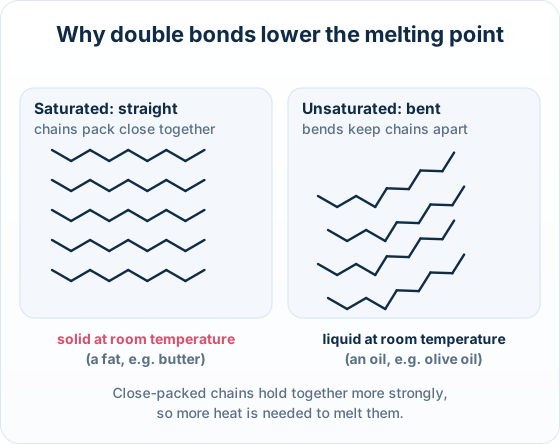
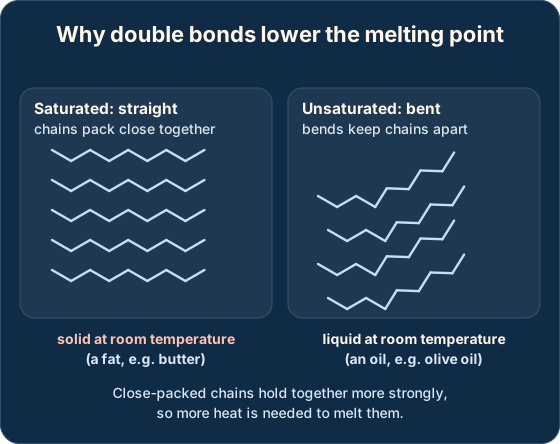
Remember it as: Bent chains, loose packing, low melting point.
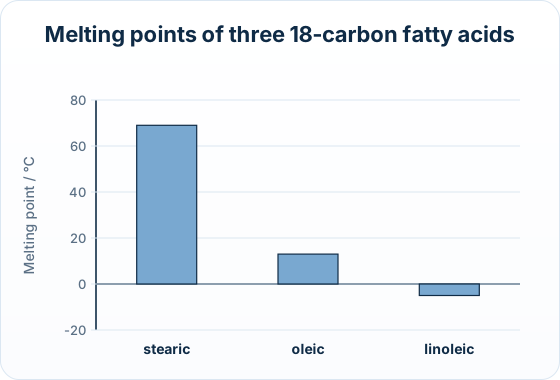
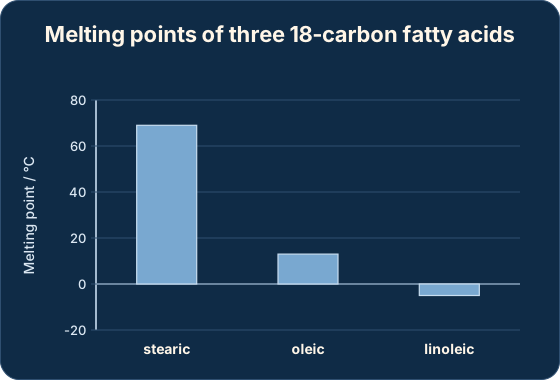
Not about covalent bonds breaking: Melting does not break the covalent bonds in the chains. It separates whole molecules, which is easier when bent chains are held apart.
The big idea: Plants store liquid, unsaturated oils; warm-bodied animals store more saturated, solid fats.
The points to remember
- Plants store energy as oils rich in unsaturated fatty acids.
- Oils stay liquid even when cold, so seeds and fruits can store and use them at low temperatures.
- Endotherms (birds, mammals) store fats richer in saturated fatty acids.
- Their bodies are kept warm, so these fats are soft enough in the body while forming a stable, solid store.
Plant oils
- Unsaturated fatty acids
- Liquid even when cold
- Olive, sunflower, linseed oil
Endotherm fats
- More saturated fatty acids
- Solid at room temperature
- Butter, lard, beef fat
Real example: beef fat: Beef fat is about half saturated fatty acids, so it is solid in the kitchen but soft in the warm body of the cow.
Memorize terms 3x faster
Smart flashcards show you cards right before you forget them. Perfect for definitions and key concepts.
How it is asked: Multiple-choice items on melting points (often with a chart), on why oils are liquid, on two drawn fatty acids, and a one-mark State on a chain in a drawn triglyceride.
The diagram shows a triglyceride. One fatty acid chain contains a double bond. State the type of fatty acid shown by that chain.
Model answer plan
See the answer broken into clear points, with guidance on how each point earns marks.
And a multiple-choice item on melting points:
Oils are liquid at room temperature while fats are solid. What explains this difference?
Model answer plan
See the answer broken into clear points, with guidance on how each point earns marks.