Causes of the crisis at Higher Level: The same statement as SL. At Higher Level, connect each specific cause to population growth and to global transport, and explain exactly how an invasive species harms the native community.
Practise this as you read
- Explain how global transport adds to biodiversity loss.
- Discuss the impacts of an invasive species.
Free preview
This is the free notes preview
You're reading the free notes. Aimnova Pro unlocks the full study experience — and you can try it with your first topic free to keep:
- FlashcardsLock in vocabulary and key terms with spaced repetition.
- Practice questionsAnswer exam-style questions and get instant AI marking.
- Mock exams & past-paper vaultSit full mocks and see exactly how examiners award marks.
- Personalised study planA daily plan built around your exam date and weak areas.
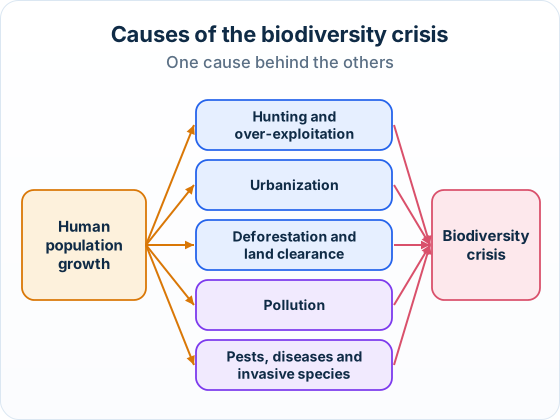
The big idea: Human population growth is the overarching cause: more people need more food, land, water and materials, and that drives every specific cause of biodiversity loss.
The points to remember
- The human population has grown very fast, especially in the last 100 years.
- More people need more food, land, water, energy and materials.
- That demand drives the specific causes: over-exploitation, urbanization, land clearance, pollution and invasive species.
- So population growth is the overarching cause: the cause behind the others.
Remember it as: More people, more pressure.
Real example: farmland: Farming now uses a large share of all the ice-free land on Earth. Most of that land was once forest, grassland or wetland.
Link the levels correctly:
Population growth works through the others: Population growth does not kill species directly. Explain which specific cause it drives, such as clearing land for food.
Learn what examiners really want
See exactly what to write to score full marks. Our AI shows you model answers and the key phrases examiners look for.
The big idea: People take too many wild animals and plants, cover land with towns, and clear forests for farms, destroying natural habitat.
The points to remember
- Over-exploitation: hunting, fishing or harvesting a species faster than it can reproduce.
- Urbanization: towns, cities and roads spread over natural habitat.
- Deforestation and land clearance for agriculture remove whole habitats.
- Loss of natural habitat is the biggest single cause: every species living there is affected.
- Reclaiming or restoring degraded land is not a cause: it helps biodiversity.
Causes of loss
- Towns and cities spreading
- Land cleared for farms
- Species over-harvested
Not causes
- Reclaiming degraded land
- Setting up nature reserves
- Rewilding farmland
Real example: pangolins: Pangolins are scaly anteaters of Africa and Asia. Hunted for their meat and scales, they are among the most trafficked wild mammals in the world.
Read the options carefully:
Restoration is not a cause: Reclamation of a degraded ecosystem restores habitat. In a list of causes, it is the odd one out.
The big idea: Pollution harms species where they live, and global transport carries pests, diseases and invasive alien species to places they never reached before.
The points to remember
- Pollution: pesticides, fertilizer run-off, plastics, oil and gases from burning fossil fuels.
- Global transport: ships, planes and trade carry species around the world.
- An invasive alien species has no natural predators in its new home, so its numbers grow fast.
- Invasive species eat, outcompete or infect native species, and break food chains.
- New pests and diseases can kill native species that have no resistance to them.
Real example: ash dieback: A fungus from Asia, carried to Europe on imported young trees, causes ash dieback. It is killing a large share of Europe's ash trees.
Name the cause exactly:
Not just 'pollution': 'Pollution' on its own is too vague for a mark. Say which pollution, such as pesticides from farms or carbon dioxide from burning fossil fuels.
Never wonder what to study next
Get a personalized daily plan based on your exam date, progress, and weak areas. We'll tell you exactly what to review each day.
How it is tested: Paper 1A: which listed activities cause biodiversity loss. Paper 2: state or outline a cause, or discuss the impact of an invasive species.
Explain how global transport contributes to the current biodiversity crisis.
Model answer plan
See the answer broken into clear points, with guidance on how each point earns marks.
Be specific: Name the cause exactly: 'nitrate run-off from farms', not just 'pollution'; 'over-fishing of cod', not just 'humans'.