Ecosystem loss at Higher Level: The same statement as SL. At Higher Level, explain why losing an ecosystem is worse than losing one species, and read deforestation data from satellites.
Practise this as you read
- Explain how deforestation affects biodiversity.
- Suggest reasons for a trend in deforestation data.
Free preview
This is the free notes preview
You're reading the free notes. Aimnova Pro unlocks the full study experience — and you can try it with your first topic free to keep:
- FlashcardsLock in vocabulary and key terms with spaced repetition.
- Practice questionsAnswer exam-style questions and get instant AI marking.
- Mock exams & past-paper vaultSit full mocks and see exactly how examiners award marks.
- Personalised study planA daily plan built around your exam date and weak areas.
The big idea: People do not only drive single species extinct. They destroy whole ecosystems: the community and the place it lives in.
The points to remember
- Ecosystem loss: a whole ecosystem, such as a forest, wetland or reef, is destroyed or replaced.
- Direct human causes: logging, clearing land for farms and plantations, mining, building dams, towns and roads, draining wetlands.
- Indirect human causes: pollution, and the climate change caused by burning fuels.
- When an ecosystem goes, every species in it loses its habitat at once.
- Only causes that are anthropogenic (made by people) count here.
Remember it as: Gone with the whole place.
Anthropogenic
- A dam floods a forest
- Logging and plantations
- Draining a wetland for farms
Natural
- Lightning starts a fire
- A long drought kills trees
- Insects eat leaves and saplings
Real example: mangroves: Large areas of mangrove forest along tropical coasts have been cleared to dig shrimp-farming ponds: a whole coastal ecosystem replaced by tanks.
Check who caused it:
Natural events do not count: A fire started by lightning, a drought or an insect outbreak is not anthropogenic. A dam that floods a forest is.
Never wonder what to study next
Get a personalized daily plan based on your exam date, progress, and weak areas. We'll tell you exactly what to review each day.
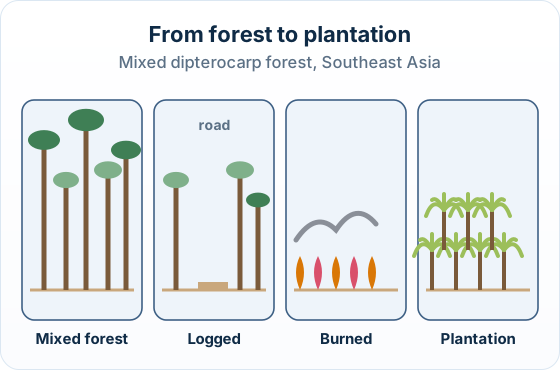
The big idea: In Southeast Asia, mixed dipterocarp forest is being logged and replaced with plantations: a whole ecosystem lost.
The points to remember
- Mixed dipterocarp forest: tall rainforest of many tree species, many of them dipterocarps, in Borneo, Sumatra and Malaysia.
- Logging takes out the valuable trees and cuts roads into the forest.
- The rest is cleared and burned for oil palm and other plantations.
- Species lose habitat, food and shelter; soil washes away and floods increase.
- Satellite images show the loss year by year; better images now show even small clearings.
Real example: orangutans in Borneo: Bornean orangutans live in dipterocarp forest. As it is logged and replaced with oil palm, they lose the fruit trees they feed on and the tall trees they nest in.
Read a deforestation map or graph carefully:
Logging and plantations, not rewilding: Forest lost on a map is explained by logging and plantations. Rewilding and afforestation add forest; they cannot explain a loss.
The big idea: A second case study comes from closer to home: an ecosystem that people have destroyed in a region you know.
The points to remember
- Choose an ecosystem lost from your own region: a drained marsh, a cleared forest, a ploughed grassland or a shrunken lake.
- Name the human cause: farming, water extraction, building or pollution.
- Say what was lost: the habitat, the species that lived there and the services it gave people.
- Use the same three steps for the dipterocarp forest: cause, loss, effect on species.
Remember it as: Cause, loss, effect.
Cause
- What people did: diverted water, ploughed, cleared, built
Loss
- The habitat and community that disappeared
Effect
- Species gone from the area; services lost
Real example: the tallgrass prairie: Tallgrass prairie once covered much of central North America. Ploughed for farmland in the 1800s and 1900s, only a few per cent of it is left.
Make it about the place:
Name the ecosystem: Say which ecosystem was lost, such as a lake or a prairie, not only which species. That is what makes it ecosystem loss.
Stop wasting time on topics you know
Our AI identifies your weak areas and focuses your study time where it matters. No more overstudying easy topics.
How it is tested: Paper 1A: which cause is human, or which activities explain forest loss on a map. Paper 1B: read deforestation graphs. Paper 2: outline or explain how deforestation affects biodiversity.
Explain how replacing mixed dipterocarp forest with oil palm plantations is a loss of an ecosystem, not just of some species.
Model answer plan
See the answer broken into clear points, with guidance on how each point earns marks.
Human, not natural: Only human causes count here. A dam, logging or a plantation is human; lightning, a drought or an insect outbreak is natural.