Species counts at Higher Level: The same statement as SL. At Higher Level, explain why the total is uncertain, and use splitters and lumpers as an example of how science classifies the same data in different ways.
Practise this as you read
- Explain why the number of species on Earth is uncertain.
- Outline what the fossil record shows about past biodiversity.
Free preview
This is the free notes preview
You're reading the free notes. Aimnova Pro unlocks the full study experience — and you can try it with your first topic free to keep:
- FlashcardsLock in vocabulary and key terms with spaced repetition.
- Practice questionsAnswer exam-style questions and get instant AI marking.
- Mock exams & past-paper vaultSit full mocks and see exactly how examiners award marks.
- Personalised study planA daily plan built around your exam date and weak areas.
The big idea: Millions of species have been discovered, named and described, but many more are still to be discovered.
The points to remember
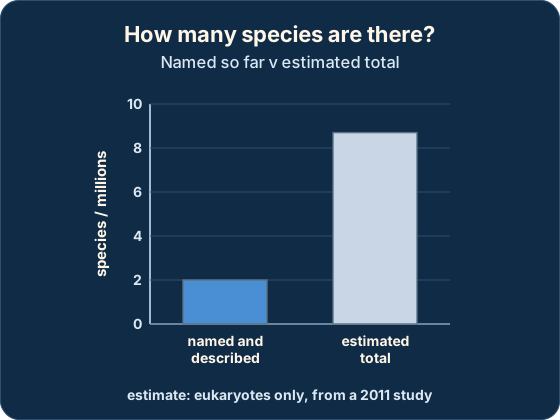
- About 2 million species have been named and described so far.
- Estimates of the total are much higher: one well-known study estimated about 8.7 million.
- Thousands of new species are still described every year.
- Most unknown species are small (insects, fungi, microbes) or live in hard-to-reach places, such as the deep sea and tropical forests.
- So the true number of species on Earth is not known.
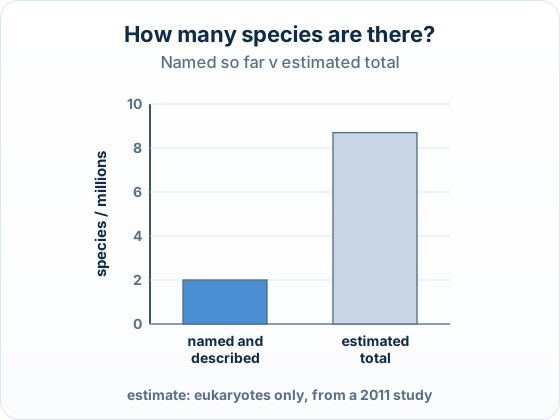
Real example: fungi: About 150,000 species of fungi have been described. Estimates of the real number run from about 2 to 4 million, so most fungi are still unknown.
Do not overstate what is known:
Not 'all species are known': It is wrong to say that all species, or nearly all, have been discovered. Many more remain to be found.
Feeling unprepared for exams?
Get a clear study plan, practice with real questions, and know exactly where you stand before exam day. No more guessing.
The big idea: Evidence from fossils suggests that there are more species alive on Earth today than at any time in the past.
The points to remember
- Fossils show which kinds of organisms lived at each time in the past.
- Counted over 540 million years, the number of groups has risen overall.
- There were five mass extinctions: sharp falls when many species died out quickly.
- After each one, new species evolved and diversity recovered, then rose higher.
- So biodiversity today is the highest the fossil record shows.
Remember it as: Five falls, but the line ends highest.
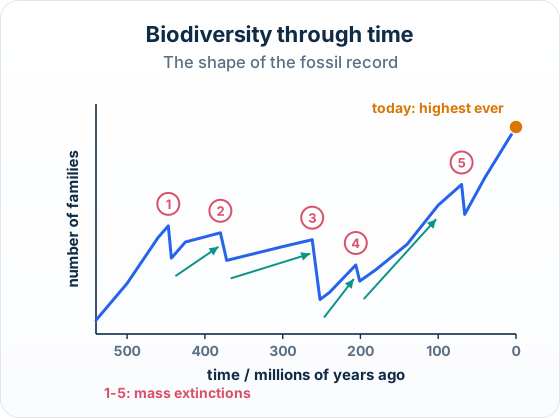
Real example: the end-Permian extinction: About 252 million years ago the largest mass extinction wiped out most species in the sea. Life took millions of years to recover, and then grew more diverse than before.
Read the graph the right way:
Not 'the same as in the past': Biodiversity has not stayed the same, and it has not only fallen. The fossil record shows a rise with five sharp dips.
The big idea: Classification is pattern recognition: the same observations can be classified in different ways, so species counts differ.
The points to remember
- Scientists group organisms by looking for patterns in their features and DNA.
- Splitters treat small differences as important, so they recognise more species.
- Lumpers treat small differences as variation within one species, so they recognise fewer.
- The observations are the same: only the way they are classified differs.
- So the number of species in a group can change without anything new being found.
Remember it as: Splitters split, lumpers lump.
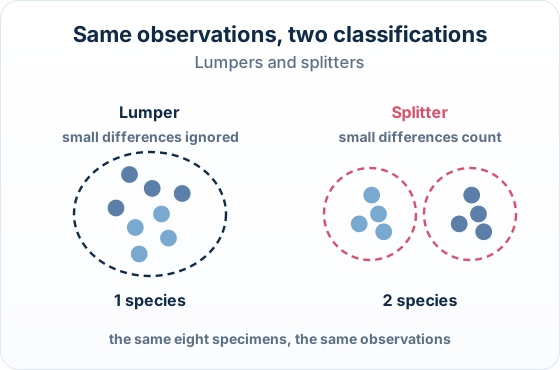
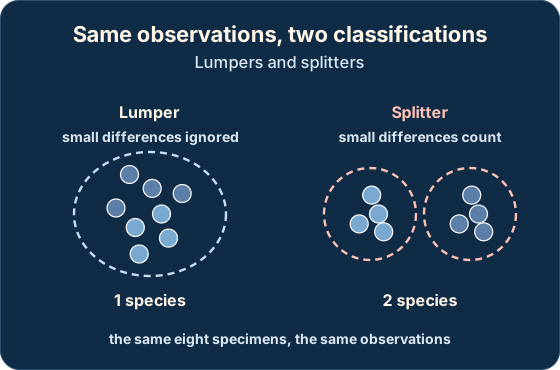
Real example: giraffes: A 2016 DNA study split giraffes into four species. Many biologists still lump them as one species with several subspecies: the same data, classified two ways.
Use the words correctly:
Not a mistake: When two scientists count different numbers of species in a group, neither has to be wrong. They classify the same observations in different ways.
Memorize terms 3x faster
Smart flashcards show you cards right before you forget them. Perfect for definitions and key concepts.
How it is tested: Paper 1A: which statement about species numbers is supported by evidence. Paper 1B or 2: read a fossil-record graph, or explain why the total number of species is not known.
About 2 million species have been named and described, but estimates of the total number of species on Earth are far higher. Explain why the total number of species on Earth is uncertain.
Model answer plan
See the answer broken into clear points, with guidance on how each point earns marks.
Supported by evidence: Only two claims are supported: many species are still unknown, and more species are alive now than at any time in the past.